

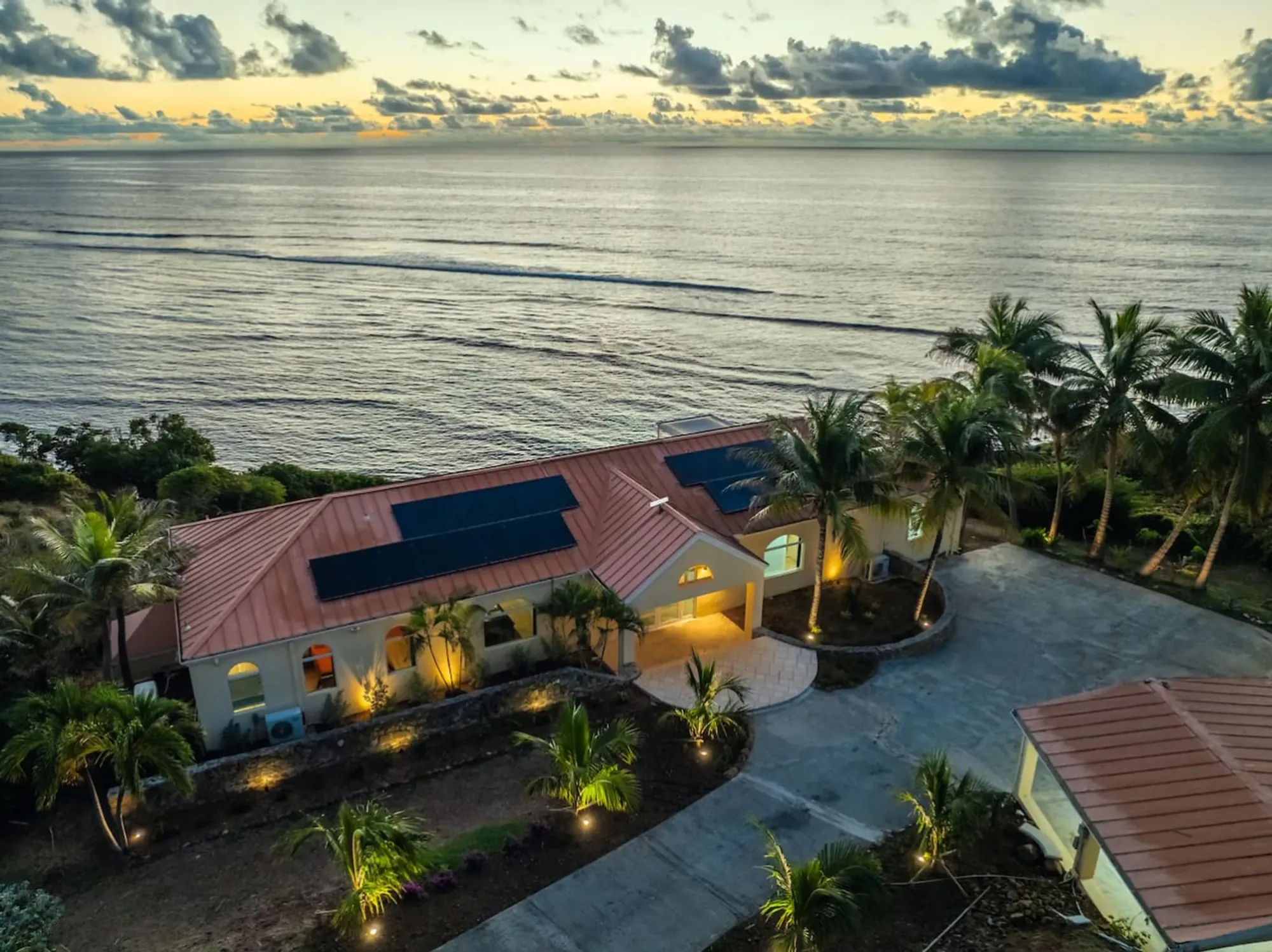
St. Croix is the biggest of the U.S. Virgin Islands and the one with the most to do on it: a reef at the bottom of the villa's steps, a national monument a mile and a half offshore, two Danish towns, a bay that glows on dark nights, a rainforest at one end and the easternmost point in the United States at the other. It is also an easy island to use. U.S. citizens fly in without a passport, the money is the dollar, and the whole place is about 28 miles long, so nothing in this guide is more than about an hour from the East End. This is every outing worth your time, grouped by what you feel like doing, with the drive time from The Cerulean on each one, the guide that goes deeper, and a week to copy. The base is a five-bedroom oceanfront villa that sleeps twelve, with its own reef-protected beach, Point Udall ten minutes away and Christiansted a quarter of an hour.
How the island is laid out
St. Croix runs east to west, about 28 miles long and 84 square miles in all, and its three coasts face three different ways. The East End, where the villa sits, is the sunny, breezy end: low coastal hills, golden grass, sea grape and the sunrise, with the Jack and Isaac Bay Preserve and Point Udall at its tip. The north shore has the reef wall, Salt River Bay and Cane Bay. The west end around Frederiksted is the lee side and the sunset side, the only coast where the sun sets into the sea, with the rainforest in the hills behind it. Our East End overview and the island map show how it fits together.
Drive times from the villa fall into three rings. Inside twenty minutes: Point Udall, the preserve trailhead, Cramer's Park, Chenay Bay, the Shoys, Green Cay Marina, the Reef golf course and Christiansted. About 30 to 45 minutes: the airport, Salt River Bay, Cane Bay, the farmers market and Agrifest at Estate Lower Love. About 50 minutes to an hour and a bit: Frederiksted, the Cruzan distillery, Estate Whim, Rainbow Beach, Sandy Point, the rainforest and the tide pools. You drive on the left in ordinary American cars, at 35 mph on most roads, and the driving guide covers the roads by name and number.
A car is part of the plan: there is no Uber or Lyft in the U.S. Virgin Islands, and the local companies meet flights and deliver to the villa, so a group of twelve takes two cars or a van and a car. The car rental directory lists them, and getting around covers taxis, the seaplane to St. Thomas and the ferry. Everything else in this guide is sorted by theme, so skip to the water, the towns, the food, the walks, the days with children or the rainy afternoon, and read the rest by the pool.
The reef at the bottom of the steps
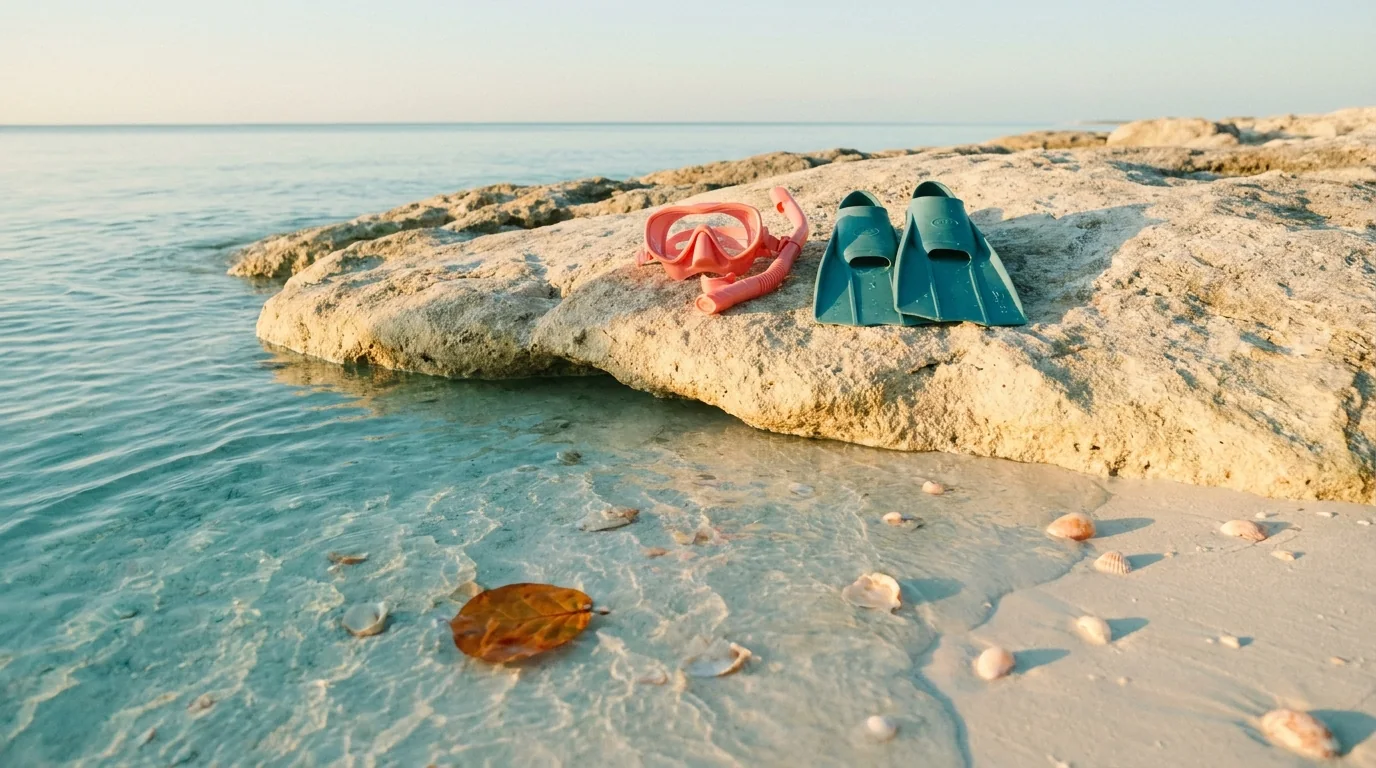
Start where you wake up. Down a short set of steps from the pool deck, The Cerulean has its own private beach on shallow water, and a reef a short way out takes the push out of the swell, so the water inside stays calm and the fish stay close. The snorkeling starts a few feet from the beach: parrotfish, sergeant majors and, on a quiet morning, a green turtle grazing the grass. Guests mention this reef more than any other single thing about the house, and our note on snorkeling off the beach has the first impressions. The entry is over rock, so pack water shoes for everyone, and go before lunch, when the trade wind is lightest and the water clearest.
St. Croix is a shore-snorkeling island, and the whole of it is in our snorkeling feature: the East End bays inside the St. Croix East End Marine Park, 60 square miles of protected water since 2003; Cane Bay on the north shore, where a reef shelf ends in a wall about 100 to 200 yards off the sand; the Frederiksted Pier, whose pilings have grown a reef of sponges you can swim to for free from the town beach; and Rainbow Beach, the gentlest sandy entry on the island. The snorkeling directory keeps the short list, and the sea stays between about 79 and 85°F all year, so a swimsuit and a long-sleeve rash guard are all most people wear.
The sunscreen rule belongs here because the reef out front is the reason for it. The territory's Act 8185 bans the sale of sunscreens containing oxybenzone, octinoxate and octocrylene, in force since March 30, 2020, so bring mineral sunscreen, meaning zinc oxide or titanium dioxide, or buy a bottle at an island pharmacy. Every sea turtle here is federally protected: keep several body lengths back, never swim above one, and let it set the pace. Our sea turtle guide has the three species, their seasons and the rescue hotline.
Buck Island and the underwater trail
If the group does one organized trip, this is it. Buck Island Reef National Monument protects a 176-acre island and more than 19,000 acres of surrounding sea about a mile and a half off the northeast coast. President Kennedy set it aside in 1961, the monument became a no-take reserve in 2001, and along the island's eastern lagoon the National Park Service keeps a marked underwater trail: you swim through coral grottoes in water no deeper than about 12 feet, past signs on the sea floor, with elkhorn coral standing over you and the fish of a reef nobody has fished in a generation. Turtle Beach at the island's west end, which the park calls West Beach, has picnic tables, grills and shallow clear water for the rest of the party, and a marked trail climbs to an overlook in about 45 minutes.
Park-licensed concessionaires run every trip, which suits a group: the boats are small, the crews give a lesson, guides take six people at a time and the gear comes with the ticket. As listed on its own site in October 2026, Big Beard's Adventure Tours runs a full day on the sailing catamaran Renegade for $135 per adult and a half day on a power catamaran for $95, both from the Christiansted boardwalk, 15 to 20 minutes from the villa. From the East End, Buck Island Charters sails Teroro II, for up to 24 guests, and the smaller Dragonfly out of Green Cay Marina, minutes down the road, with a children's rate. Private charters for a group start around $1,200.
A half day suits children under about eight and anyone who wants the afternoon by the pool; the full day adds Turtle Beach time and lunch, and families with older children usually prefer it. Winter mornings fill, so tell the villa's concierge your date and group size when you book the stay. Our Buck Island guide covers the history, every operator and the rules, the boat charter directory lists the fleet, including Lyric Sails' live-music sunset catamaran out of Frederiksted, and the journal's Buck Island day describes the crossing.
Diving, fishing and the glowing bay
Divers come to St. Croix for the north shore wall, and they can walk to it. At Cane Bay, about 45 minutes from the villa along the North Shore Road, you gear up on the sand, surface-swim 100 to 200 yards to a white mooring buoy, and drop over a lip that falls from about 40 feet toward a basin geologists put at roughly four kilometers deep. Salt River Canyon puts a boat on two walls facing each other across a chasm, and the Frederiksted Pier on the west end is one of the Caribbean's best-known macro dives, with seahorses, frogfish and octopus among the pilings and a night dive that divers fly here for. Five dive shops serve the island; the Christiansted ones are about 15 minutes from the villa. The diving guide explains the wall, the scuba directory lists the shops, and the dive week post lays out seven days for a mixed group of divers and non-divers.
Fishing starts almost at the villa's front yard. Lang Bank, the drop-off a few miles off the island's east tip, holds mahi, wahoo, kingfish, tuna and marlin in season, charters run out of Christiansted and Salt River, and mahi and wahoo peak in winter. Most captains clean what you bring in, and the villa's outdoor kitchen does the rest. The fishing directory lists the boats.
The night outing is Salt River Bay, about 35 minutes from the villa, where the back lagoon lights up when you touch the water. The glow comes from a dense population of a single dinoflagellate, Pyrodinium bahamense, and this is one of only about fourteen documented bioluminescent bays in the world and one of seven in the Caribbean that glow all year. The moon decides the night: book the new moon and the nights either side, or the two weeks after full moon, when the moon rises late. Three kayak outfitters run the night tours, including Sea Thru Kayaks' clear boats at about $55 a person for two hours, and all meet at Salt River Marina. Our bio bay guide has the moon math, and the watersports directory adds the jet skis, kayaks and paddleboards of the west end and Chenay Bay.
| On the water | From the villa | Book it |
|---|---|---|
| The villa's reef | Down the steps | Nothing to book, water shoes on |
| Buck Island | Green Cay Marina minutes away, boardwalk 15-20 min | Morning departure, weeks ahead in winter |
| Cane Bay wall | About 45 min | A dive shop for a guided shore dive |
| Frederiksted Pier | About 50 min | A no-ship day for the snorkel, a shop for the night dive |
| Salt River bio bay | About 35 min | A dark night around the new moon |
| Lang Bank fishing | Boats from Christiansted and Salt River | A half or full day, cleaned catch for the grill |
The East End beaches
The villa's own quarter of the island has a beach for every age within twenty minutes, and most of them sit inside the East End Marine Park. Cramer's Park, about ten minutes away, is the island's beach park: shallow, typically very calm water, restrooms, covered pavilions, grills and sea grape shade, busiest on weekends. Chenay Bay, about ten minutes, is the family bay, shallow and grassy close to shore with plenty of shade, turtles and rays often cruising the grass, and the East End's calm paddling water. The Shoys, about fifteen minutes, is a calm crescent behind a guard gate at The Buccaneer's entrance: give the guard your name, say you are going to the beach, and park on the gravel. Grapetree Bay on the south side is a long ribbon of sand under sea grape with no facilities and nobody on it.
The best beach snorkel on the East End is a short walk from the road. Isaac Bay and Jack Bay sit inside The Nature Conservancy's 300-acre Jack and Isaac Bay Preserve, protected since 1999 and reached only on foot from a small lot on the right just before Point Udall, about five minutes' drive from the villa. The trail reaches East End Bay in about ten minutes, then Isaac Bay, then Jack Bay, over reefs the Conservancy says hold at least 400 fish species, and green turtles nest on both beaches from July. The preserve is kept natural, so carry water and shade in and out. Our walk to Jack and Isaac Bay describes the trail and the East End beaches guide rates all of them, access rules included.
Inside the marine park, shore fishing is hook-and-line only, and only in the recreational stretches; Grapetree, Jack and Isaac are no-take; spearfishing and taking conch, lobster or whelk are prohibited from every park beach; and in the turtle preserve waters off Isaac and Jack Bay you keep 50 yards from any turtle. The beaches directory puts every beach on the island on one page, starting with the villa's own. Our journal post on a week on the East End shows how the beaches, a round of golf and a Christiansted morning fit into seven relaxed days.
| Beach | From the villa | Best for |
|---|---|---|
| The villa's beach | Down the steps | A morning snorkel before anyone is up |
| Cramer's Park | About 10 min | Small children on a weekday, grills and shade |
| Chenay Bay | About 10 min | Toddlers, kayaks, turtles over the grass |
| The Shoys | About 15 min | Calm swimming, a small reef at the eastern end |
| Isaac Bay | About 5 min plus a hike | The best beach snorkel on the East End |
| Grapetree Bay | About 15 min | A long empty strand under sea grape |
Beaches across the island
Cane Bay is the beach St. Croix people take you to first: a long, tree-shaded curve on the north shore, about 45 minutes from the villa, with free roadside parking, a dive shop across the road and two bars you can walk to barefoot, The Landing Beach Bar for lunch, closed Tuesdays, and AMA at Cane Bay for dinner. The reef in front of it holds parrotfish, turtles and staghorn coral, and the north shore is at its glassiest from about May through November. Davis Bay next door, at Carambola, is the quieter alternative on a still day. Our Cane Bay guide has the hours and the step-by-step.
The west end is the sunset side and the lee side, about 45 to 55 minutes away, where the water lies flat most mornings. Rainbow Beach, just north of Frederiksted, is the social choice: calm water over sand, a modest reef off the beach, Rhythms bar and grill on the sand from about 11 am to 7 pm with live music on its calendar, and West End Water Sports next door renting snorkel gear, chairs, paddleboards and kayaks. Dorsch Beach south of town is quieter and shadier, the town beach beside Fort Frederik is the sea-glass beach, Sprat Hall's rocky patches hold more life, and strong swimmers can reach a shallow shipwreck off Butler Bay on a flat morning. The west end beaches guide walks that coast from Ham's Bay to Sandy Point.
Sandy Point, at the island's southwest tip, is the most famous beach on St. Croix: about two miles of white sand with nothing built on it, protected since 1984 as a National Wildlife Refuge for nesting leatherback turtles, and the beach from the last scene of The Shawshank Redemption. It opens to walkers on Saturdays and Sundays from 10 am to 4 pm, closes entirely from April 1 through August 31 for nesting, has no shade, water or restrooms, and is free. It is about an hour from the villa, so leave by 8:30 or 9 for the gate. The Sandy Point guide has the film, the turtles and the rules.
A west end day from the East End
- Leave the villa after an early lunch and take the Melvin Evans Highway across the island, about 50 minutes.
- Swim and snorkel at Rainbow Beach, with chairs and gear from West End Water Sports if you want them.
- Walk Frederiksted's waterfront: the red fort, Buddhoe Park and the free art museum on Strand Street.
- If no cruise ship is in, snorkel the pier's first pilings from the town beach after about 5 pm.
- Stay for the sunset, the only one on the island that goes down into the sea, then dinner on Strand Street.
- Take the Melvin Evans Highway home and allow about an hour after dark.
Christiansted
Christiansted is a small Danish colonial harbor town, founded on September 1, 1734, with a yellow fort on the water, arcaded sidewalks, red roofs and a boardwalk where the seaplanes land, 15 to 20 minutes from the villa. It earns several visits a week. Fort Christiansvaern, built between 1738 and 1749, is open daily 8:30 am to 4:30 pm, and as of the National Park Service's posted rates entry is $10 for adults, free under 16, good for three days. The Scale House, the Custom House and the Steeple Building stand on the wharf, Government House is up on King Street, and the whole historic site became the first National Park Service unit in the Virgin Islands in 1952. Our Christiansted guide walks it block by block with every business current for 2026, and a morning in Christiansted is the short version.
Alexander Hamilton clerked here. He spent roughly seven years on St. Croix, from about 1765 until the fall of 1772, working at the counting house of Beekman and Cruger at 7 and 8 King Street, and the letter he wrote to his father on September 6, 1772, describing the night of August 31, was printed in the Royal Danish American Gazette that October and helped send him north. The National Park Service's free self-guided map has eight stops within a few blocks of the wharf, about an hour at a slow pace, and CHANT runs a Tuesday morning walking tour. The Hamilton guide shows which plaques mark the real sites.
Christiansted is a working town. The boardwalk has lunch tables over the harbor, a short ferry crosses to Protestant Cay in about two minutes, the galleries open late on the third Thursday of the month from November through May for Art Thursday, and the Apothecary Hall Museum keeps an 1820s Danish pharmacy down to its bottles. For dinner, Savant on Hospital Street has been the downtown staple since 1998 and wants a reservation days ahead in winter. The culture and history directory lists every site with its hours, and the art scene post covers the galleries and the island's craft traditions.
Frederiksted and the sunset coast
Frederiksted is St. Croix's second town, on the far west end about 50 minutes from the villa, and the one that matters most to the island's history. On July 3, 1848, about 8,000 enslaved people from the western estates marched into town and surrounded the red fort on the waterfront, and by late afternoon Governor-General Peter von Scholten had proclaimed every unfree person in the Danish West Indies free. Denmark had planned to take twelve more years. Fort Frederik, built between 1752 and 1760, is the museum where it happened, open weekdays 8:30 to 4 and Saturday afternoons as of 2026; the bust of General Buddhoe, who led the march, stands in Buddhoe Park by the pier, and July 3 is a territorial holiday. Our guide to July 3, 1848 tells the whole day, and the Frederiksted guide walks the Victorian streets that rose after the 1878 Fireburn.
The town is a compact grid you walk in under two miles, flat and easy, lovely in the morning or the late afternoon. The Caribbean Museum Center for the Arts at 10 Strand Street is free, open Tuesday through Saturday 9 to 4, with rotating exhibitions and an artist-in-residence program. The 1,526-foot cruise pier, officially the Ann E. Abramson Marine Facility, is the island's only cruise dock by day and a free snorkel from the town beach on quiet days; ships call most often from December through March, arriving around 8 am and sailing around 5 pm, and the town is quiet again by late afternoon. On the third Friday from October to May, Rhythms at Sunset takes the waterfront park on Strand Street from 6 to 9 pm, free.
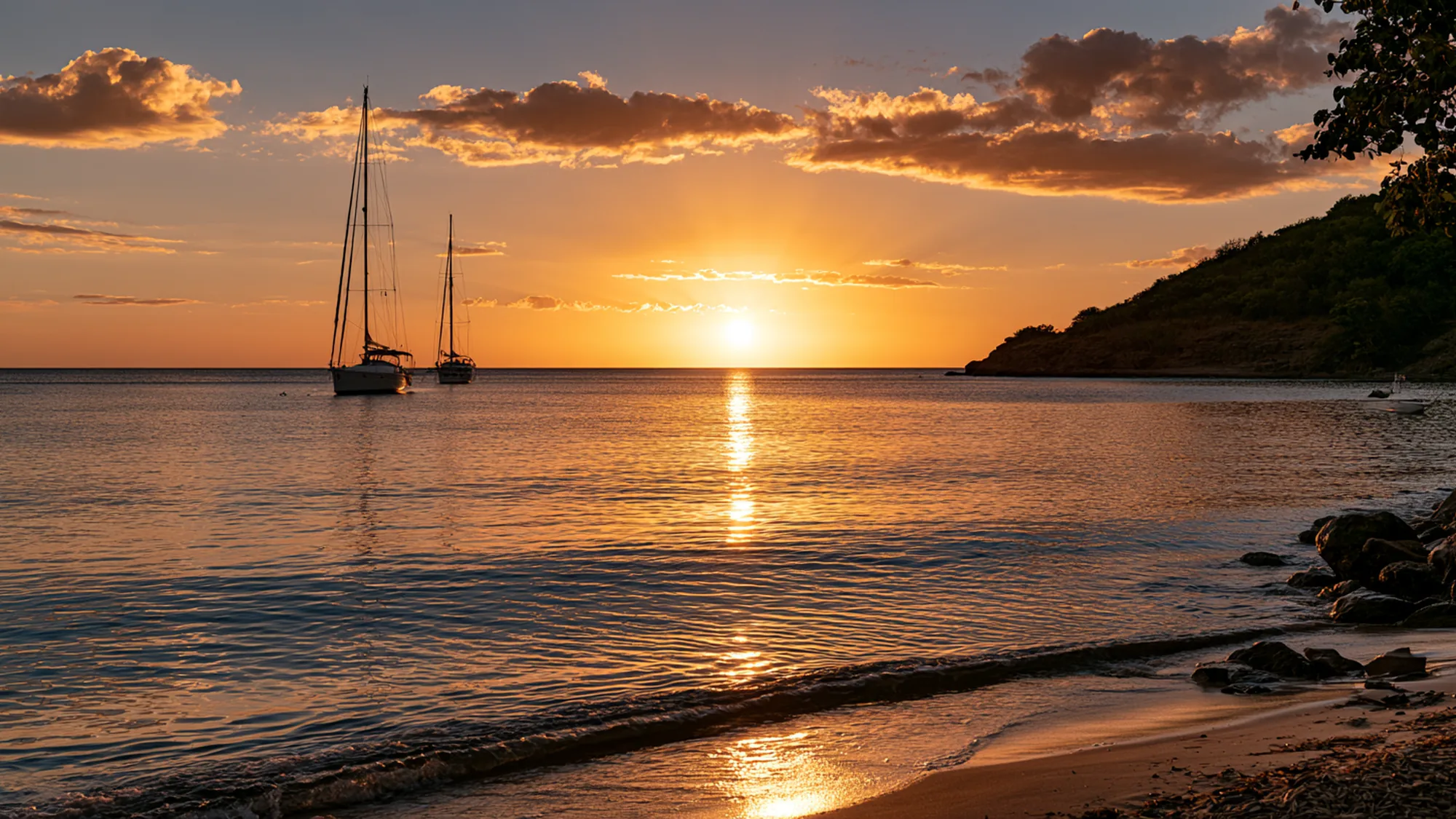
Then the sunset. The island runs east to west, so Frederiksted is the one place where the sun goes down into open water, and Fort Frederik's deep-red walls take the last light straight on. Rainbow Beach a mile north pairs the sunset with Rhythms on the sand; Polly's at the Pier, Turtle's Deli and Louie and Nacho's Beach Bar cover the rest of the day. Our pier guide covers the seahorses and the ship schedule, and the photography guide explains why the golden hour here lasts about half an hour and where to stand for it.
The island's history, place by place
St. Croix has flown seven flags: Spain from Columbus's 1493 claim, the Netherlands and England with their rival tobacco settlements, France from 1650, the Knights of Malta from 1651 to 1665, Denmark from 1733 to 1917, and the United States since Transfer Day, March 31, 1917, when the islands changed hands for $25 million in gold. That is why the towns are Danish, the name is French, the estates carry English names and the people are U.S. citizens, since 1927. Our seven flags guide gives the dates and the reason each flag came and went, and the complete history of St. Croix tells the whole story, from the first people to today, in a long read for the veranda.
The history is on the ground within an hour of the villa. Salt River Bay, about 35 to 40 minutes along the north shore, is the only place under the U.S. flag where a Columbus landing is pinned to a marked point: on November 14, 1493, a boat from his second voyage went in for water, the people already living there fought it off at the Cape of the Arrows, and a Spanish seaman died within days. Today it is a quiet national-park beach with a marker and the low earthworks of a 1640s fort, protected since 1992, and thirty to sixty minutes covers it; pair it with Cane Bay a few minutes west. The Columbus guide has the documented history and the places to stand.
The sugar estates are everywhere you drive: well over a hundred mill towers survive on the hilltops, most built between 1750 and 1800, and every one marks a plantation worked by enslaved Africans. Estate Whim, on Centerline Road near Frederiksted, about 50 to 60 minutes from the villa, is the one kept whole by the St. Croix Landmarks Society: twelve acres with the restored great house, the island's only reconstructed windmill and the factory ruins, open Wednesday through Saturday and cruise days, 10 to 3, about $10 for adults, confirm before you drive. The Estate Whim guide decodes every other ruin on the map, and the last cane crop was processed at Bethlehem in 1966.
| Site | What happened there | From the villa |
|---|---|---|
| Fort Christiansvaern | The Danish fort of 1738 and the start of any town morning | 15-20 min |
| Salt River Bay | The 1493 landing, the ball court village and a glowing lagoon | 35-40 min |
| Estate Whim | A sugar plantation kept whole, with the only rebuilt windmill | 50-60 min |
| Fort Frederik | Emancipation proclaimed on July 3, 1848 | About 50 min |
| Ham's Bluff | The 1915 Danish lighthouse and Maroon Ridge behind it | About 1 h 10 min |
Crucian food, from the market to the villa kitchen
Crucian cooking draws on West African, Danish, Puerto Rican and down-island kitchens, and most of it never appears on a hotel menu. The working vocabulary: kallaloo, the greens-and-okra stew ladled over fungi, a cornmeal-and-okra dumpling, and the dish Crucians eat on Old Year's Night; johnny cakes, the fried breakfast bread; pates, say PAH-tays, fried turnovers of beef, chicken, conch or saltfish sold from roadside stands; roti from the Trinidadian thread; sorrel, the spiced red December drink; and maubi, a bittersweet drink brewed from tree bark. Our Crucian food guide explains each one and where to eat it, and the food and festival post is the shorter tour.
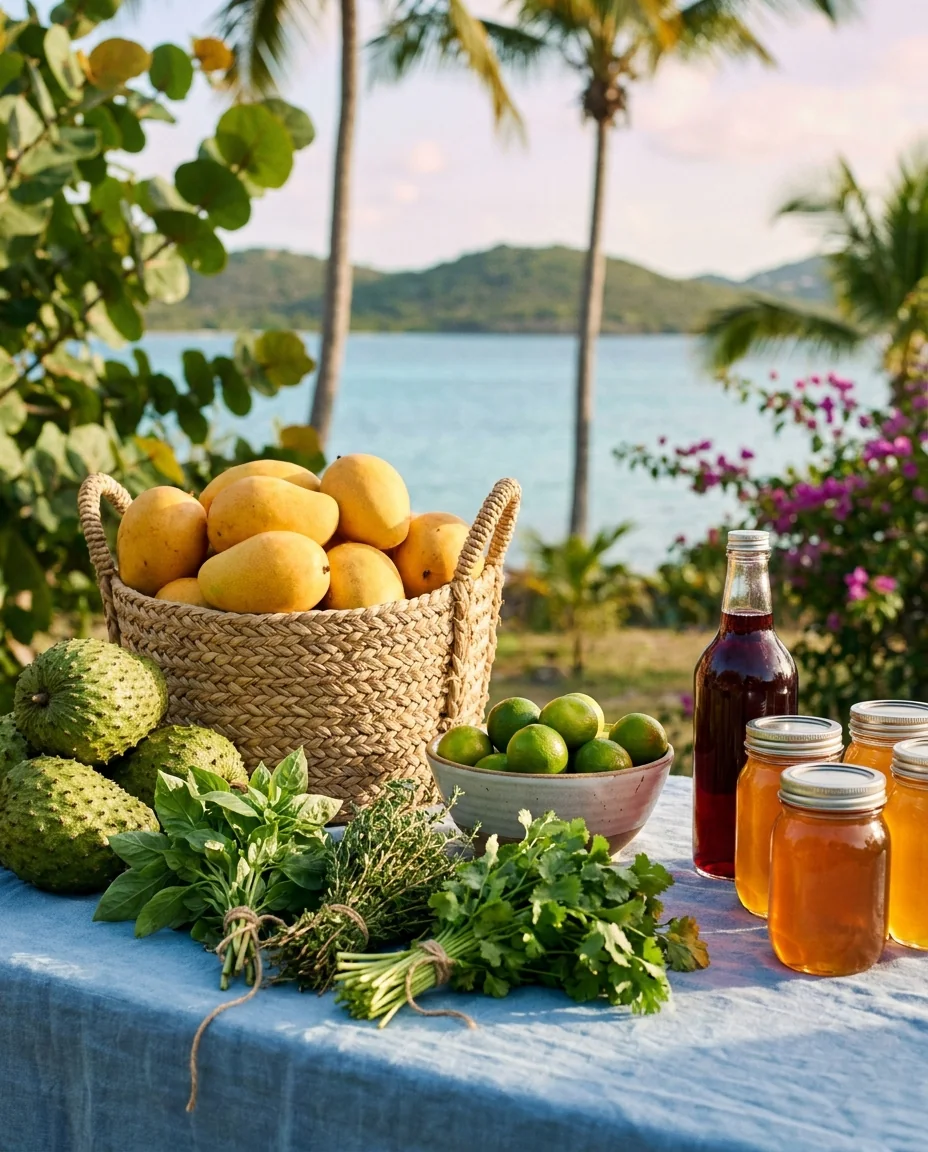
Two places anchor it. La Reine Chicken Shack, mid-island off Centerline Road about 30 to 35 minutes from the villa, serves coal-cooked chicken, ribs, conch and the island's best-known johnny cakes, with a whole roasted pig on Saturdays, cash-friendly, open from 11 am. Just south of it the La Reine Farmers Market runs every Saturday morning, vendors setting up from about 5 am and the best produce gone by late morning: seasonal fruit, herbs, honey, eggs, baked goods, bottled bush tea, dried sorrel and fresh fish. Bring cash and a bag, and the villa kitchen gets its mangoes. The food calendar guide dates the island's food year, including Mango Melee at the botanical garden on a July Sunday and Taste of St. Croix, which moved to June in 2026.
Then the restaurants and the kitchen. Duggan's Reef at Teague Bay has been the East End's beachfront classic since 1983, ten minutes from the villa, dinner Monday to Saturday with reservations; The New Deep End at Green Cay Marina is the everyday option; and Christiansted holds the densest cluster, Savant and Galangal among them. The restaurant directory lists what is open this year, town by town. At the house, the concierge arranges a private chef for one dinner or the whole stay, and the island's caterers cook in villas; ask for Crucian dishes. The private chef directory names them, the groceries and provisioning directory covers the two Plaza Extras, the gourmet Seaside Market and pre-arrival provisioning, and our post on arriving to a full kitchen explains why the first shop is the one to skip.
Rum, a brewery and the duty-free rule
Rum is St. Croix's oldest industry and the island still makes it at scale. Cruzan comes out of a working distillery at Estate Diamond, a few minutes east of Frederiksted and about 45 to 50 minutes from the villa, on land that has held a sugar mill since 1760; the Nelthropp family has run the place since 1950 and Gary Nelthropp still holds the master distiller title. Tours resumed in March 2024 and run about an hour, booked online with no walk-ins, around $25 for adults and $10 for children, ending with up to four samples and two mixed drinks; the drinking age in the territory is 18. The Cruzan guide has the dates, the tour as it stands in 2026 and the cocktails to make at the villa.
Two more distilleries and a brewery fill out the loop, and all three distilleries tour on weekdays, so make it a mid-week day. The Captain Morgan Visitor Center at Diageo's plant mid-island, off the Melvin Evans Highway, runs a one-hour experience Monday to Friday, 10 to 4, with a tasting tavern. Sion Farm Distillery, also mid-island, makes Mutiny Island Vodka, the world's first vodka distilled from breadfruit and a spirits-competition gold medalist, with free tours Monday to Friday, 11 to 5, and a tasting bar; the Sion Farm guide tells the breadfruit story. Leatherback Brewing Company near the airport is the island's craft brewery. The distillery directory has the schedules, and the rule for all of them is the same: name a driver at breakfast.
Evenings on St. Croix start at sunset, and the bars and nightlife directory sorts them: Rhythms on the sand at Rainbow Beach, the Mt. Pellier Domino Club in the rainforest with its beer-drinking pigs since 1971, the Christiansted boardwalk after dinner, and the Divi Carina Bay casino about five minutes from the villa, open until 1 am and later on weekends for guests 21 and over. Then there is the suitcase. U.S. residents bring home $1,600 per person in goods free of duty from the Virgin Islands, double the usual $800, including up to five liters of alcohol if at least one liter was made here, and there is no sales tax on the island to begin with. The duty-free guide reads the regulation and walks the shops, including the Crucian hook bracelet made in Christiansted since 1964.
Festivals, music and the island's calendar
St. Croix holds its carnival at Christmas. The Crucian Christmas Festival opens on December 26 and runs into the first days of January in Frederiksted: pageants, a calypso crown, a fenced Festival Village of concerts and food booths on the waterfront, a J'ouvert that steps off at about 4 am on Old Year's Day, a food fair, and two parades down King Street. For 2026-27 the Division of Festivals announced the Village opening December 26, the food fair December 30, J'ouvert December 31, the Children's Parade on January 1 and the Adults' Parade with fireworks on January 2, 2027. The parades are free; you stand along King Street. Our festival guide covers it start to finish, and the Christmas and New Year's post builds a family fortnight around it.
Two traditions announce every celebration here. The mocko jumbie is a masked stilt dancer with West African roots and a guardian's job, dancing well above head height on stilts that experienced performers take to about ten feet, and troupes of trained dancers, many of them children, perform at the parades, at Jump Up and at Agrifest. Quelbe is the scratch-band music the Virgin Islands made its official music by law in 2003, played on a scraped gourd, a car tail-pipe blown as a bass, a steel triangle, banjo-ukulele, guitar and flute. The mocko jumbies and quelbe guide tells where both came from and how to be a good guest, photos and tipping included.
The rest of the year has its own dates. Jump Up closes Christiansted's historic core to cars four Friday nights a year, 6 to 10 pm, free, with bands on the corners, steel pan, food stalls under the arcades and the stilt dancers over everyone's heads; the Jump Up guide has the pattern and the parking. Agrifest, the Virgin Islands Agriculture and Food Fair, takes over Estate Lower Love every Presidents' Day weekend, 30 to 40 minutes from the villa, with Senepol cattle, St. Croix sheep, kallaloo, pates and seedlings; the 2027 fair is listed for February 13 to 15, to be confirmed, and the Agrifest guide has the plan. Our events calendar dates everything from October 2026 through December 2027, month by month, with a link to each event.
Your dates
A year of things to do on St. Croix
Rhythms at Sunset opens its third-Friday season on the Frederiksted waterfront, 6 to 9 pm
Jump Up in Christiansted on the Friday after Thanksgiving, expected
The Crucian Christmas Festival Village opens in Frederiksted
J'ouvert steps off at about 4 am and the Old Year's Night kallaloo is eaten
The Children's Parade down King Street, Frederiksted
The Adults' Parade and fireworks close the 2026-27 festival
Agrifest at Estate Lower Love, expected February 13 to 15
Leatherback nesting season opens at Sandy Point, weekends open through March 31
Sandy Point closes for nesting through August 31
Emancipation Day, observed in Frederiksted
Mango Melee at the botanical garden, expected
Sandy Point reopens for weekend visits
Dates as announced or as the pattern of recent years suggests; confirm each one before you plan around it.
Point Udall and the East End walks
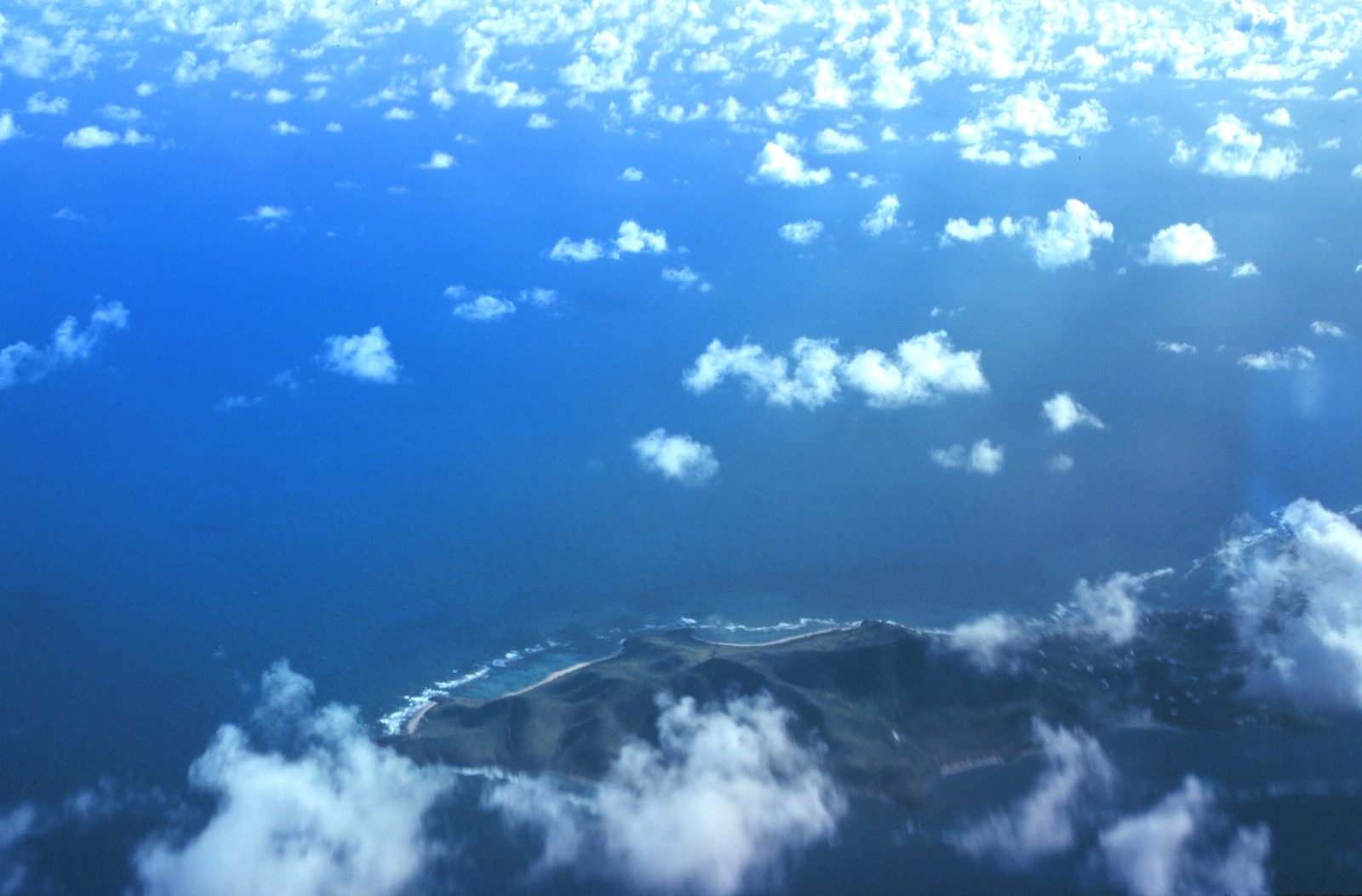
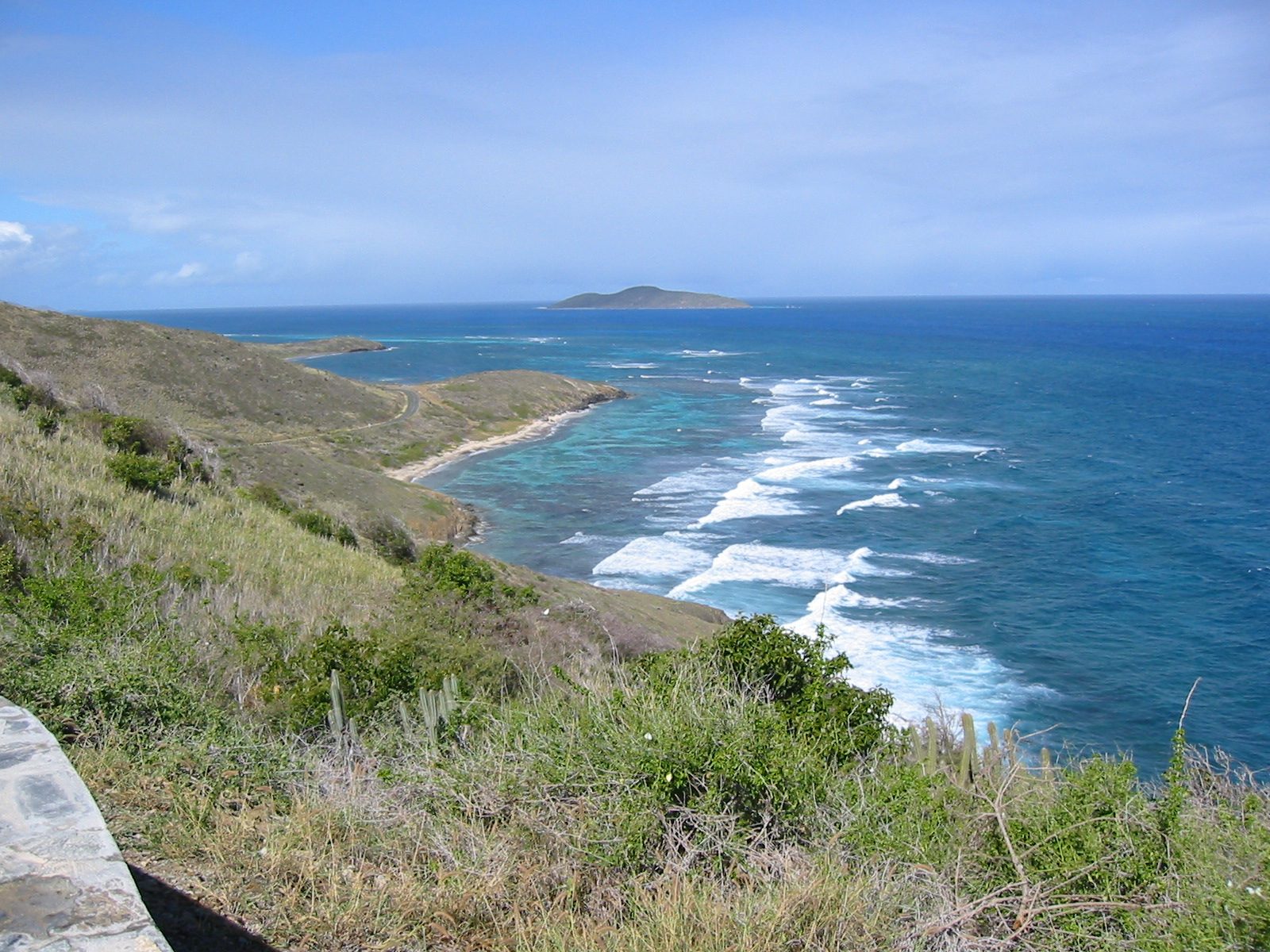
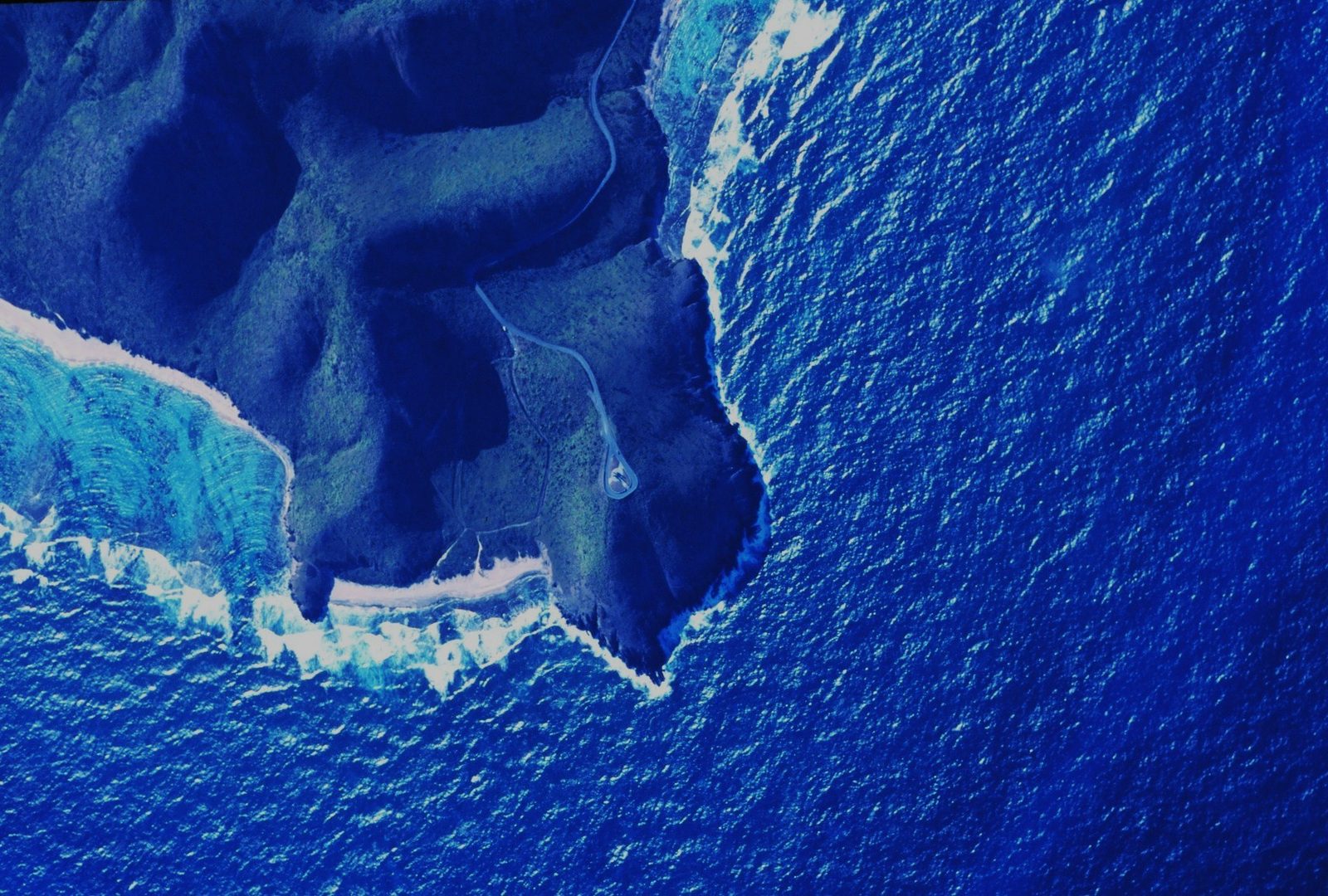
Point Udall is where the East End Road runs out. About ten minutes past the villa's gate, past Cramer's Park and the big white radio-telescope dish of the Very Long Baseline Array, the pavement climbs a sunny headland and stops at a stone sundial with nothing east of it but water. This is the easternmost point of the United States by the usual definition, named for Stewart Udall in 1969, and the Millennium Monument above it was built for the first American sunrise of 2000. Sunrise runs from about 5:42 am in early June to about 6:52 am in mid-January, Atlantic Standard Time; arrive 30 to 45 minutes early, because the color before the sun is the best of it. It is free, unstaffed and unshaded, so bring water and a hat. Our Point Udall guide has a sunrise table by month, and sunrise at Point Udall is the short journal version.
The East End is the walking end, and its trailheads are five to fifteen minutes from the villa. The Jack and Isaac Bay trail leaves the lot just before the point and reaches East End Bay in about ten minutes, and the full walk to both bays is about 3.6 miles round trip with a steady climb back up to the car. Goat Hill, the ridge's 672-foot summit, is about two miles round trip up an old four-wheel-drive track to a 360-degree view down the island's spine, across both coasts and out to Buck Island. Both walks have little shade, so start at first light with two liters of water each and be back at the car by mid-morning. The East End ridge walks guide covers the routes and the rules, and the trails and hiking directory lists every hike on the island with a difficulty note.
The wildlife here is small, close and easy to meet. The only native land mammals are bats; green iguanas warm themselves on walls, a mongoose crosses the drive at noon, brown pelicans hit the water off the reef in front of the villa, and hermit crabs work the path after dark. On the offshore cays lives the St. Croix ground lizard, one of the rarest reptiles under the U.S. flag, wiped off the main island after the mongoose arrived in the 1880s and surviving on Buck Island and Protestant Cay. Humpback whales pass offshore in February and March. Our wildlife guide covers the island's animals and where to look.
The rainforest and the north shore hikes
The northwest hills get roughly 50 inches of rain a year against 25 to 38 on the East End, which is enough to grow a closed-canopy moist forest of mahogany, kapok, turpentine and saman trees. Islanders call it the Rain Forest, and Mahogany Road, Route 76, runs through the middle of it, paved, narrow and driven daily by ordinary cars. Along it: St. Croix LEAP, a mahogany workshop; the Mt. Pellier Domino Club at 49 Mahogany Road, open Tuesday through Sunday since 1971, cash only, with pigs that drink non-alcoholic beer from the can; Creque Dam, a 45-foot arch dam of 1926 hidden in the trees; and the St. George Village Botanical Garden at the forest's edge, built among a plantation's ruins and open daily 9 to 3. The loop is about an hour each way from the villa and the rainforest guide lays it out, and lists the roads that need a Jeep.
The north shore's famous walk is the Annaly Bay tide pools: about two miles each way from the Carambola Beach Resort over a ridge, 350 to 550 feet of climbing, to clear pools set into dark rock at the foot of the hills with the open sea breaking on the ledge beyond. Go on a calm morning, swim the sheltered inner pools, and keep everyone off the outer rim; BushTribe lists a guided hike at about $50 a person, meeting at 8 am, and Tan Tan Tours runs a jeep road down to the beach. It is about an hour from the villa by car and three to four hours car to car. The tide pools guide reads the swell forecast for you, and our hikes post and the note on Monk's Bath, a saltwater pool on the wild northwest coast, add the rest of that corner.
Ham's Bluff, on the far northwest corner about an hour and ten minutes from the villa, is a short, steep walk of about 0.8 miles to the cast-iron lighthouse the Danes finished in 1915, standing more than 350 feet above the sea with the whole north shore below. The ridge behind it is Maroon Ridge, where enslaved Africans who escaped the plantations lived free from the 1730s onward, and a 2,386-acre territorial park now covers it. Admire the tower from the ground; it is not safe to climb. The Ham's Bluff guide tells the lighthouse's and the ridge's history, and pairs the climb with an afternoon in Frederiksted.
| Walk | Length | From the villa |
|---|---|---|
| Jack and Isaac Bay | About 3.6 mi round trip, 10 min to the first bay | About 5 min to the trailhead |
| Goat Hill | About 2 mi round trip, 672 ft summit | About 10 min |
| Annaly Bay tide pools | About 2 mi each way plus a swim | About 1 hour |
| Ham's Bluff lighthouse | About 0.8 mi each way, 330 ft of climbing | About 1 h 10 min |
| Mahogany Road | A drive with stops, a Jeep only for the Scenic Road | About 1 hour |
Golf, spa days and slow afternoons
The island has three golf courses, each with its own character. The Reef Golf Course at Teague Bay is the villa's local track, about ten minutes away: a relaxed nine-hole, par-35 course over the bay with a driving range and a disc golf course besides, where the dress code is roughly wear something, and a sunrise nine before the pool day is the East End move. The Buccaneer's 18-hole, par-70 course east of Christiansted, from 1973, has ocean views from thirteen holes and is open to the public. Carambola, in the northwest valley, is Robert Trent Jones Sr.'s 18-hole, par-72 design of 1966, the only championship-length course in the U.S. Virgin Islands, and winter mornings there go first. The golf directory has all three; the East End trade wind is the hazard, so take one more club.
Massage, yoga and beauty services come to the villa through the concierge and set up on the pool deck; sunset massages on the deck book out, so reserve early in the week. Off the property, Beach Massage and Bodywork Delivered sets up on the beach or at the villa, The Hideaway Spa at The Buccaneer has oceanfront treatment rooms, and Christiansted has day spas for a town morning. The spas and wellness directory lists them, and the couples' guide stacks the sunset sail, the glowing bay and the sunrise with two mugs at Point Udall.
Some of the best afternoons are the ones with nothing on them. The pool holds the middle of the day, the outdoor kitchen grills the fish somebody bought at the market, the poolside drinks refrigerator saves a trip inside, and the fire pit keeps the group outside after dark. Our post on a day by the pool describes how the deck becomes the real living room, and the photography guide suggests what to do with the camera while everyone else naps: the mill towers in the last light, the fort colors in Christiansted, the Milky Way over the open sea to the east on a moonless night.
“A gorgeous home with an amazing view. Each bedroom had its own en-suite bathroom. Combine the large patio, pool, outdoor kitchen and its own beach, and this property will not disappoint.”
Dave, a guest in March 2026
St. Croix with children
St. Croix is an easy Caribbean trip for a family: a domestic flight, dollars, no passport for U.S. citizens, and reef-protected water on the side of the island where the villa sits. Sort the water by age. With water shoes on, toddlers can paddle in the villa's calm shallows in the morning, at Chenay Bay with a cooler and shade, or at Cramer's Park on a weekday, where the water is shallow and typically very calm and there are restrooms and pavilions. Children of about five to eight do well over the grassy shallows at Chenay, the villa reef a few feet out, and Buck Island's west beach on a half-day trip with the trail treated as optional. From about nine up, a confident swimmer manages the Buck Island trail with a buddy, the inshore reef at Cane Bay on a calm day and Rainbow Beach. Start every child in the pool with a mask, then fifteen minutes off the villa's beach with water shoes on.
The land days are easy too. Children can climb the forts' ramparts and see the cannon, and those under 16 enter Fort Christiansvaern free. Estate Whim is an outdoor site with a windmill to walk around and ask about its Living Museum days. Agrifest in February has a petting zoo, donkey-cart rides and a livestock pavilion, the early hours of a Jump Up are the family shift with stilt dancers and steel pan, and the Children's Parade on January 1 is theirs. Mango Melee in July has a children's mango-eating contest. The glowing bay takes children from about eight on Sea Thru Kayaks' night tours, and the Cruzan tour allows children with juice at the bar. Our guide to St. Croix with kids has car seats, the doctor, the sunscreen law and a real week for three generations.
The house does its share. The house has a high chair, a travel crib and baby gates; the five bedrooms are all en-suite; the guest cottage about twenty steps away, with its own kitchen, gives teenagers or grandparents their own door; there are two refrigerators, an ice maker and a washer and dryer; and the hospital in Christiansted runs a 24-hour emergency room. Our posts on bringing the whole family and a family summer on St. Croix cover how twelve people spread out across the main house and the guest cottage, and what a summer week looks like with turtle hatchlings and mango season.
| Age | Best water | Best land day |
|---|---|---|
| Toddlers | The villa's shallows, Chenay Bay, Cramer's Park on a weekday | Cramer's Park grills, the fort's ramparts, the botanical garden |
| About 5 to 8 | Chenay's grass, the villa reef, Buck Island's beach on a half day | Agrifest, the Children's Parade, Estate Whim's windmill |
| About 9 and up | The Buck Island trail, Cane Bay inshore, Rainbow Beach | Jump Up's early hours, the bio bay from age 8, the Hamilton walk |
| Teenagers | Isaac Bay, the pier from shore, a Discover Scuba morning | Goat Hill at dawn, the tide pools with a guide, a sunset sail |
Rainy afternoons and indoor hours
Most St. Croix showers pass in about twenty minutes, warm and loud, and the right response is a covered veranda and a coffee. The East End gets less of it than the airport, and the sea is clear again soon after. On a showery day the island has plenty to do indoors, and Christiansted's covered arcades make an easy town morning. Our rainy day guide has the circuit; the weather by month guide puts NOAA's numbers to the whole year, with the sea between about 79 and 85°F and afternoons in the mid-80s to about 90°F.
The museums are a few blocks apart. Fort Christiansvaern's barrack rooms and the Apothecary Hall Museum, an 1820s Danish pharmacy in service for more than 140 years, are a few blocks apart in Christiansted; the Caribbean Museum Center for the Arts in Frederiksted is free, Tuesday to Saturday; Estate Whim's exhibit halls sit under roofs on their twelve acres; and the three distilleries pour on weekdays. The Christiansted arcades hold the island's jewelers, including the hook bracelet shops, and the duty-free rule makes a rainy hour in them worthwhile. A wet morning is also the day for the seaplane: about 25 minutes from the Christiansted harbor to the Charlotte Amalie waterfront on St. Thomas, downtown to downtown, with a full day between flights, as our three islands guide describes.
And the house is built for it. The great room under the beams, a chef's kitchen with service for twelve, smart TVs and a sound system, high-speed Wi-Fi and a covered outdoor seating area facing the sea make an indoor afternoon easy, and the pool is ready again soon after. A private chef booked for that evening turns a wet day into the best dinner of the week; the amenities list has everything the house keeps, and the chef's kitchen page shows what you have to cook with.
The rainy half-day
7 itemsYour ticks stay in this browser only.
Planning the trip
There is a good week on the East End in every month. Airport highs move only from about 84°F in January to about 89°F in August; what changes through the year is the breeze, the festival dates and the flights. Mid-December through April is the high season, with the clearest skies, the Christmas Winds freshening the verandas in spells, and the festival, Agrifest and whales offshore in February and March; it fills first, so Christmas, Presidents' week and Easter want a year's notice. May and June bring most of the same days at lower rates with a warmer sea, and September through November bring the warmest water, the quietest beaches and the easiest dinner reservations. The season for tropical weather runs June through November, and our hurricane season guide covers how guests plan summer and fall stays with confidence. The best time to visit guide walks the year month by month.
Getting here is a domestic trip for U.S. citizens: a REAL ID-compliant license boards the plane, there is no immigration or customs line on arrival, and the one extra step is a short agriculture and customs check on the way home. American flies Miami to St. Croix daily year-round; Charlotte goes daily from December 17, 2026, Atlanta on Delta daily from December 19, Chicago on winter Saturdays from December 19, and United's Saturday Newark nonstop starts October 31, 2026, the first New York-area nonstop in more than 30 years. The villa is about 35 to 40 minutes from the airport. Our getting here page has the schedules, the fly-from pages cover each city, the no-passport guide has the ID rules, and getting to St. Croix is the short version. Flying private? See private aviation.
Packing is mostly leaving things at home. The villa supplies the household, the island supplies the dress code, and U.S. plugs and dollars cover the rest; what is left is mineral sunscreen, water shoes, a hat that survives the trade wind, your own mask if the fit matters, and a bag with room for rum on the way home. The packing guide is the list. For a milestone week, the groups and celebrations guide covers splitting the bedrooms, feeding twelve, a boat for the whole party and the USVI marriage license, and the holiday posts, Thanksgiving, spring break and Easter and January and February, plan each season's week in detail. Our first guide to the island from the spring makes a good one-page read.
The short packing list
8 itemsYour ticks stay in this browser only.
A week from the villa
A Saturday-to-Saturday week fits all of this at an easy pace. The pattern that works is a swim off the villa's beach most mornings before the breeze builds, one outing in the middle of each day, and the pool, the outdoor kitchen and the fire pit for the afternoons and evenings. Keep one day flexible, so the Buck Island morning lands on the calmest sea of the week, the bio bay on the darkest night and the west end on a day with no ship at the pier. Give each cluster of the island a day: the East End and Christiansted, the north shore, the west end.
Here is a week to copy. Saturday is arrival, the cars, a swim before dinner and the first sunset behind the hills. Sunday opens with the villa reef at seven and masks in the pool for the children, then a slow drive to Point Udall and nothing else. Monday is Buck Island, a morning departure from Green Cay or the boardwalk, back for a late lunch and the pool. Tuesday is Christiansted: the fort, the Hamilton walk, lunch over the harbor, the arcades, and Duggan's Reef or the Deep End for dinner near home. Wednesday goes west after an early lunch: Estate Whim or the Cruzan tour, Frederiksted's fort and the art museum, Rainbow Beach, the sunset over the sea and dinner on Strand Street. Thursday is the north shore: Salt River's landing beach, Cane Bay for a swim and lunch at The Landing, and the bio bay kayak that night if the moon is dark. Friday is the flexible day: Isaac Bay with the teenagers, a sunrise nine at the Reef and a chef in the villa kitchen that evening, or simply the villa reef again. Saturday is a last early swim before the drive to the airport.
Groups adjust it to their mix. A party with small children swaps Isaac Bay for Cramer's Park and takes the Buck Island half day; divers fold the dive week into the same days; a festival week moves the west end day to a parade; and a longer stay repeats the pattern with the rainforest loop, Ham's Bluff and a Sandy Point weekend added. The guides hub holds all 44 guides by theme, the island directory holds every verified business, and the journal keeps the seasonal posts, so the week can be rebuilt around whatever the group liked most.
| Day | The outing | From the villa |
|---|---|---|
| Saturday | Arrive, collect the cars, a swim before dinner | 35-40 min from the airport |
| Sunday | The villa reef at 7 am, Point Udall, nothing else | About 10 min |
| Monday | Buck Island, earliest departure | Minutes to Green Cay Marina |
| Tuesday | Christiansted: the fort, the Hamilton walk, lunch on the boardwalk | 15-20 min |
| Wednesday | The west end: Estate Whim or Cruzan, Frederiksted, Rainbow Beach, sunset | About 50 min |
| Thursday | The north shore: Salt River, Cane Bay, the bio bay at night | 35-45 min |
| Friday | Flexible: Isaac Bay, the Reef course, a chef at the villa, or the reef again | 5 to 10 min |
| Saturday | A last early swim, then the airport | 35-40 min |
Doing it all from The Cerulean
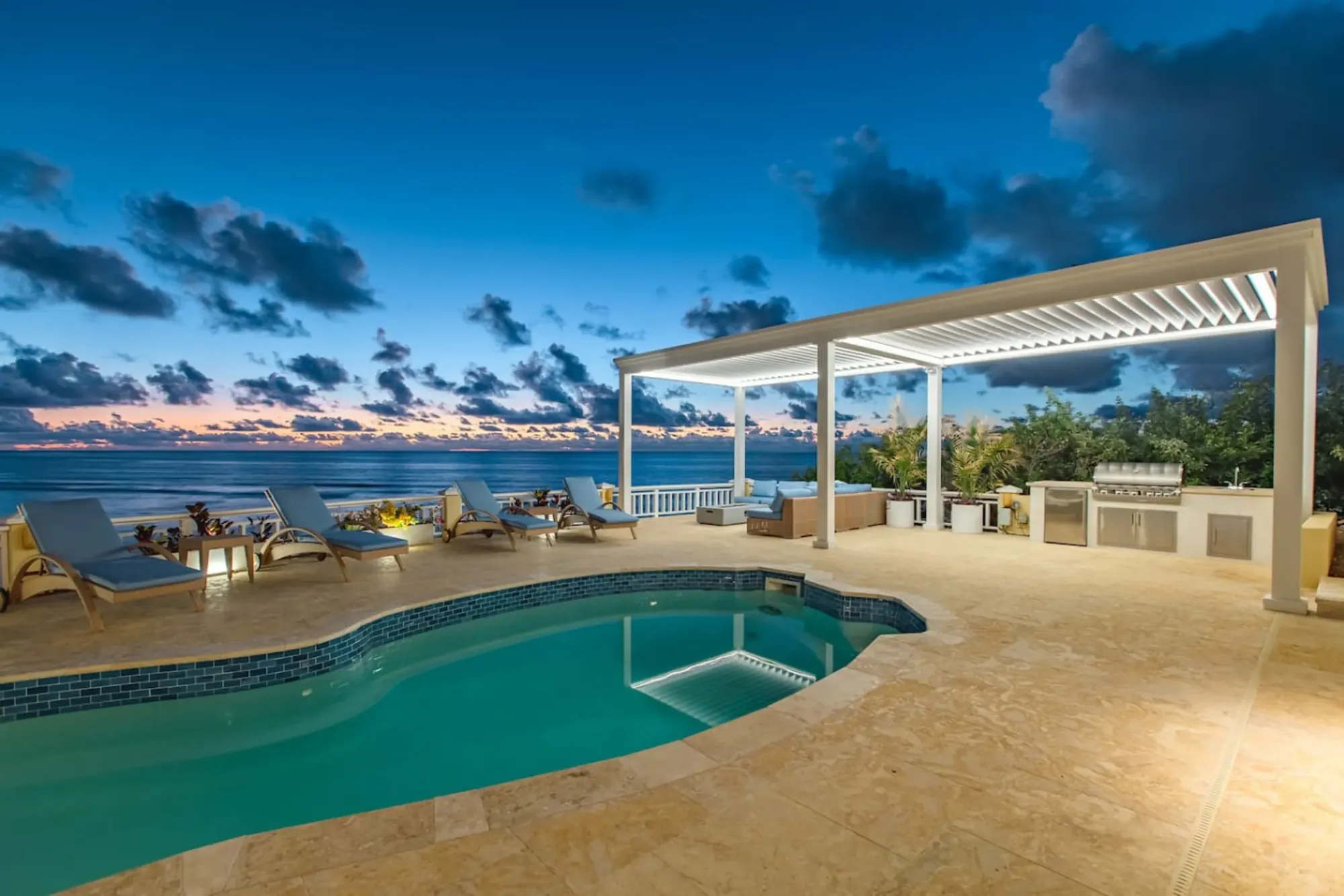
The Cerulean is built for a week like this. The house sleeps twelve across four en-suite bedrooms in the main house and a guest cottage about twenty steps away with its own kitchen, living room, bedroom and a loft with the sixth bed, so three generations or two families have room to spread out between outings. The pool sits on a deck above the sea, the outdoor kitchen, the gas grill and the fire pit are a few steps from it, the pergola's motorized louvers manage the shade, and the private beach is a short set of steps below, with the reef that keeps its water calm a few feet out. The villa pages walk through the bedrooms, the guest cottage, the pool and deck and the private beach.
The geography does the rest. Green Cay Marina and the East End's own Buck Island boats are minutes down the road, Christiansted is 15 to 20 minutes, the Point Udall trailhead is about five, Chenay Bay, the Shoys and Cramer's Park are all inside a quarter of an hour, and the Divi casino and Duggan's Reef are closer than that. The north shore is 35 to 45 minutes, the west end about 50, and the airport 35 to 40. The concierge arranges the welcome, a guided drive to the villa and a full tour by the villa managers, and then the week: provisioning before you land, a private chef for a dinner or the stay, a boat for twelve, in-villa massage and yoga, airport pickup and a vehicle. Our post on why the mornings are the point explains the east-facing veranda, and the beach and grounds page shows the lighting that runs down to the sea after dark.
The best outing of the week is usually the shortest. Walk down the steps at seven with a mask and a coffee still on the deck, put your face in the calm water inside the reef, and watch the parrotfish start their day while the sun comes up out of the sea in front of you. Then climb back up for breakfast, open this guide, and decide which part of the island the day belongs to. Hold your week on the calendar, and bring the water shoes.
Questions people ask
What are the best things to do on St. Croix?
Snorkel the underwater trail at Buck Island Reef National Monument, swim and snorkel the East End's reef-protected bays, walk Christiansted's Danish waterfront and its yellow fort, stand at Point Udall for the first sunrise under the U.S. flag, paddle the glowing bay at Salt River on a dark night, eat kallaloo and johnny cakes, tour the Cruzan rum distillery, and finish a day on the west end, the only coast where the sun sets into the sea. From a villa on the East End, every one of those is within about an hour's drive.
How many days do you need on St. Croix?
A week is the right length. The island is about 28 miles long and its outings sit in three clusters: the East End and Christiansted, 5 to 20 minutes from the villa; the north shore with Salt River and Cane Bay, about 35 to 45 minutes; and the west end with Frederiksted, the distillery and the sunset beaches, about 50 minutes. A Saturday-to-Saturday week gives each cluster a day, a Buck Island morning, a slow day at the house and a spare day for whatever the group liked most.
Do you need a car on St. Croix?
Yes. There is no Uber or Lyft in the U.S. Virgin Islands, taxis work for a single ride, and the island's best days are drives. You drive on the left in ordinary left-hand-drive American cars, with a 35 mph limit on most roads; most visitors are comfortable within ten minutes. A group of twelve usually takes two cars, or a van and a car, and the local companies deliver to the villa. Our car rental directory lists them.
Is St. Croix good for families with children?
Yes, and the East End is the easiest part of it. U.S. citizens fly in without a passport and use dollars, the East End beaches are reef-protected and shallow, Chenay Bay and Cramer's Park have calm, grassy water close to shore, and the villa's own beach lets a child practice with a mask a few feet from the sand. Buck Island's half-day trip suits children under about eight, the forts are climbable, and the hospital in Christiansted runs a 24-hour emergency room.
What is the one outing to book before you arrive?
Buck Island. Only operators licensed by the National Park Service may land visitors there, the boats are small, and winter mornings fill. Big Beard's lists a full day at $135 per adult and a half day at $95 as of October 2026; Buck Island Charters sails from Green Cay Marina, minutes from the villa. Tell the concierge your date and group size when you book the villa. A private chef for one dinner and a bio bay night around the new moon are the other two to reserve early.
What is there to do on St. Croix at night?
Christiansted's boardwalk most nights: Brew STX, Shupe's, The Mill and Rum Runners sit on the water, and Levels on Company Street runs live music Wednesday to Saturday. Four Friday nights a year the town closes its streets for Jump Up, with steel pan and mocko jumbies on stilts. The Divi Carina Bay casino is about five minutes from the villa. On a dark night the Salt River bio bay kayak is the best evening on the island, and the villa's fire pit and the stars over the East End close most nights.
What can you do on St. Croix without getting in the water?
Plenty. Walk Christiansted block by block and climb Fort Christiansvaern, drive to Point Udall for sunrise, tour Estate Whim's sugar plantation and the Cruzan distillery, visit the free art museum in Frederiksted, drive Mahogany Road through the rainforest to the Domino Club, play the nine-hole Reef course ten minutes from the villa, book an in-villa massage, hike to Ham's Bluff lighthouse, and eat your way through the Saturday farmers market. Our rainy day guide has the indoor circuit.
Do U.S. citizens need a passport for St. Croix?
No. The U.S. Virgin Islands are U.S. territory, so the flight down is a domestic flight: a REAL ID-compliant license or another TSA-accepted ID boards the plane, there is no immigration or customs line on arrival, the money is the dollar and U.S. phones generally work as at home. On the way back there is a short agriculture and customs check at the airport, and a $1,600 per person duty-free allowance, double the usual figure. Non-U.S. citizens follow the normal U.S. entry rules.
Where is the best sunset on St. Croix?
The west end. The island runs east to west, so Frederiksted faces the sunset, the one coast where the sun goes down into open sea. Rainbow Beach, with Rhythms bar on the sand from about 11 to 7, is the social choice; Dorsch Beach and the town beach by Fort Frederik are quieter. The villa faces east, so every morning the sun comes up out of the sea in front of the veranda.
Sources
Facts in this story were checked in October 2026 against the sources below. Event dates, flight schedules, prices and hours change, so confirm anything you plan around.
- National Park Service, Buck Island Reef National Monument: outdoor activities
- National Park Service, Buck Island Reef National Monument: directions and authorized concessioners
- National Park Service, Christiansted National Historic Site: hours
- National Park Service, Christiansted National Historic Site: fees and passes
- National Park Service, Salt River Bay: plan your visit
- National Park Service, Columbus Landing Site at Salt River Point
- U.S. Fish and Wildlife Service, Sandy Point National Wildlife Refuge: visit us
- The Nature Conservancy, Jack and Isaac Bay Preserve
- DPNR Coastal Zone Management, marine protected areas (St. Croix East End Marine Park)
- Visit USVI, Explore Point Udall
- Visit USVI, no passport required for U.S. visitors
- Visit USVI, Celebrate Crucian Christmas Festival
- Visit USVI, Jump Up
- VI Agrifest, official site
- Big Beard's Adventure Tours (prices, October 2026)
- GoToStCroix, Cane Bay Wall dive site
- GoToStCroix, Chenay Bay beach
- GoToStCroix, Cramer's Park beach
- Cruzan Rum, tours and experiences
- St. Croix Landmarks Society, Estate Whim Museum
- Caribbean Museum Center for the Arts (hours, admission)
- Rhythms at Rainbow Beach (hours)
- Sweet Bottom Dive Center, Cane Bay
- BushTribe Eco Adventures, adventures and pricing
- Government of the U.S. Virgin Islands, July 3 Emancipation Day
- Virgin Islands Port Authority, Ann E. Abramson Marine Facility (Frederiksted Pier)