

The CeruleanSt. Croix · U.S. Virgin Islands
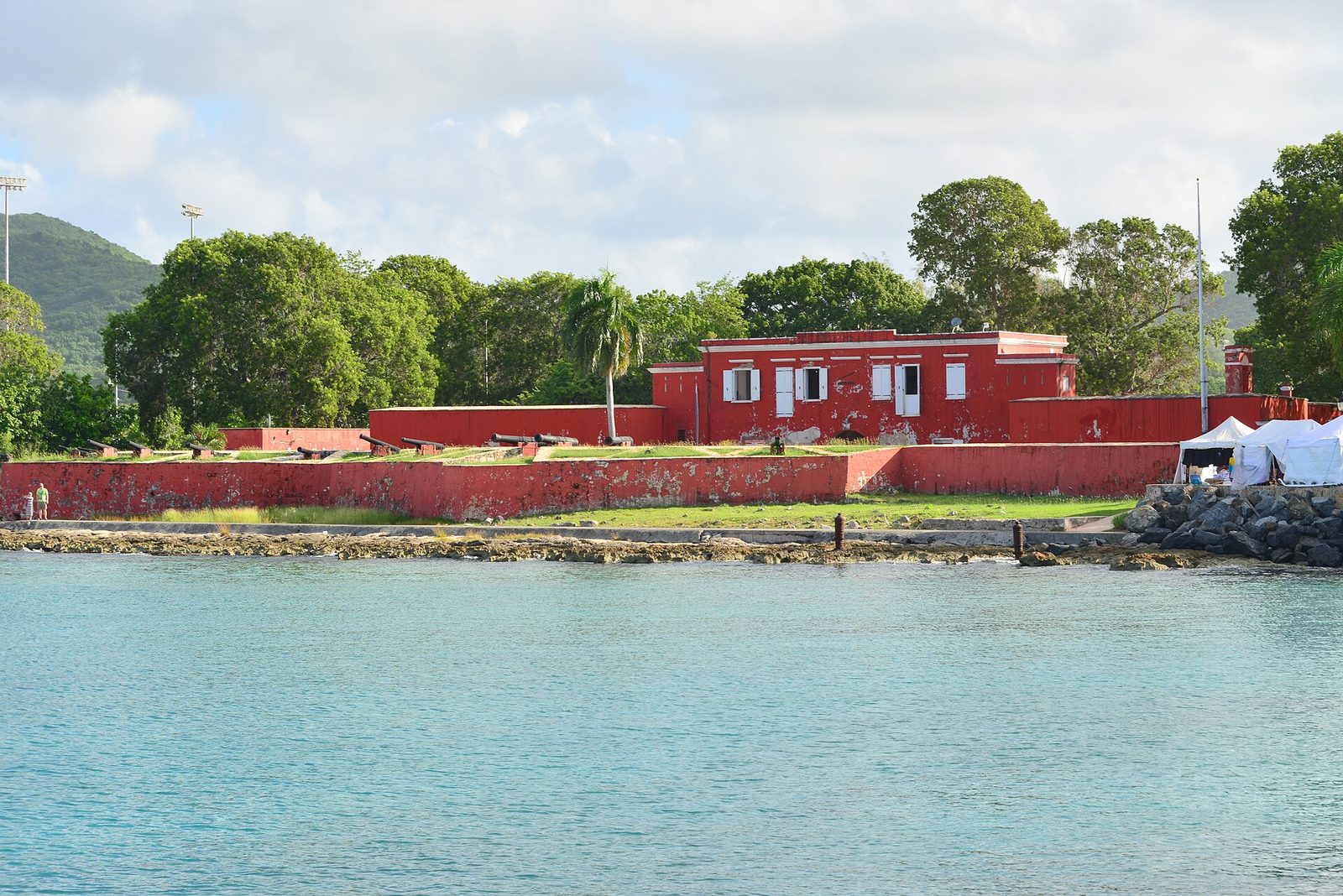
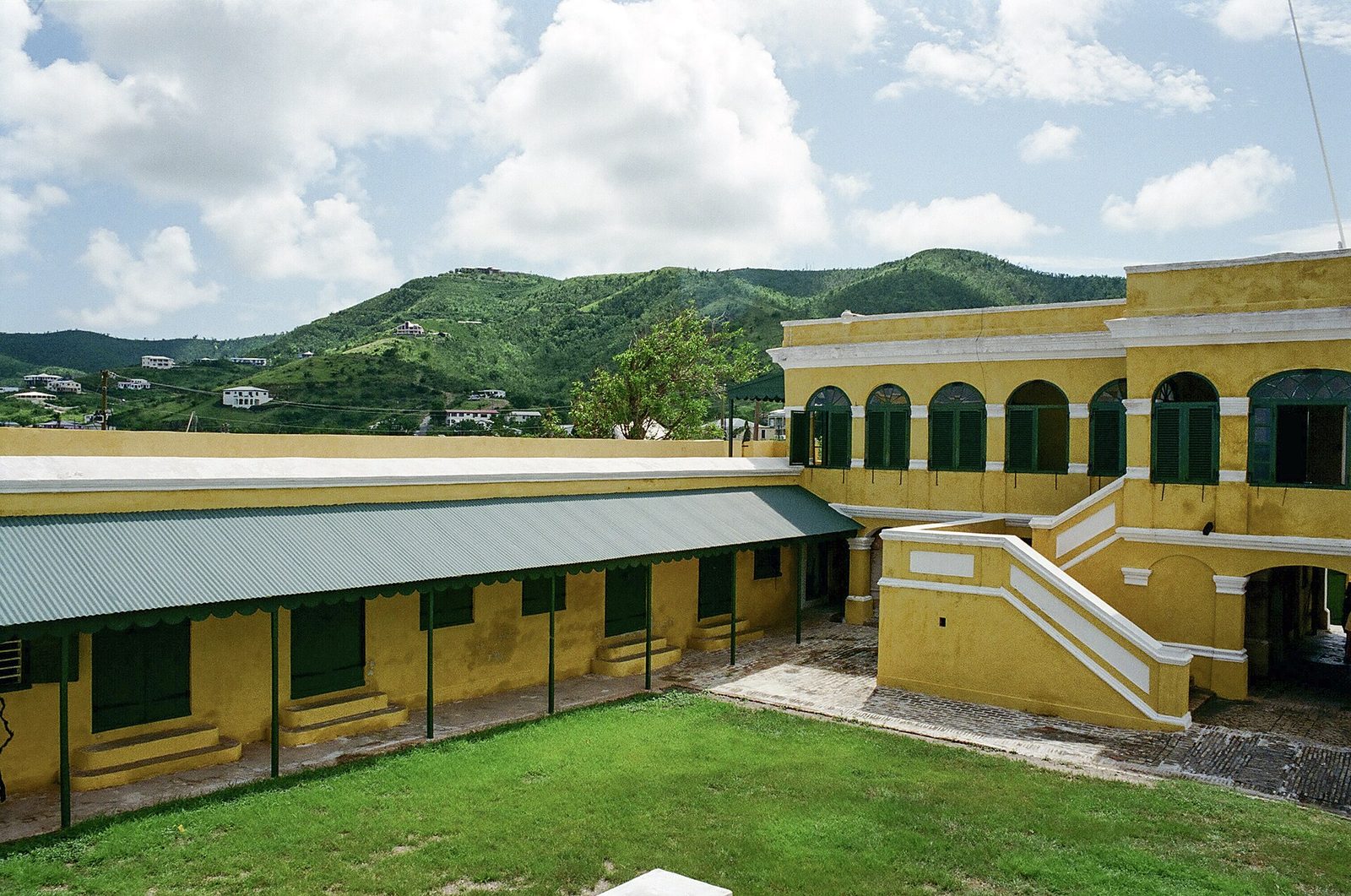
Fort Christiansvaern Courtyard 08

Seven Flags Over St. Croix: The Real Chronology, 1493–1917

Spain, Holland, England, France, the Knights of Malta, Denmark, America: one small island, seven owners — with the dates, the reasons, and the places where you can still stand in each chapter.

Photo: gillfoto (CC BY-SA 4.0)

St. Croix has flown the flags of seven sovereigns — Spain, the Netherlands, England, France, the Knights of Malta, Denmark and the United States — plus two British occupations the usual count leaves out. That is not a trivia answer. It is why the island's towns are Danish, its name is French, its estates carry English names, its people are U.S. citizens, and its history includes more than a century of legal slavery under the Danish flag. Here are the dates, the reason each flag came and went, and the places where you can still stand in each chapter. This is the express version; for the whole island story — the first peoples, the sugar economy, emancipation, the Fireburn and the century since — see our complete history of St. Croix.

Seven flags, and how to count them

The "seven flags" is a Crucian convention, not a legal category. The seven are Spain, the Netherlands, England, France, the Knights of Malta, Denmark and the United States. Two of those, the Dutch and the English, held the island at the same time in the 1640s and never held it alone for long. One, the Knights of Malta, was a Catholic military order rather than a nation, and it ran St. Croix from 1651 to 1665 as a French dependency, in the name of Louis XIV. And Britain, which occupied the Danish islands twice during the Napoleonic wars, is left off because it took the islands and gave them back.

So you could argue for six, or eight, or nine. Nobody on St. Croix does. You will find frequent reference to the "seven flags" there, with the Knights counted among the rulers, and that is how the island tells it. Take the seven as the frame and the British as the footnote.

What the count hides is why each flag came and went, and the reason is nearly always sugar, war or debt. Spain claimed the island and never farmed it. The Dutch, English and French came for tobacco and killed one another over it. Denmark bought it for sugar, built two towns on the profits of enslaved labor, and sold it when the sugar and the money were gone. The United States bought it for a war it had not yet entered. Read the flags that way and the island's map — Danish forts, French name, English estate names, American citizenship — becomes an explanation.

The count also hides the people who were here for a thousand years before the first flag, and the enslaved Africans who built the Danish island and freed themselves in 1848, who are represented by no flag at all. This guide keeps both in view. The dates come from the Danish National Archives, the National Park Service, the St. Croix Landmarks Society and the historian Aimery Caron's reading of the 17th-century records; where they disagree, the text says so.

  1. Nov 14, 1493Columbus's fleet anchors off Salt River and his men fight the Kalinago — the first recorded fight between Spaniards and Native Americans
  2. 1638Dutch settlers under Louis Capoen dig in at Salt River and at the site of Christiansted
  3. July 1645English planters kill the Dutch deputy governor and drive the Dutch and French off the island
  4. 1650Spain expels the English in July and the French from St. Kitts take the whole island in September
  5. 1651France sells St. Kitts and its dependencies, St. Croix included, to the Knights of Malta, who rule to 1665
  6. 1695–96France evacuates its colonists to Saint-Domingue and the island lies empty for 38 years
  7. June 15, 1733The Danish West India and Guinea Company buys St. Croix from France for 750,000 livres
  8. July 3, 1848Von Scholten proclaims emancipation at Fort Frederik after 8,000 people march on the town
  9. March 31, 1917Denmark hands the islands to the United States at 4 pm — $25 million in gold
  10. Feb 25, 1927Virgin Islanders become U.S. citizens

Before any flag: Igneri, Taíno, Kalinago

The oldest pottery on St. Croix belongs to the Igneri and puts people on the island from around the first century CE to about 700. The Taíno followed, roughly 700 to 1425, and left the village and ceremonial ball court at Salt River that archaeologists unearthed in 1923 — the only ball court known in the U.S. Virgin Islands. Around 1425 the Kalinago (the people the Spanish called Caribs) took over the north-shore village, and it was a Kalinago canoe that met Columbus's longboat in 1493.

That is a thousand years of history before the first European name, and it ended fast. The Spanish never colonized the islands, but most or all of the native population was eventually dispersed or killed, and by the end of the 16th century the islands were said to be uninhabited. The date usually given for an empty island is 1590. Slave raids, disease and flight did the work.

So the seven flags begin over an island that had just been emptied. When the Dutch dug in at Salt River in 1638, or the French counted 300 planters in 1650, or the Danes bought an empty island in 1733, they were describing land that had been farmed, fished and defended for fifty generations. The Columbus story and what is left to see at Salt River are in our 1493 guide; the bay itself, and the glowing lagoon behind it, are in the Salt River guide.

Spain, 1493: a claim, a fight and a century of raids

Spain's flag is first because Columbus put it there, in the loose sense that counted in 1493. On his second voyage he reached the island on November 14, named it Santa Cruz — Holy Cross — and anchored off the north shore at what is now Salt River Bay. A boat sent ashore for water met a Kalinago canoe; the fight that followed is the first recorded clash between Spaniards and the native people of the Americas, and Columbus named the point Cabo de la Flecha, the Cape of the Arrow. Then he sailed on. That is the whole Spanish landing: one day, one skirmish, one name.

The name is what lasted. Santa Cruz became the French Sainte-Croix, which the Danes wrote as Sankt Croix, which the Americans respelled Saint Croix after 1917. The people are Crucians, from the Spanish form.

What Spain did not do was settle. Its interest was Puerto Rico, to the west, and Santa Cruz was a nuisance to be kept empty of rivals; the Spanish flag here in the 1500s and 1600s meant raids, not government. The historian Aimery Caron dates them from the records: English tobacco planters from Barbados in 1631, attacked from Puerto Rico within four months; French planters and their Dutch allies in 1634, "promptly dislodged by a Spanish force of 40 men aboard a frigate"; English settlers from Tortuga in 1635, driven out over two years, forty killed and 23 captured in 1637; a force of 150 men in April 1647; and a final sweep in July 1650.

Why the flag came: a claim by right of discovery, and Puerto Rico's flank. Why it went: Spain never invested in holding the island, and once France put a garrison ashore in 1650, Madrid let it go. What survives: the name, the demonym, and the beach at Salt River. Nothing Spanish was ever built here.

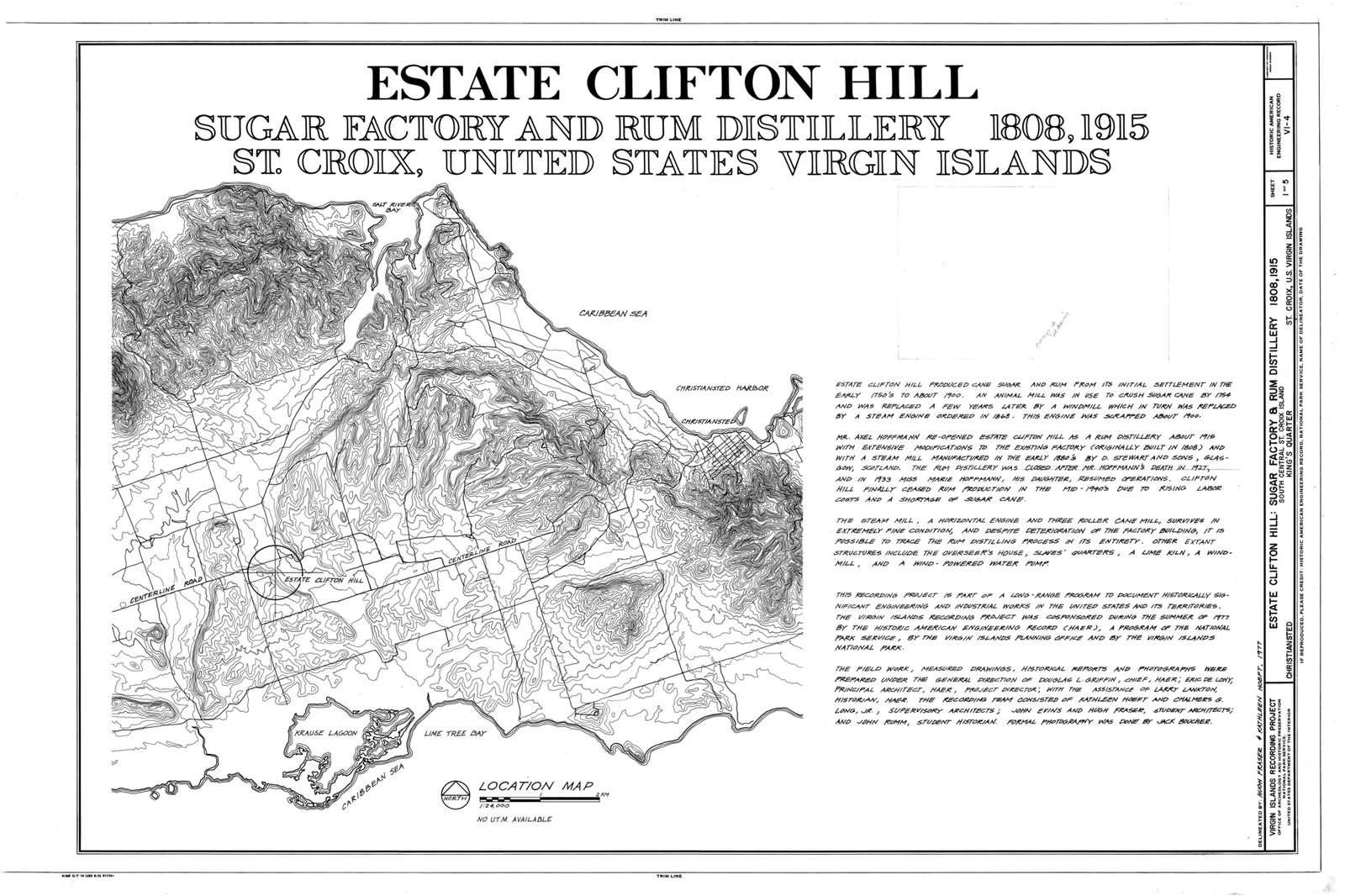
Estate Clifton Hill, Sugar Factory and Rum Distillery, Title Sheet - Estate Clifton Hill, Sugar Factory and Rum Distillery, South Central Street, Christiansted, St. HAER VI,1-KING,2-A- (sheet 1 of 5)
St. Croix as the mapmakers of the 1700s and 1800s drew it. Under the Danish flag the island was surveyed into nine quarters and about 250 named estates, and the maps of the period are where most of today's place names first appear. Photo: Fraser, Hugh (Public domain)

The Netherlands and England: tobacco, quarrels and a double killing

The short version says Dutch and English settlers arrived together in 1625, joined by French refugees from St. Kitts. Caron's reading of the records puts the first durable settlement in 1638, when a Dutch party under Deputy Governor Louis Capoen — including "50 Zeelanders sent recently by the Dutch West Indies Company" — established itself at Salt River and at the site of the present town of Christiansted. French deserters from St. Kitts joined them in 1639. In 1641 the English arrived at the west end under Colonel William Caverly and a Mr. Brainsby: about 50 men against a Franco-Dutch community of about 100.

They grew tobacco, and tobacco is what they fought over. In 1645 a dispute over the quality of the crop turned violent. English planters were imprisoned; their countrymen freed them "by the force of arms"; the Franco-Dutch counterattacked, and both Capoen and Brainsby died. The English brought in reinforcements — Caron gives 500 to 600 men against no more than 200 — expelled the French in July 1645, killed the new Dutch deputy governor, Denis, and his lieutenant, and forced the last Dutch off the island two months later. The Dutch went to St. Eustatius and St. Martin, the French to Guadeloupe.

England's flag then flew alone for five years, and it was Spain that ended it. The Spanish force of April 1647 wiped out the West End English community; the raid of July 1650 expelled the rest, who "were already suffering severely from an epidemic of a tropical fever." (The invasion from Puerto Rico is sometimes dated to August 1650.)

Why these flags came: cheap land, tobacco, and a foothold between the Spanish Main and the Leewards. Why they went: each other, then Spain, then fever. What survives: almost nothing you can touch. The low earthwork of Fort Salé, from this period, is the only known structure to survive from this early colonial period, and it is a hump in the grass. The Dutch and English left their mark another way, as ancestors and cousins of the planters Denmark would recruit a century later.

France, 1650: de Poincy's gamble and the Knights of Malta

France's turn began in September 1650, with a bluff. Philippe de Lonvilliers de Poincy, governor of French St. Kitts and himself a Knight of Malta, heard that the English had been thrown off Santa Cruz and sent about 160 men. The Spanish garrison withdrew without a fight — one account has de Poincy's men talking it into sailing for San Juan — and the French took possession "of the whole island of Sainte Croix." De Poincy then sent about 300 planters from St. Kitts. The island had a French name and, for the first time, a government that meant to stay.

The next year the flag changed hands on paper. In 1651 the Company of the American Islands sold St. Kitts and de Poincy's dependencies — St. Croix, St. Barthélemy and St. Martin — to the Knights of Malta, the Catholic military order de Poincy already served. The Order held St. Croix from 1651 to 1665 in the name of Louis XIV, and de Poincy governed for it until his death in 1660. In 1657 a rebellion overthrew the Knights' regime, and de Poincy sent a new governor to restore order, build fortifications and a monastery, and clear forest for plantations. Fever did the rest.

In 1665 the Knights sold to the newly formed French West India Company, which held the island until 1674, when Louis XIV took it into the crown's hands. Then came the War of the Grand Alliance: in 1695 and 1696 France evacuated its colonists to Saint-Domingue, the future Haiti, and abandoned the island, which lay empty for 38 years. France kept the title, which is why it was Louis XV who sold St. Croix in 1733.

Why the French flag came: to deny the island to Spain and England and to farm it. Why it went: mortality, losses and a European war that made a small colony not worth defending. What survives: the name Sainte-Croix; possibly a few estate names, since the Landmarks Society says La Grange is "believed" to date from the French era; and the Maltese cross, which still turns up in island iconography. Nothing standing can be firmly dated to the French decades.

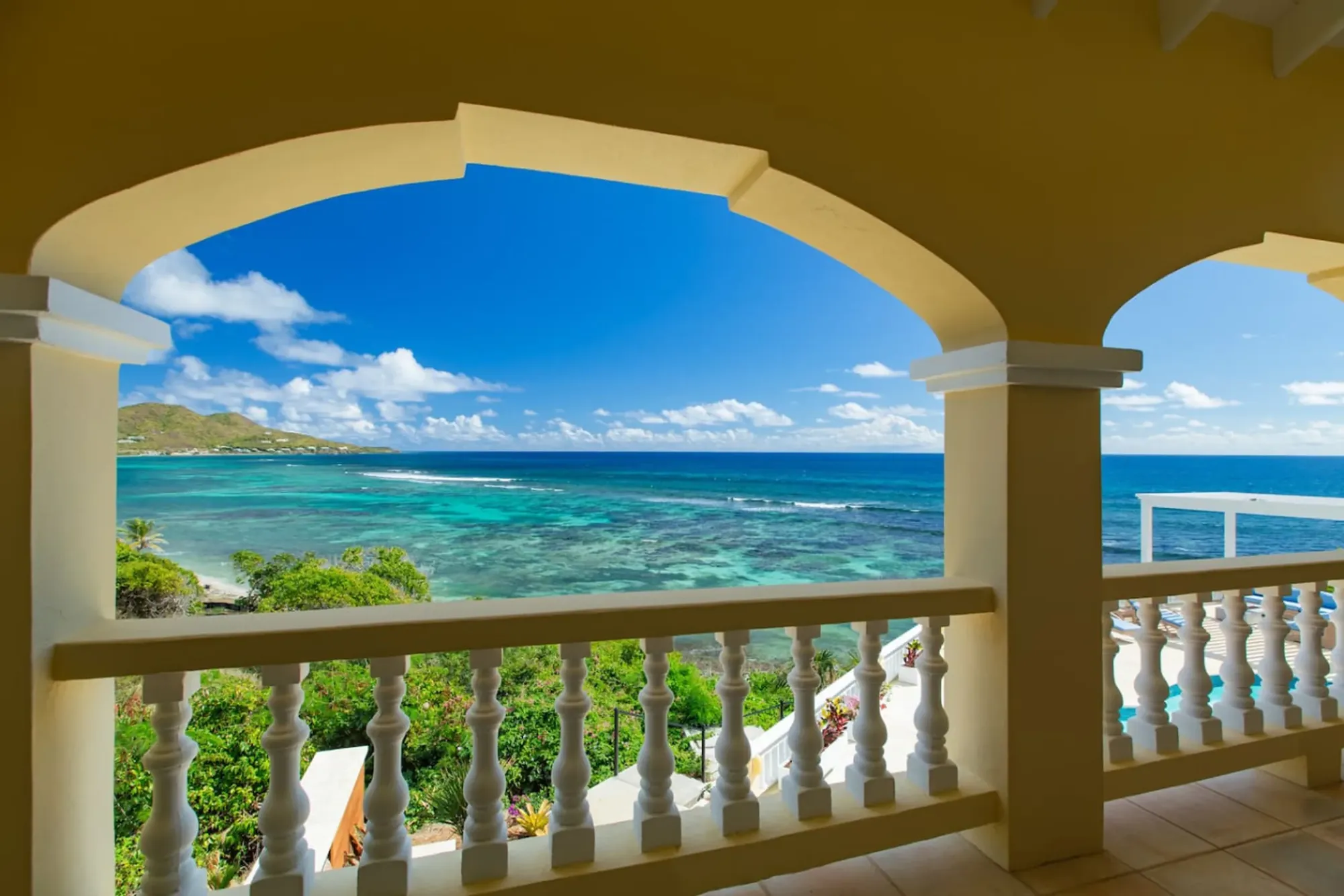
Turquoise bay framed by the villa's arched veranda
The Cerulean

Plan it from the villa.

Five bedrooms, a private swimmable beach, and all of this within a day trip.

Sleeps 12 · 4.90 ★ · rates by season

Denmark, 1733: 750,000 livres for an empty island

Denmark's flag arrived by contract. The Danish West India and Guinea Company already held St. Thomas and St. John, both small and mountainous, and in 1725 Frederik Moth, the governor on St. Thomas, urged the directors to consider buying Santa Cruz — flat, fertile and empty since the French left. On June 15, 1733, France and Denmark-Norway signed a treaty by which the company bought St. Croix for 750,000 livres. Louis XV ratified it on June 28 and took half the price in French coin at once, the rest within eighteen months. (Some summaries credit the sale to the French West India Company; it was the French crown that signed.)

Moth was named the first Danish governor of St. Croix on November 16, 1733, and on September 1, 1734, he established Christiansted and named it for the reigning king, Christian VI. From May 1735 the town was laid out on a grid, and the Building Code of 1747 dictated street widths, setbacks and materials, which is why the blocks still line up. Frederiksted was founded at the west end in 1751 (some sources say 1752), named for Frederik V, with Fort Frederik begun in 1752 and finished around 1760.

The company could not settle the island with Danes, so it did not try. It offered tax exemptions and cheap land, and the planters who came were mostly English-speaking, from the Leeward Islands and especially St. Kitts, with Dutch and French planters among them — which is why English, not Danish, became the language of the cane fields. The 1742 census counted 120 sugar plantations and 122 cotton plantations. In 1754 the bankrupt company handed all three islands to the crown; Frederik V took direct control, and Christiansted became the capital of the Danish West Indies, which it stayed until 1871.

Why the Danish flag came: sugar land for a company that had run out of it. Why it stayed 184 years: the sugar paid, and then the towns and the forts and the debts were there. What survives: nearly everything you will photograph — the two towns, the two forts, the street grid, the arcades, the estate names, the windmill ruins on almost every hill. Denmark is the flag you can still walk through.

750,000Livres paid in 1733
About 250Estates on Danish St. Croix
18,000–20,000Enslaved at the peak
184Years under Denmark
$25 millionU.S. price in 1917

Sugar, and the people forced to make it

The Danish flag was raised over a sugar factory, and the factory ran on enslaved Africans. In 1742 there were 1,906 enslaved people on St. Croix and 360 whites. By 1754 the enslaved numbered 7,566. At the peak of the plantation economy, in the mid-to-late 1700s, the enslaved population stood between 18,000 and 20,000 against 1,500 to 2,000 whites, and more than 58 percent of the island's land was under sugar cane. The Danish National Archives counts about 250 plantations in nine quarters — Company, King's, Queen's, Prince's, West End, Northside A and B, East End A and B.

Every one of those estates was worked by people bought on the West African coast — the "Guinea" in the company's name was the coast it traded from — shipped across the Atlantic and held for life with their children. Denmark is often described as the first European state to outlaw the slave trade, and that is true only narrowly: a 1792 decree ended Denmark's transatlantic trade, but it took effect only on January 1, 1803, and it freed nobody.

Slavery lasted 45 more years and did not end by decree. On July 3, 1848, some 8,000 enslaved people marched on Frederiksted behind the man remembered as General Buddhoe — recorded as Moses Gottlieb and as John Gottliff — and Governor-General Peter von Scholten, at Fort Frederik, declared "all unfree in the Danish West Indies are from today emancipated." That day has its own guide.

Freedom did not end the plantation. Emancipation came with labor rules that tied the freed to the estates on yearly contracts, and in October 1878 the Fireburn — a labor revolt led by four women laborers, remembered as the Queens — burned most of Frederiksted and around fifty plantations. The Frederiksted guide and the Estate Whim guide take up that story and the economy under it.

Read the Danish chapter with both facts in one hand: the towns are handsome, and they were paid for by people who had no say in the flag. The forts you will climb were built to guard the harbor and to keep order in a slave colony; Fort Christiansvaern spent most of its life as the colony's jail. None of this is hidden on St. Croix, and a visitor who wants the architecture without the history is missing what the architecture was for.
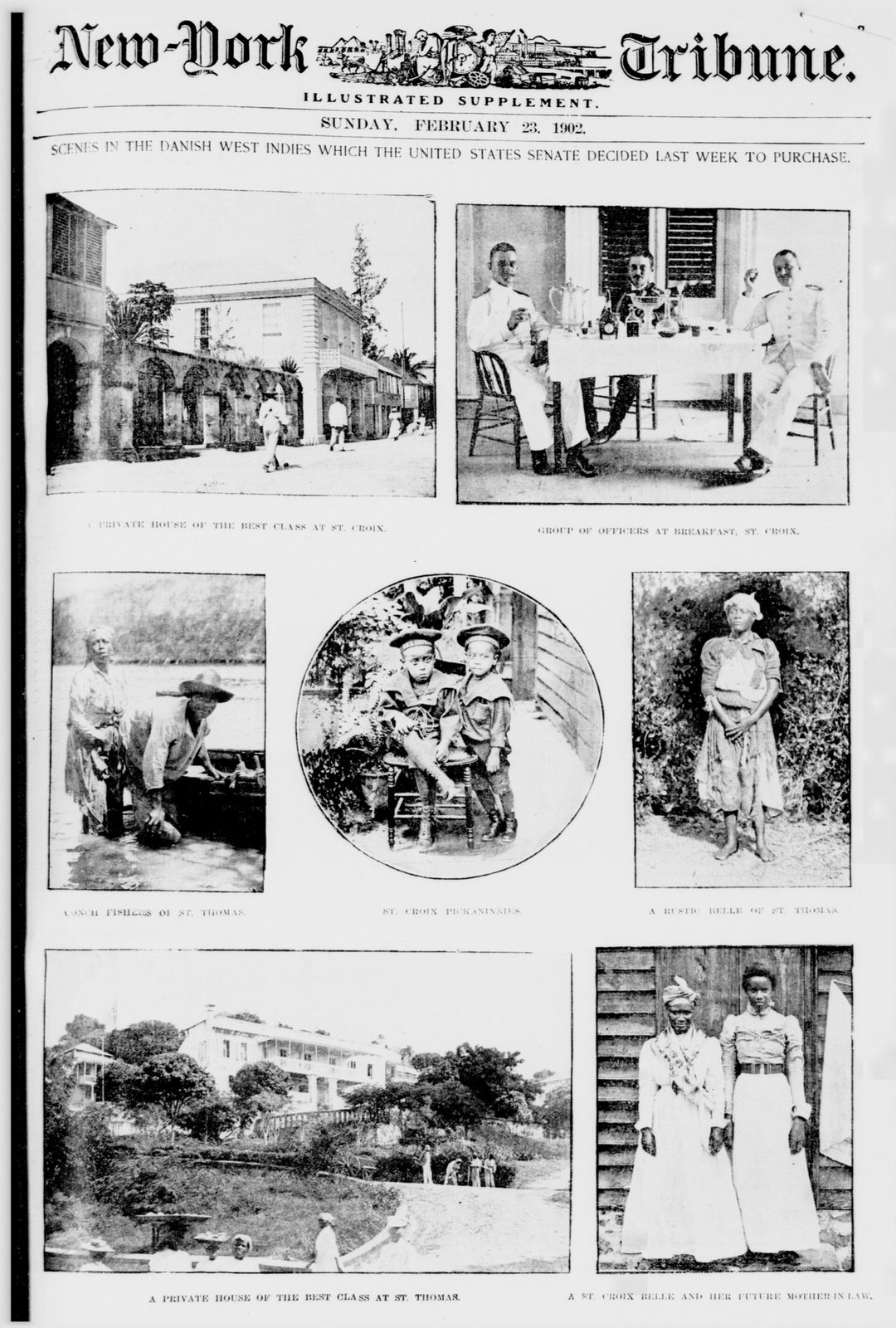
Scenes in the Danish West Indies which the United States Senate decided last week to purchase LOC 4231382350
Period art from the Danish West Indies: paintings, prints and illustrations from the 1800s and from the 1917 sale — the island as it was shown to Copenhagen and to Washington. Photo: The Library of Congress (No restrictions)

Britain, twice: 1801–02 and 1807–15

The British flag flew over St. Croix for about nine years in total, and it is the chapter the count leaves out. Both occupations were side effects of Denmark's position in the Napoleonic wars. In March 1801 a British fleet arrived at St. Thomas; Denmark-Norway accepted the Articles of Capitulation, and the British took the islands without a shot being fired. They handed them back in April 1802. In December 1807, with Denmark allied to France, a British fleet returned, took St. Thomas on December 22 and St. Croix on December 25 — again without resistance — and stayed until 1815, when the peace returned the islands to Denmark.

Why the British came: to keep Danish harbors and Danish sugar out of French hands while Denmark was on the wrong side of the war. Why they left: the wars ended and the treaties said so. Neither occupation changed the planters, the language or the labor system; many planters were English-speaking already.

What survives from the British years: nothing you can point to with confidence — no British fort, no British street name, no plaque we could verify. Fort Christiansvaern was there for both surrenders and fired at nobody. The occupations matter mostly as the start of Denmark's long doubt about the islands: the sugar economy was already heading into the decline — soil exhaustion, competition from European sugar beet, hurricanes, falling prices, debt — and within fifty years Copenhagen would be trying to sell.
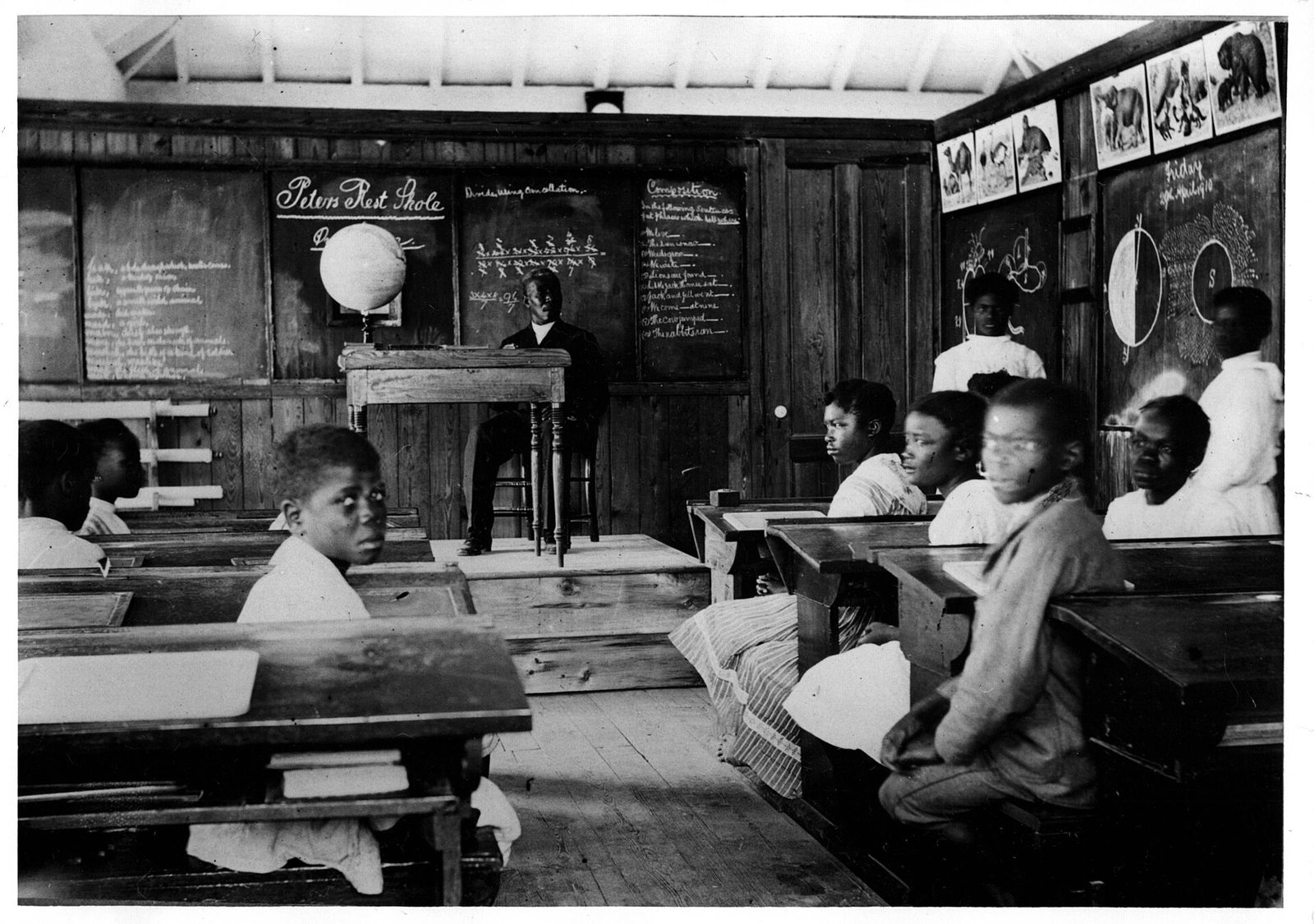
Class in a class room, Peter’s Rest Skole (9468858371)
St. Croix in the last decades of Danish rule, around 1900: photographs and postcards from the Danish West Indies, when the sugar economy was failing and the sale to the United States was already being discussed. Photo: National Museum of Denmark from Denmark (No restrictions)

The long Danish afternoon: decline, debt and three tries at a sale

The Danish flag flew longest, and for most of that time over a colony in slow decline. Emancipation in 1848 removed the forced labor the estates were built on; the labor rules that replaced it produced the Fireburn of 1878; and in 1871 the capital of the Danish West Indies moved from Christiansted back to Charlotte Amalie on St. Thomas, where it had been before 1754. Christiansted, seat of the whole colony for 117 years, became the second town of a second island.

The United States had wanted the islands for a long time. The Landmarks Society dates the first approach to 1865, when Washington sought them "for naval strategic advantage." On October 24, 1867, a treaty was signed to buy St. Thomas and St. John — not St. Croix — for $7.5 million in gold; the U.S. Senate never ratified it. On January 24, 1902, a second treaty was signed for all three islands at $5 million; it failed in the Danish legislature.

The third try was made under pressure. By 1916 the First World War was two years old, Germany was sinking ships with submarines, the Panama Canal was close by, and Washington feared that if Germany overran Denmark it would inherit three Caribbean harbors. Denmark had a colony that was an economic burden, and a use for $25 million. On August 4, 1916, at the Biltmore Hotel in New York, Secretary of State Robert Lansing and the Danish minister Constantin Brun signed the Treaty of the Danish West Indies; the U.S. Senate approved it on September 7.

Denmark then put the sale to its voters. In the referendum of December 14, 1916, 64.2 percent approved; the Danish parliament ratified on December 22, President Wilson on January 16, 1917, and ratifications were exchanged on January 17. The islanders were not asked officially; an unofficial vote in the islands ran 99.83 percent in favor. Why Denmark's flag went: sugar and money gone, a war coming, and a buyer at last willing to pay.

FlagYearsWhy it cameWhy it wentWhat to see today
Spain1493 claim, raids to 1650Columbus's claim and Puerto Rico's flankNever settled it and let France have it in 1650Salt River Bay and the island's name
Netherlands1638–1645 (with the French)Tobacco and cotton landKilled off and driven out by the English in 1645The Fort Salé earthwork at Salt River, barely
England1631, then 1641–1650Tobacco planters from Barbados and the LeewardsSpanish raids of 1647 and 1650, then feverLittle on the ground, much in the later estate names
France1650–51 and 1665–1696To deny the island to Spain and England and to farm itMortality, losses and the War of the Grand AllianceThe name Sainte-Croix and perhaps La Grange
Knights of Malta1651–1665Bought St. Kitts and its dependencies from FranceSold to the French West India CompanyThe Maltese cross in island iconography
Denmark1733–1917Sugar land for the West India and Guinea CompanySugar and money gone, a world war comingChristiansted, Frederiksted, the forts, Whim, the estate names
Britain (occupier)1801–02 and 1807–15Napoleonic wars, Denmark allied to FrancePeace returned the islandsNothing you can point to
United States1917 to todayGerman submarines and the Panama CanalStill hereTransfer Day, March 31, and the fort lawn in Christiansted

The United States, 1917: $25 million in gold and a 48-ton warrant

Transfer Day was March 31, 1917, at 4 pm on St. Thomas and St. Croix at the same hour, and St. Croix held two ceremonies. In Christiansted, by the Landmarks Society's account, at 3:30 pm half a company of Danish gendarmes under Captain F. N. C. Fuglede marched from their barracks on Hospital Street to the wharf and lined up facing Fort Christiansvaern; opposite them stood U.S. Marines under First Lieutenant Edward A. Willing, driven over from Frederiksted by automobile because their ship could not cross the sandbar into Christiansted harbor. Government Secretary Will Jacobsen, the police master and the Colonial Council arrived before the Steeple clock struck four, and Jacobsen read the Royal Act.

Then Fuglede gave the order and the Dannebrog came down while the Christiansted Industrial Band played the Danish royal anthem. Marines and gendarmes exchanged places, and Willing raised the Stars and Stripes to "Hail Columbia." In Frederiksted the USS Olympia, under Captain Bion B. Bierer, had arrived at noon; as the steeple struck four, the Lutheran minister John Faber said a prayer for the old flag, a 21-gun salute preceded the lowering of the Dannebrog and another followed the raising of the American flag. That was the whole of it: one hour on a Saturday afternoon.

The money changed hands in Washington the same day, and not as gold. Secretary Lansing presented Constantin Brun with a warrant for $25 million; Treasury Secretary William McAdoo explained that a warrant was used "because the actual gold coin would weigh nearly forty eight tons." The price was about $740 million in 2025 dollars. It bought three islands, three harbors and a population that had not been consulted and did not become citizens that afternoon.

You will see April 1, 1917 in a few references. The ceremonies, the warrant and the public holiday are all March 31, and that is the date the Virgin Islands keep. Why the American flag came: a war Washington was about to enter, and harbors it did not want Germany to have. Why it stayed: it is still there.

“By Order of His Majesty the King of Denmark, Commodore Konow, Governor ad-interim of the Danish West Indies, delivers at this moment these islands to the representatives of the United States of America.”

The Royal Act, read at Christiansted by Government Secretary Will Jacobsen, March 31, 1917 (St. Croix Landmarks Society)

Flag seven, slowly: Navy rule, citizenship and the Organic Acts

The United States bought the islands for a war and governed them at first as if the war were the point. From 1917 the Virgin Islands were administered by the U.S. Navy, with naval officers as governors. Islanders were not citizens; they had traded Danish subjecthood for an undefined status, and it took a decade to define it. Congress granted citizenship on February 25, 1927, and the islands became, in the language of the law, an unincorporated territory.

Naval rule ended in 1931, when President Hoover moved the islands by executive order from the Navy Department to the Department of the Interior. On June 22, 1936, Congress passed the Organic Act of the Virgin Islands, the territory's first civil framework, and the Revised Organic Act of 1954 set up the present government with separate executive, legislative and judicial branches. Governors were appointed from Washington until the first popularly elected governor, Melvin H. Evans, took office in 1970. That is the arc of the seventh flag: purchase 1917, citizenship 1927, civil government 1936, self-government 1954, an elected governor 1970.

Those dates are the ones the island marks. Transfer Day, March 31, is a territorial public holiday, and the 2017 centennial was observed in Christiansted with a military parade, a ceremony on the lawn of the National Historic Site, a naturalization ceremony, and an address by Denmark's prime minister, Lars Løkke Rasmussen, who acknowledged Denmark's history with slavery. Emancipation Day is July 3. Neither is a tourist event; both are the island talking to itself about the flags.

One more thing about the seventh flag: it kept the Danish town. What is now Christiansted National Historic Site was established in 1952 "through the initiative of concerned local citizens," and that is why the fort, the warehouse, the Steeple Building, the Custom House and the Scale House are maintained rather than demolished. Denmark built them; the people of Christiansted, under the American flag, are why they are still there.

A seven-flags day, north shore to west end

  1. Start at Salt River Bay for 1493 and the 1600s — the beach at Columbus's Landing and the low earthwork of Fort Salé, open sunrise to sunset, free.
  2. Drive into Christiansted and give the National Historic Site two hours — Fort Christiansvaern, the Company Warehouse, the Steeple Building, the Scale House and the Custom House, all Danish.
  3. Walk King, Company and Strand Streets and stop at Government House and Apothecary Hall — the everyday Denmark of the 1700s and 1800s.
  4. Take Centerline Road west and read the estate signs as you go — English, French, Danish and Dutch names on one road.
  5. Stop at Estate Whim for the sugar economy told whole, then finish at Fort Frederik in Frederiksted, where emancipation was proclaimed in 1848 and the island's second Transfer Day ceremony was held in 1917.
  6. Drive back east — about 45 minutes from Frederiksted to the East End — and read the Transfer Day account over dinner.

What survives on the ground: Christiansted

Denmark is the flag you can walk through, and Christiansted is where you do it. The National Park Service keeps five buildings on the seven-acre waterfront site and dates them plainly: Fort Christiansvaern (begun 1738, finished 1749), the Danish West India and Guinea Company Warehouse (1749), the Steeple Building (1753, built as the Danish Lutheran church), the Danish Custom House (1844) and the Scale House (1856). Read them as one machine — fort, warehouse and wharf, customs house, scale house, church — for the sugar and rum going out and the enslaved people and goods coming in.

The fort is where the Danish flag came down in 1917, and it is the one building you can walk top to bottom: ramparts, cannon, courtyard, cells. It served as the colony's jail for most of its life and, from 1878, as police headquarters and courts, which is why it survived. As of 2026 it is open daily 8:30 am to 4:30 pm, closed Thanksgiving and Christmas, with a $10 adult ticket good for three days and free entry under 16 — check the NPS page, because hours and fees change.

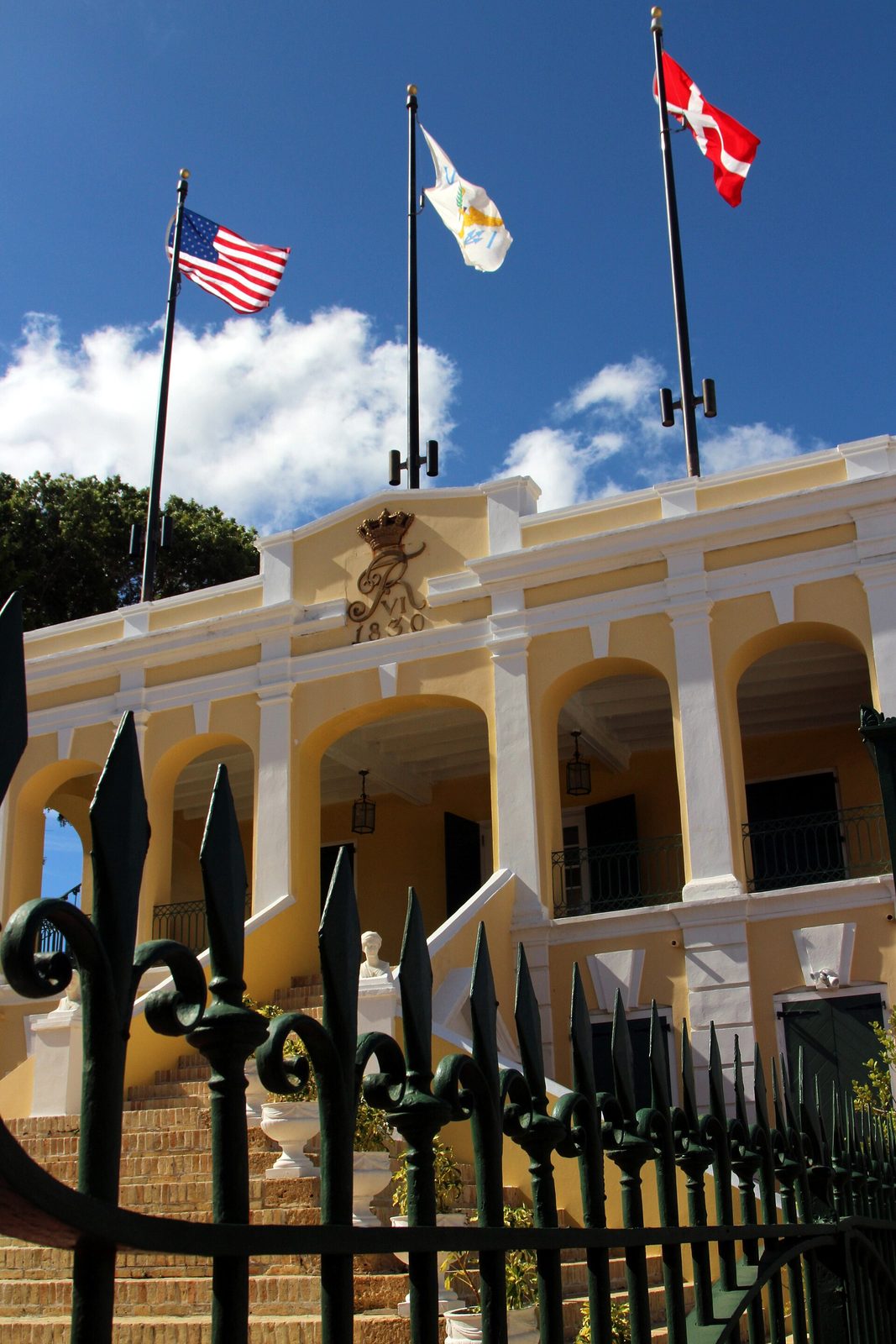
Then walk the grid. The streets still carry the names the Danes gave them, in English: King Street and Company Street parallel to the water; Queen Cross, King Cross, Church and Hospital Streets running down to the harbor; Strand Street along the waterfront at the western end. The "Company" is the West India and Guinea Company; Hospital Street is the one the gendarmes marched down on Transfer Day. Government House on King Street was joined into one building in 1830 by von Scholten, who would proclaim emancipation eighteen years later. Apothecary Hall, run by the Landmarks Society, is a Danish colonial pharmacy established in 1820, opened as a museum in 1987.

The arcaded sidewalks, the yellow of the fort, the 1747 building code — all of that is Denmark, and all of it is in the Christiansted town guide. Alexander Hamilton clerked at King and King's Cross Streets as a teenager and left for New York in 1772, and his mother was jailed in the fort in 1750; that thread is in the Hamilton guide. On the wharf facing the fort you are standing where Fuglede's gendarmes lined up at 3:30 on March 31, 1917.
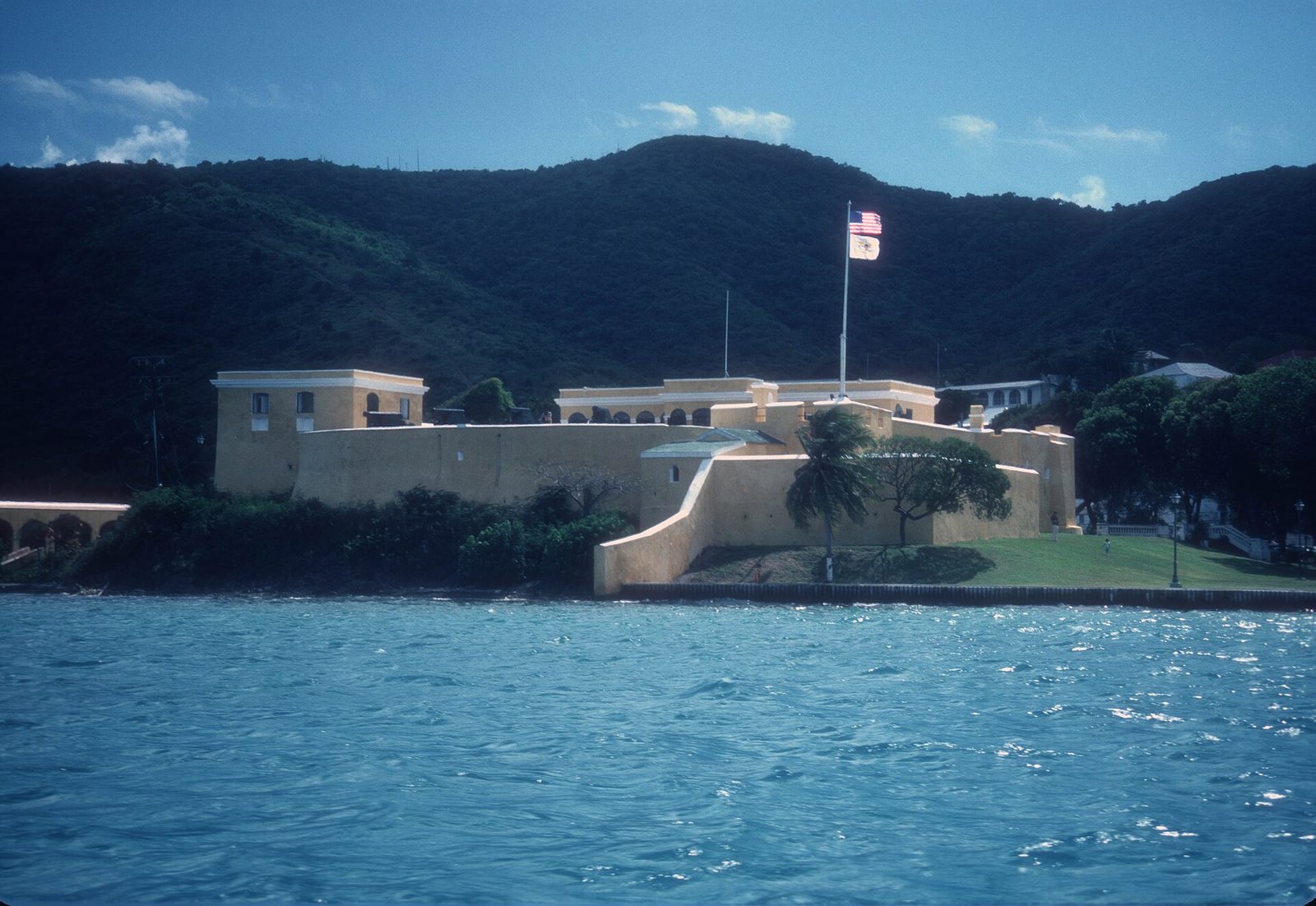
CHRISTIANSTED NATIONAL HISTORIC SITE
Fort Christiansvaern, begun in 1738 on Christiansted's waterfront: the colony's jail for most of its life, and the place where the Danish flag came down at four o'clock on March 31, 1917. Photo: JERRYE & ROY KLOTZ MD (CC BY-SA 3.0)

What survives on the ground: Frederiksted, Whim and the estate names

Frederiksted is the second Danish town, and its history sits in one building. Fort Frederik, on the waterfront, was begun in 1752, finished around 1760 and named for Frederik V; on July 3, 1848, some 8,000 people surrounded it and von Scholten proclaimed emancipation there; and on March 31, 1917, the town held its own Transfer Day ceremony. The fort is a museum today — as of late 2025, open weekdays 8:30 to 4 and Saturday afternoons 1 to 4, but confirm before you cross the island. The town around it was rebuilt after the Fireburn of 1878, which is why Frederiksted's architecture is Victorian where Christiansted's is a century older.

Estate Whim, on Centerline Road near Frederiksted, is the Landmarks Society's twelve-acre plantation museum — restored great house, windmill and factory complex, and the "My Granny House" exhibit — and it is where the economy every flag after 1733 depended on is kept whole. It has its own guide, linked above; go before the forts if you can, because Whim explains what the forts were guarding.

The subtlest Danish survival is the one you drive past without noticing: the estate names. The Danish National Archives' list, compiled by the historian George Tyson from the land-tax records and P. L. Oxholm's cadastral map of 1794 (printed 1799), runs to about 250 estates in nine quarters, and those names still label the island's map and its addresses. Naming became common in the 1760s and the names entered the tax rolls in 1803.

Read a stretch of them and the whole planter population appears: mostly English — Whim, Judith's Fancy, William's Delight, Work and Rest, Wheel of Fortune, Hard Labour, Humbug, Jealousy, Little Profit, Barren Spot; a French layer — La Grange, La Vallée, La Reine, La Grande Princesse, Bonne Esperance, Mon Bijou, Belvedere, Sans Souci; a Dutch handful — Rust op Twist, Drie Kloven, Eindracht; and roughly a dozen Danish ones, by the late historian Arnold Highfield's count — Fredensborg, Hogensborg, Sorgenfri, Bulowsminde, Hafensight, Frederikshaab. That is the honest census of who owned Danish St. Croix: land named in four languages under a fifth flag.

It is also the map of the villa's neighborhood. The East End Lit. B quarter on the Danish rolls takes in Teague Bay, Grapetree Bay, Cotton Valley, Turner Hole, Solitude and Jacks and Isaacs Bay, and Buck Island was an estate of its own, number 42 — which is why the road signs on the way home from Christiansted read like a page from the Danish tax rolls. They are one.
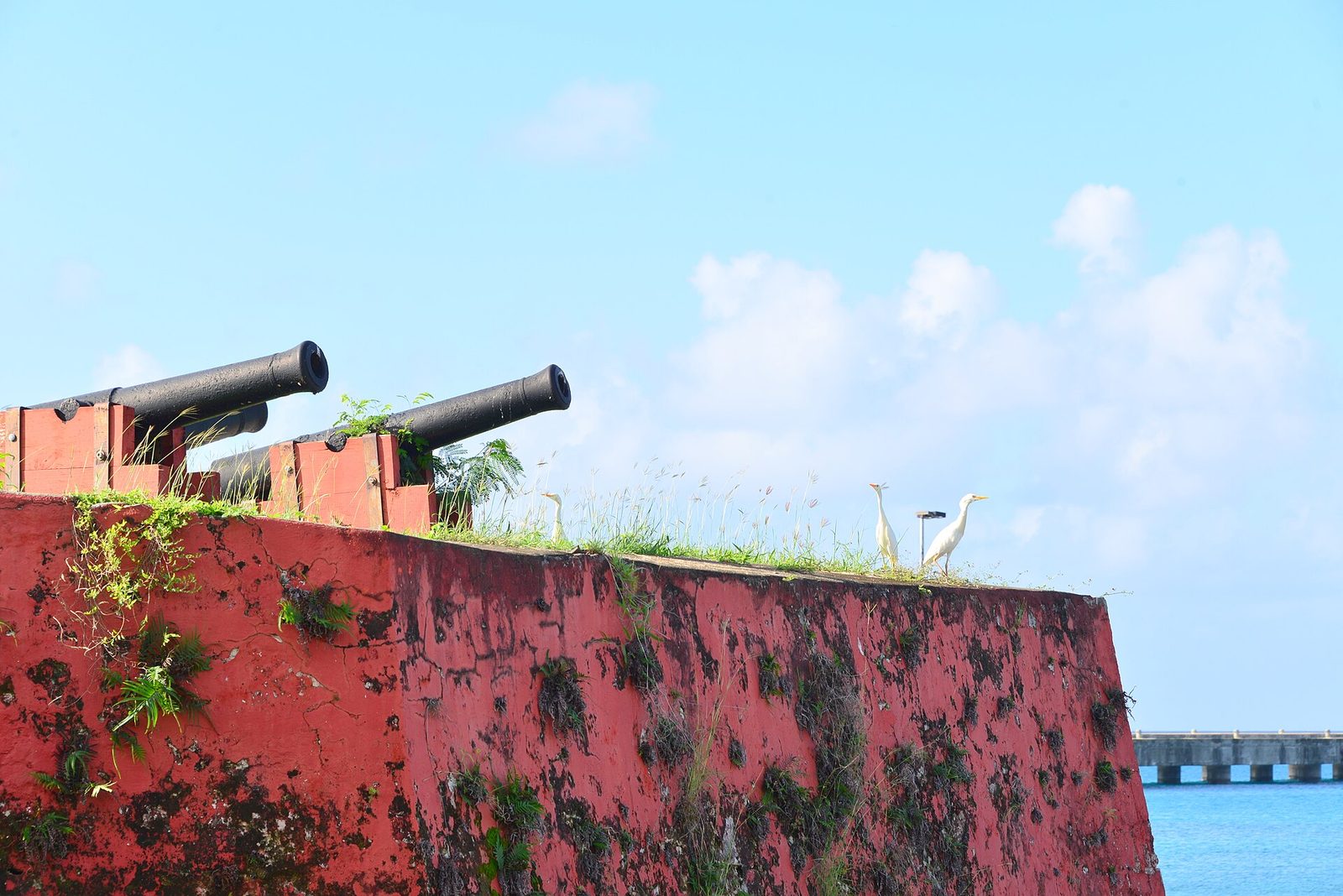
Frederiksted Southeast, St Croix 00840, USVI - panoramio (3)
Fort Frederik on the Frederiksted waterfront, built in the 1750s and named for Frederik V. Emancipation was proclaimed here on July 3, 1848; the town's Transfer Day ceremony followed on March 31, 1917. Photo: Андрей Бобровский (CC BY 3.0)

Myths to avoid

The tidy story sands off untidy facts. A few worth keeping in view. "Seven nations ruled St. Croix." Six did, plus a religious order, plus a seventh nation that occupied it twice and is not counted. "Columbus discovered St. Croix." He anchored off it for a day, sent a boat ashore, fought the people who lived there and left; the island had been inhabited for well over a thousand years, and it was not discovered so much as claimed.

"Denmark abolished slavery in 1792." Denmark decreed an end to its transatlantic slave trade in 1792, effective 1803; it freed no one, and slavery on St. Croix ended in 1848 only because 8,000 enslaved people made it end. "Frederiksted and Christiansted were founded together." Christiansted dates to 1734, Frederiksted to 1751 or 1752, a generation later. "St. Croix was a Danish-speaking island." Danish was the language of the administration and the church; the planters were mostly English-speaking, and English is what the island spoke and speaks — which is why the estate names and the everyday street names are what they are.

On the American chapter: "The U.S. paid $25 million in gold." It paid a $25 million warrant, because the coin would have weighed nearly forty-eight tons — "in gold" is the treaty's standard of payment, not a shipment. "Transfer Day was April 1." March 31, 1917, at 4 pm; April 1 shows up in a few references, but the ceremonies, the warrant and the holiday are all March 31. "Virgin Islanders became citizens in 1917." February 25, 1927, ten years later, with the U.S. Navy as their government in between.

Two more. "The Danish street names." Christiansted's streets have Danish originals, but English is what is on the signs and in everyone's mouth. "The Transfer Day monument." We looked, and we could not verify a dedicated one on St. Croix. The commemoration lives at the fort and its lawn in Christiansted, where the 2017 centennial ceremony was held, and in some years there is no official ceremony at all.
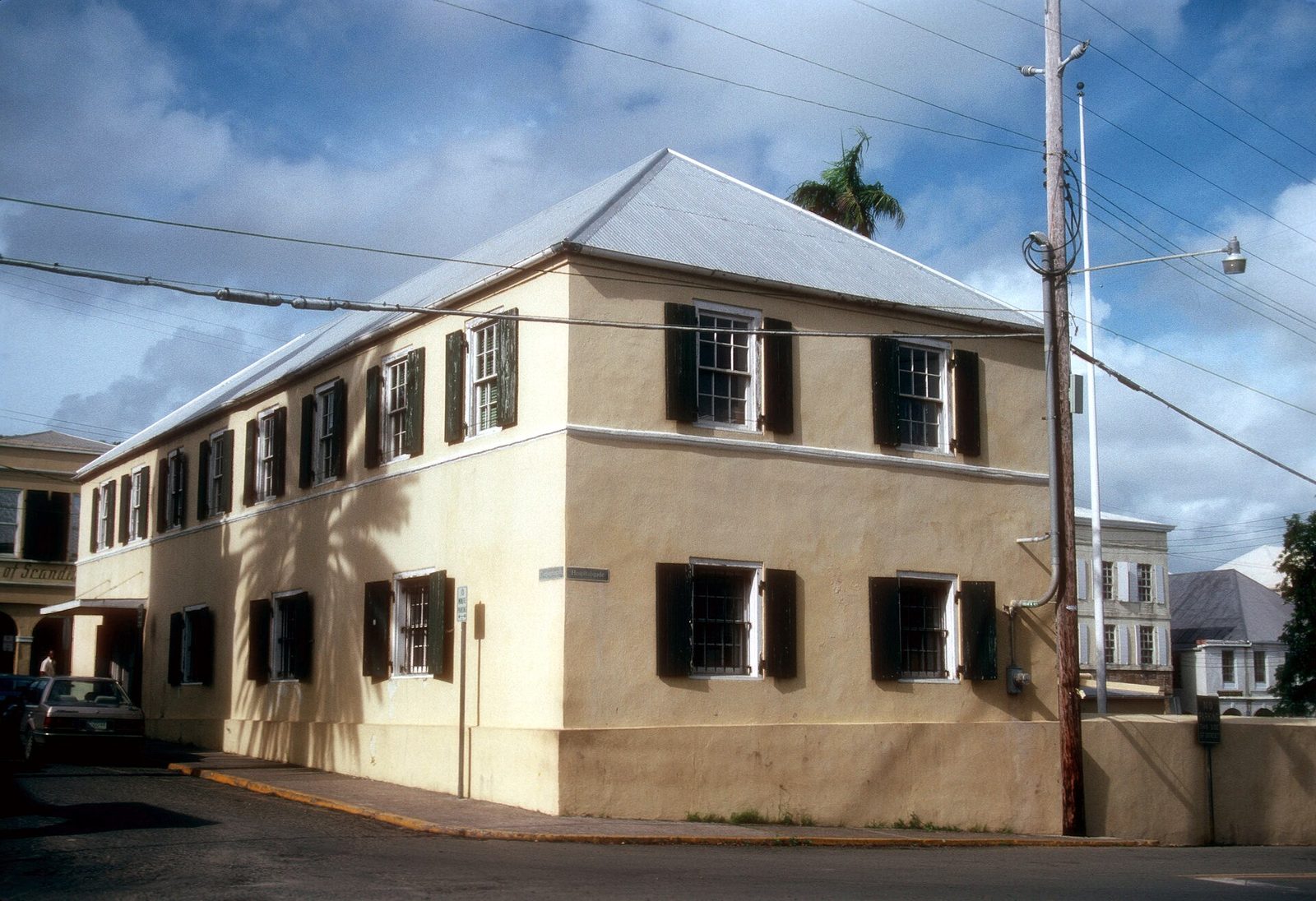
DANISH WEST INDIA & GUINEA COMPANY WAREHOUSE
Photo: JERRYE & ROY KLOTZ MD (CC BY-SA 3.0)
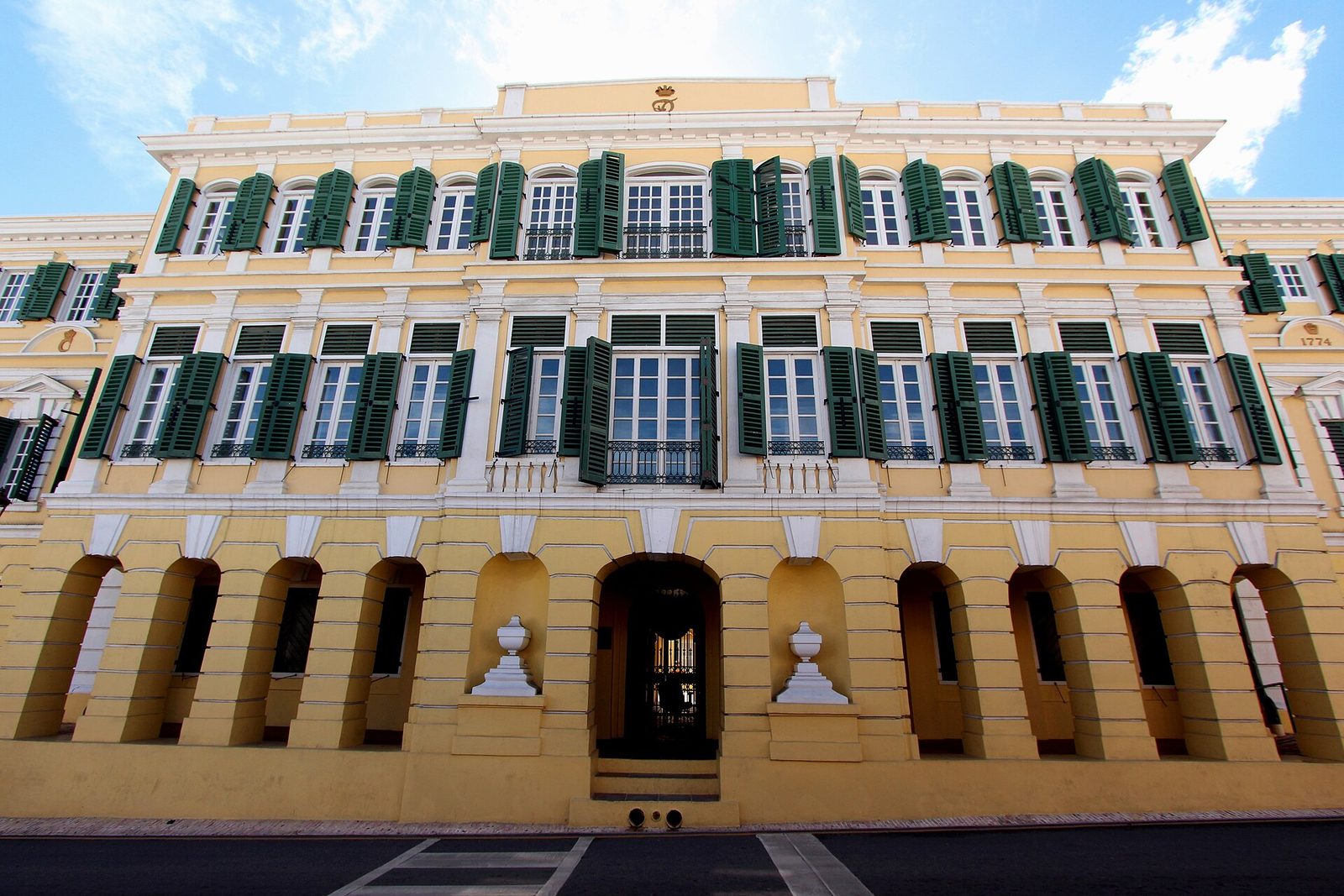
Governor Mansion (22753876584)
Photo: Prayitno / Thank you for (12 millions +) view from Los Angeles, USA (CC BY 2.0)
Governor Mansion (23249997232)
Photo: Prayitno / Thank you for (12 millions +) view from Los Angeles, USA (CC BY 2.0)

Transfer Day, Emancipation Day and when to go

The forts and museums are open year-round, and the seven-flags day works in any month. The two dates worth planning around are March 31 and July 3. Transfer Day is a territorial public holiday: expect government offices closed, some businesses with them, and the National Historic Site's hours to shift — check nps.gov/chri that week. Some years there are official ceremonies in Christiansted, and the 2017 centennial filled the fort lawn; other years there are none. Emancipation Day, July 3, is the bigger date on St. Croix and belongs to Frederiksted, where the 1848 march ended. If you are here for either, go, and let the locals set the tone.

Practicalities: Christiansted is about 15 to 20 minutes west of the East End; Frederiksted roughly 45 minutes across the island; the whole loop in the steps above is a full day with lunch in either town. Fort Christiansvaern's ticket is good for three days, so a return trip later in the week costs nothing. Whim and Fort Frederik keep their own hours and are worth a call before you cross the island for them. Sandy Point, if you want to add the west end's beach, is open weekends only, 10 am to 4 pm, and closed April 1 through August 31 for turtle nesting.

Rain is the other reason to do this. A wet morning on the East End is the natural time for forts and museums, and the seven-flags loop is the best rainy-day plan on the island. Our cultural and historic directory lists the sites with hours and links, and the driving guide covers driving on the left and the cross-island roads.

With kids and with a group

The seven flags are the easiest history to sell to a child because the frame is a game: seven flags, find each one. Give them the list on the drive in and let them collect — the Spanish name on the sign at Salt River, the Dutch earthwork, the French names on the estate signs, the Danish fort, the American flag on the fort's pole. Fort Christiansvaern is the payoff: children are allowed to climb the ramparts, count the cannon and stand in the cells. Whim's grounds are shaded and open, and the windmill makes sense to a ten-year-old in a way a treaty never will.

With a group of twelve, split the day rather than march everyone through everything: the history-minded do the full loop; the rest meet in Christiansted for lunch and the boardwalk, or in Frederiksted for the pier and the sunset. The story to tell at dinner is 1917, because it is short and everyone can picture it — a wharf, two lines of soldiers, a band, a flag down and a flag up, a warrant handed over in Washington. The story to tell on the drive is 1848, because it is the one that matters most and the one the island holds closest.

One honest caution. Fort Christiansvaern was a jail, the Company Warehouse handled the enslaved people the company shipped in, and Whim is a plantation. Children ask direct questions in those places, and the sites answer them directly; let them. St. Croix does not soften the story for visitors, and neither should the adults who bring them.

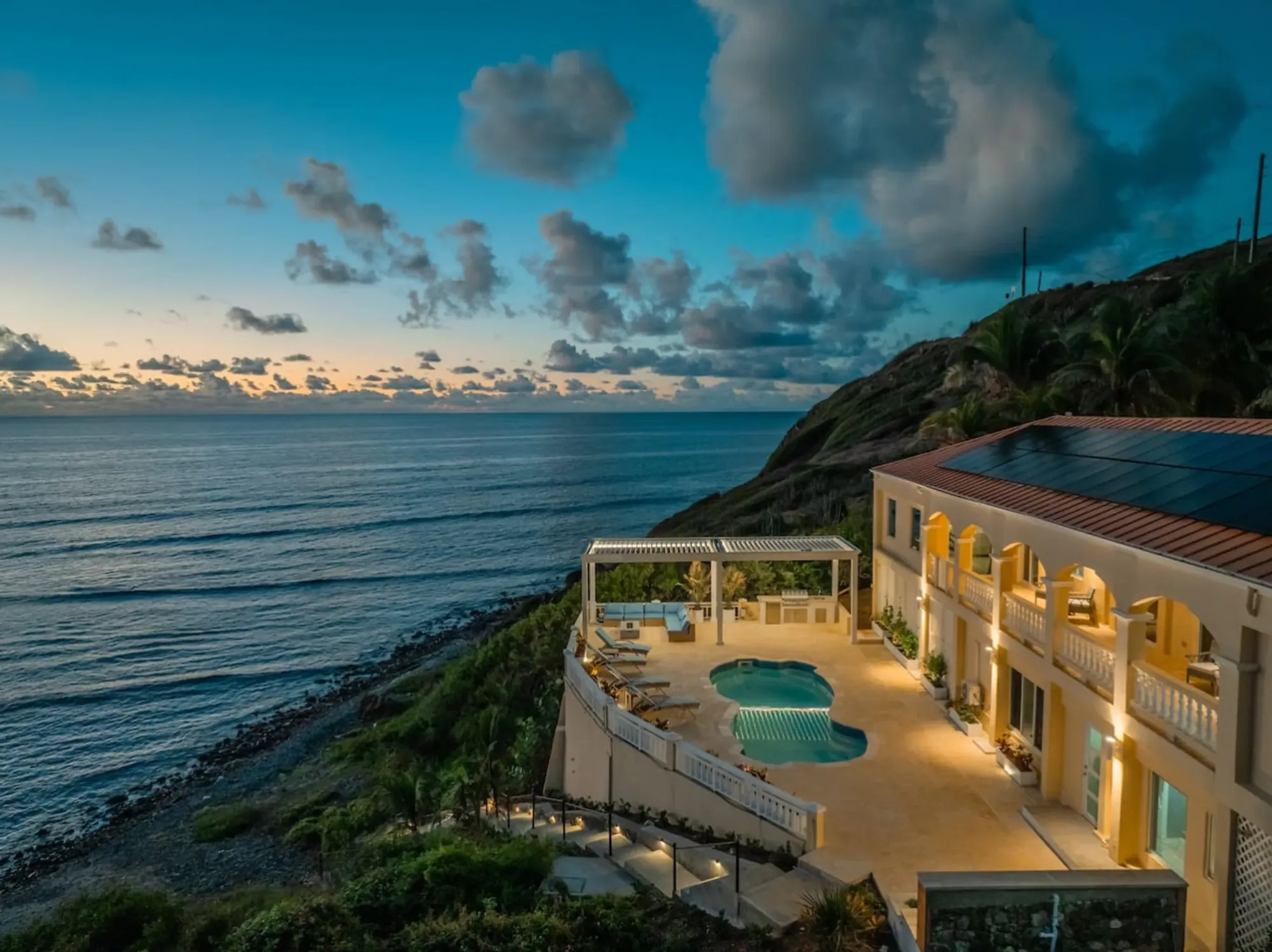
The arched veranda at The Cerulean, on the East End: Christiansted's Danish waterfront is about 15 to 20 minutes' drive west, and the estate names on the way are Danish-era.
The arched veranda at The Cerulean, on the East End: Christiansted's Danish waterfront is about 15 to 20 minutes' drive west, and the estate names on the way are Danish-era. Photo: The Cerulean

Doing it from The Cerulean

The villa sits on the East End, in the part of the island the Danish tax rolls called East End Lit. B — the quarter of Teague Bay, Grapetree Bay, Cotton Valley, Solitude and Jacks and Isaacs Bay. So the seven flags start at the gate: the road signs on the way to town are the estate list, and the first Danish fact of the day is the address. Christiansted is about 15 to 20 minutes west; Salt River about half an hour; Frederiksted and Whim about 45 minutes across the island. The full loop is one long day, or two easy half-days with the beach in between.

We recommend the two-day version. Day one: sunrise on the pool deck, then Christiansted before the heat — the fort at opening, the grid, Government House, Apothecary Hall, lunch on the boardwalk — and back to the East End for the afternoon on the beach. Day two: Salt River in the morning, then Centerline Road, Whim and Fort Frederik, and home before dark.

The concierge can arrange a guide for the Christiansted National Historic Site or a driver for the cross-island day, and can find out whether anything is scheduled for March 31 or July 3 if your dates fall on either. If your group is mixed, send the historians into town and keep the swimmers home; the villa's kitchen will hold everyone at dinner. The East End beaches guide is the companion piece for the half of the family that stayed.

A last thought for the drive home. The seven flags are usually told as a story about Europe — who bought, who sold, who fought whom. Told from the East End it is a story about a place that outlasted all of them: the Kalinago at Salt River, the enslaved who built the towns and freed themselves, the Crucians who kept the estate names and made English out of a Danish colony. Seven flags came and went. The island kept the name, the towns, the names on the road signs, and the people. That is what you are looking at from the veranda.

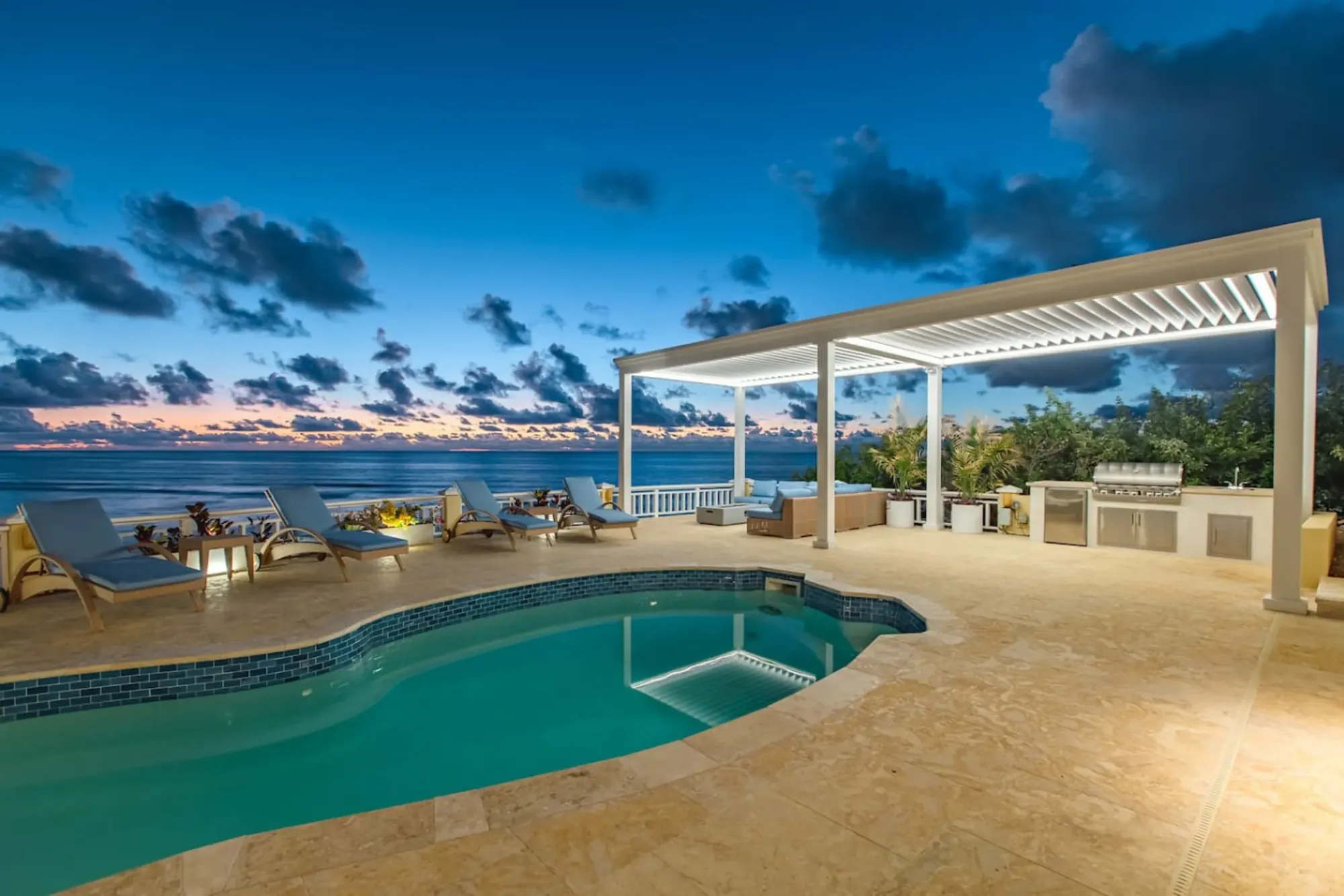
The Cerulean's pool at sunset above the sea
The Cerulean

Twelve of you, one private beach.

The Cerulean sleeps twelve on St. Croix's quiet East End — check your dates.

Sleeps 12 · 4.90 ★ · rates by season

Questions people ask

What are the seven flags of St. Croix?

The conventional list is Spain (Columbus's 1493 claim), the Netherlands and England (rival tobacco settlements of the 1630s and 1640s), France (from 1650), the Knights of Malta (1651 to 1665, holding the island for France), Denmark (1733 to 1917) and the United States (since March 31, 1917). Britain occupied the Danish islands twice, in 1801-02 and 1807-15, but is usually left off because it handed them back rather than owning them.

Why are the Knights of Malta counted as a flag?

Because they actually governed. In 1651 France's Company of the American Islands sold St. Kitts and its dependencies, including St. Croix, to the Knights of Malta, a Catholic military order. The Order ruled St. Croix from 1651 to 1665 in the name of Louis XIV, under Philippe de Poincy and his successors, put down a rebellion in 1657, and sold out to the French West India Company in 1665. It was not a nation, which is why the count is a convention rather than a legal fact.

When did Denmark buy St. Croix and for how much?

By a treaty of June 15, 1733, the Danish West India and Guinea Company bought St. Croix from France for 750,000 livres. Louis XV ratified it on June 28, 1733, took half the price in French coin at once and the rest within eighteen months. Frederik Moth was named the first Danish governor that November and founded Christiansted on September 1, 1734. The Danish crown took the island over from the bankrupt company in 1754.

Why did Britain occupy St. Croix?

Twice, and both times because of Denmark's position in the Napoleonic wars. A British fleet took the Danish islands in March 1801 without a shot fired and returned them in April 1802. In December 1807, with Denmark allied to France, the British came back, took St. Thomas on December 22 and St. Croix on December 25, and stayed until 1815. Neither occupation changed the plantations, the language or the labor system, and there is nothing British to see on the ground.

Why did the United States buy the Virgin Islands?

War, mostly. Washington had wanted the islands since 1865 for their harbors; treaties in 1867 ($7.5 million for St. Thomas and St. John) and 1902 ($5 million) both failed. In 1916, with German submarines at sea and the Panama Canal to protect, the U.S. feared Germany could take the islands through Denmark, and Denmark, tired of a colony that lost money, agreed to sell all three for $25 million in gold. The treaty was signed August 4, 1916.

What happened on Transfer Day, March 31, 1917?

At 4 pm the Danish flag came down and the U.S. flag went up on St. Thomas and St. Croix at the same hour. In Christiansted, Danish gendarmes and U.S. Marines faced each other at the wharf below Fort Christiansvaern, the Royal Act was read, the Christiansted Industrial Band played the Danish anthem and then Hail Columbia. Frederiksted held its own ceremony as the steeple struck four, with the USS Olympia offshore. In Washington the U.S. handed Denmark a warrant for $25 million.

When did Virgin Islanders become U.S. citizens?

Not on Transfer Day. The islands were run by the U.S. Navy from 1917, and Congress granted citizenship only on February 25, 1927, a decade after the purchase. Administration moved from the Navy to the Interior Department in 1931, the Organic Act of June 22, 1936 gave the territory its first civil framework, the Revised Organic Act of 1954 set up the present three-branch government, and the first elected governor, Melvin H. Evans, took office in 1970.

Where can I see the Danish history on St. Croix today?

Christiansted National Historic Site is the core: Fort Christiansvaern (begun 1738), the Danish West India and Guinea Company Warehouse (1749), the Steeple Building (1753), the Custom House (1844) and the Scale House (1856), plus the grid of King, Company and Strand Streets around them. In Frederiksted, Fort Frederik (1750s) is where emancipation was proclaimed in 1848. Estate Whim near Frederiksted keeps a sugar plantation whole. And the estate names on every road sign are Danish-era.

Is there a Transfer Day monument on St. Croix?

Not one we could verify. Transfer Day (March 31) is a territorial public holiday, and the 2017 centennial was marked in Christiansted with a parade, a ceremony on the lawn at Christiansted National Historic Site, a naturalization ceremony and an address by the Danish prime minister. In other years there have been no official ceremonies at all. Treat the fort and its lawn as the memorial, and check local news the week before if you want to attend anything.

Did Columbus actually land on St. Croix?

He anchored off Salt River Bay on November 14, 1493, on his second voyage, and sent a boat ashore for water. The boat's crew fought a Kalinago canoe, the first recorded fight between Spaniards and Native Americans, and Columbus named the point the Cape of the Arrow. He did not settle, and Spain never colonized the island. Salt River is the only documented place under the U.S. flag where his expedition came ashore; the story is in our 1493 guide.

Sources

Facts in this guide were checked against these primary sources in 2026. Hours, prices and schedules change — confirm before you go.

  1. St. Croix Landmarks Society — Transfer Day, March 31, 1917
  2. St. Croix Landmarks Society — Plantation Life (estate names, La Grange)
  3. NPS — Christiansted National Historic Site, history and culture
  4. Aimery Caron, VI Daily News — First European settlements on Santa Cruz (1631–1650)
  5. Rigsarkivet (Danish National Archives) — Estate Names on St. Croix during the Danish period
  6. Rigsarkivet — Archives on the Danish West Indies
  7. Legislature of the U.S. Virgin Islands — Transfer Day, a significant day in Virgin Islands history
  8. GoToStCroix — USVI Transfer Day centennial commemoration (2017)
  9. Britannica — Organic Act of the Virgin Islands
Keep reading

Related guides.

The Cerulean villa at dawn above the sea
The Cerulean

Read it here. Live it from the villa.

Five bedrooms, a private beach, and all of this within a day trip.

Sleeps 12 · 4.90 ★ · rates by season