Frederiksted: Freedom City, Block by Block on the Sunset Coast
St. Croix guides · History & towns29 min readUpdated Aug 2026
The west-end town where slavery ended in 1848: the red fort, the Victorian streets, the free art museum, the pier, the beach bars, and the only sunset on St. Croix that lands in the sea.
Frederiksted is St. Croix's second town, on the far west end, and the one that matters most to the island's history: on July 3, 1848, slavery in the Danish West Indies ended here, at the red fort on the waterfront, because eight thousand people marched in and demanded it. Today it is a small Victorian grid with a long pier, a free art museum, a swimmable town beach, a few good places to eat, and the only sunset on St. Croix that goes down over open water. It is about 50 minutes from the villa. Here is how to spend a half day in it properly.
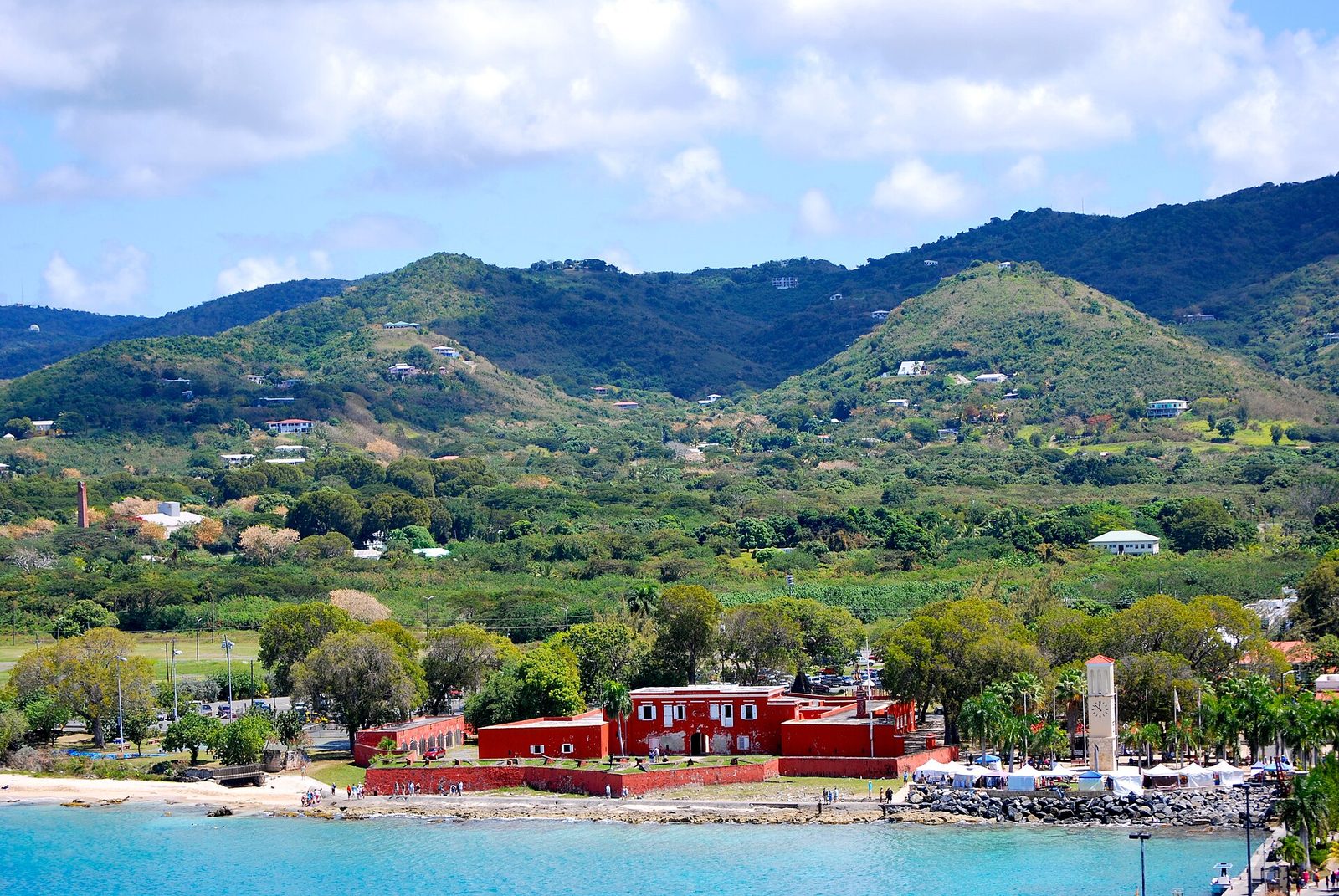
Start with scale, because it corrects the picture most first-timers carry over from Christiansted. Frederiksted is small. Fewer than a thousand people live in the town proper (528 at the 2020 census), and roughly ten thousand across the wider west end. The historic town is a Danish grid laid out in 1751, six or so blocks deep, sitting flat against a west-facing shore. You can walk from one end of it to the other in about ten minutes and see every building in this guide in an afternoon.
What it lacks in size it makes up in weight. Locals call it Freedom City, and not as a slogan: this is where Governor-General Peter von Scholten proclaimed the emancipation of the enslaved on July 3, 1848, from Fort Frederik, after a march led by the man remembered as General Buddhoe. It is also the town that burned in the labor revolt of October 1878, the Fireburn, and was rebuilt in the Victorian style you walk through now. And it is the island's cruise port: the 1,526-foot Ann E. Abramson pier is the only place cruise ships tie up on St. Croix, which gives the town two personalities depending on the day.
The third thing to know is the compass. St. Croix runs east to west, and Frederiksted sits at the western tip, so its waterfront looks straight into the sunset; The Cerulean, at the far East End, looks the other way, into the sunrise. That is why this guide ends with the sun going down over the pier and why we suggest arriving in the early afternoon: the town's best hour is its last one. It is also the island's gentlest sea, because the west coast is the lee side, sheltered from the trade winds, so the water off the town beach and the pier is usually flat and clear. Frederiksted is history first, but pack a mask.
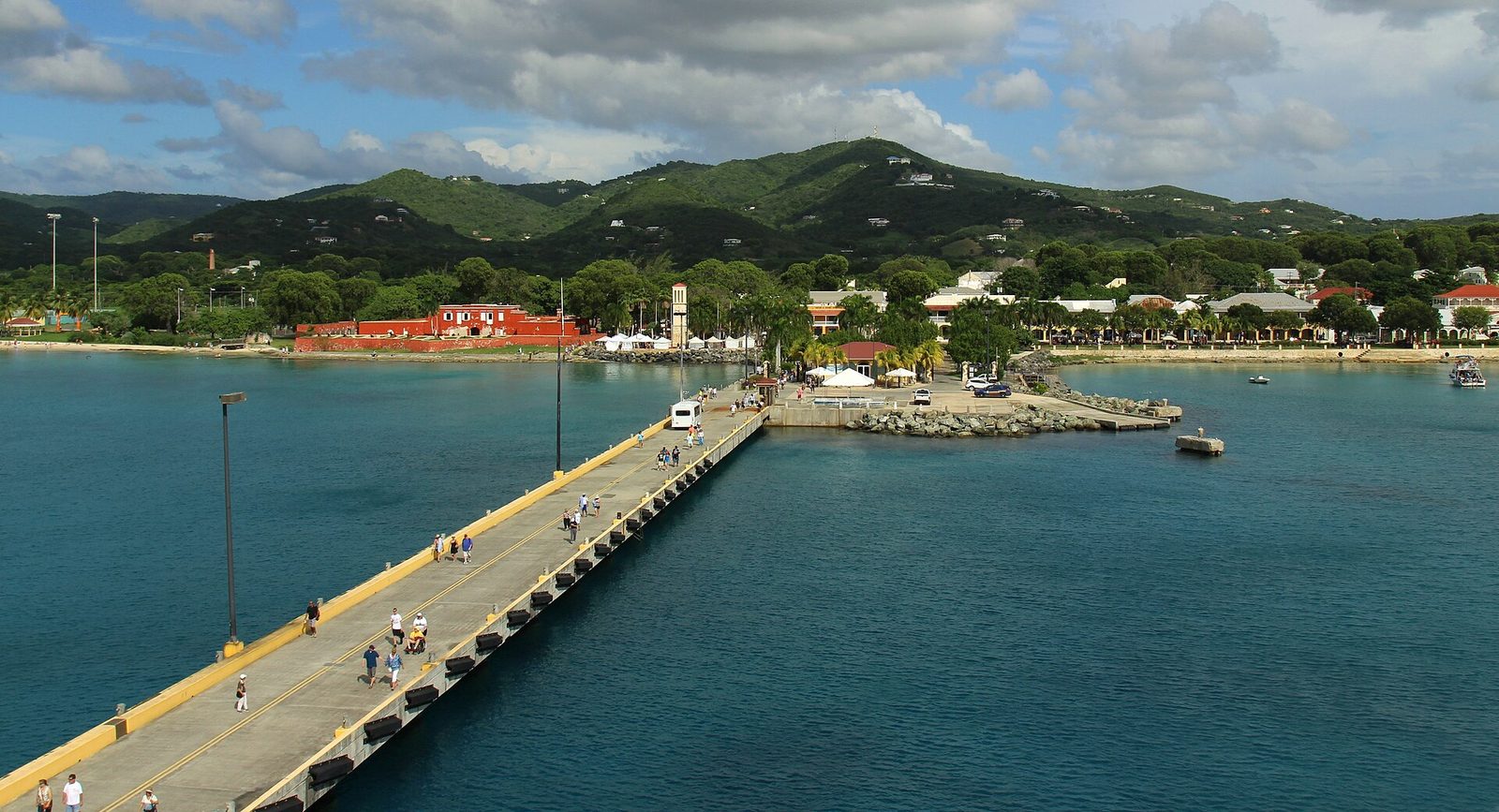
Frederiksted, St. Croix's west-end town: a Danish grid from 1751, rebuilt in Victorian style after the 1878 Fireburn, facing the island's calmest water.Photo: Mrgiarc (CC BY-SA 3.0)
A grid on the leeward coast, 1751 onward
Denmark bought St. Croix from France in 1733 and founded Christiansted first, on the north coast. Frederiksted came a generation later, laid out on a gridiron plan in 1751 and named for King Frederik V, in whose reign the Danish Crown took the islands over from the West India and Guinea Company. The site was chosen for the water: a deep natural roadstead on the sheltered coast, close to the western sugar estates that needed a port for their hogsheads of sugar and rum. The Frederiksted Historic District's National Register entry describes exactly that original town, and it notes that the first buildings burned in a fire in 1758, only a few years in.
The fort went up first, between 1752 and 1760, and the town filled in behind it in the plain Danish colonial manner: masonry ground floors, galleries and shutters, arcades along the commercial streets. The names of the streets are the Danish ones, translated. Strand Street runs along the shore; King Street, Queen Street and Prince Street run parallel behind it; the cross streets include Custom House Street, Market Street and Fisher Street. Christiansted uses the same vocabulary, and once you learn it in one town you can navigate the other.
Two disasters shaped what you see. On November 18, 1867, an earthquake and tsunami struck the Virgin Islands; a wave of about 7.6 meters at Frederiksted carried the U.S. Navy's USS Monongahela onto the shore and killed at least five people. Eleven years later, in October 1878, plantation workers set fire to much of the town during the labor revolt known as the Fireburn. What was rebuilt afterward is the Frederiksted of today: the National Register describes the district's styles as Late Victorian, Georgian and Gothic Revival, and the Victorian detailing is the reason the town looks different from Christiansted's stricter Danish streets.
The twentieth century was quieter and poorer. Sugar declined, the United States bought the islands in 1917, and the town's fortunes rose and fell with the pier, which the next sections cover. The historic district was listed on the National Register on August 9, 1976; the fort became a National Historic Landmark in 1997; the waterfront was revitalized in the early 2000s and the art museum moved onto Strand Street in 2003. That is roughly the Frederiksted you walk into now.
1751Frederiksted laid out on a grid by the Danes on the sheltered west coast
1752–1760Fort Frederik built to guard the roadstead
1758A fire destroys the town's first buildings
1776The fort's guns answer an American brigantine's salute (the disputed "first salute" claim)
July 3, 1848Von Scholten proclaims emancipation from Fort Frederik after the march
Nov 18, 1867Earthquake and tsunami
Oct 1878The Fireburn labor revolt burns much of the town
Aug 9, 1976Frederiksted Historic District listed on the National Register
1994The pier reopens as a cruise facility after Hurricane Hugo
1998Bright Bimpong's Buddhoe bust and Freedom statue mark 150 years of emancipation
Fort Frederik
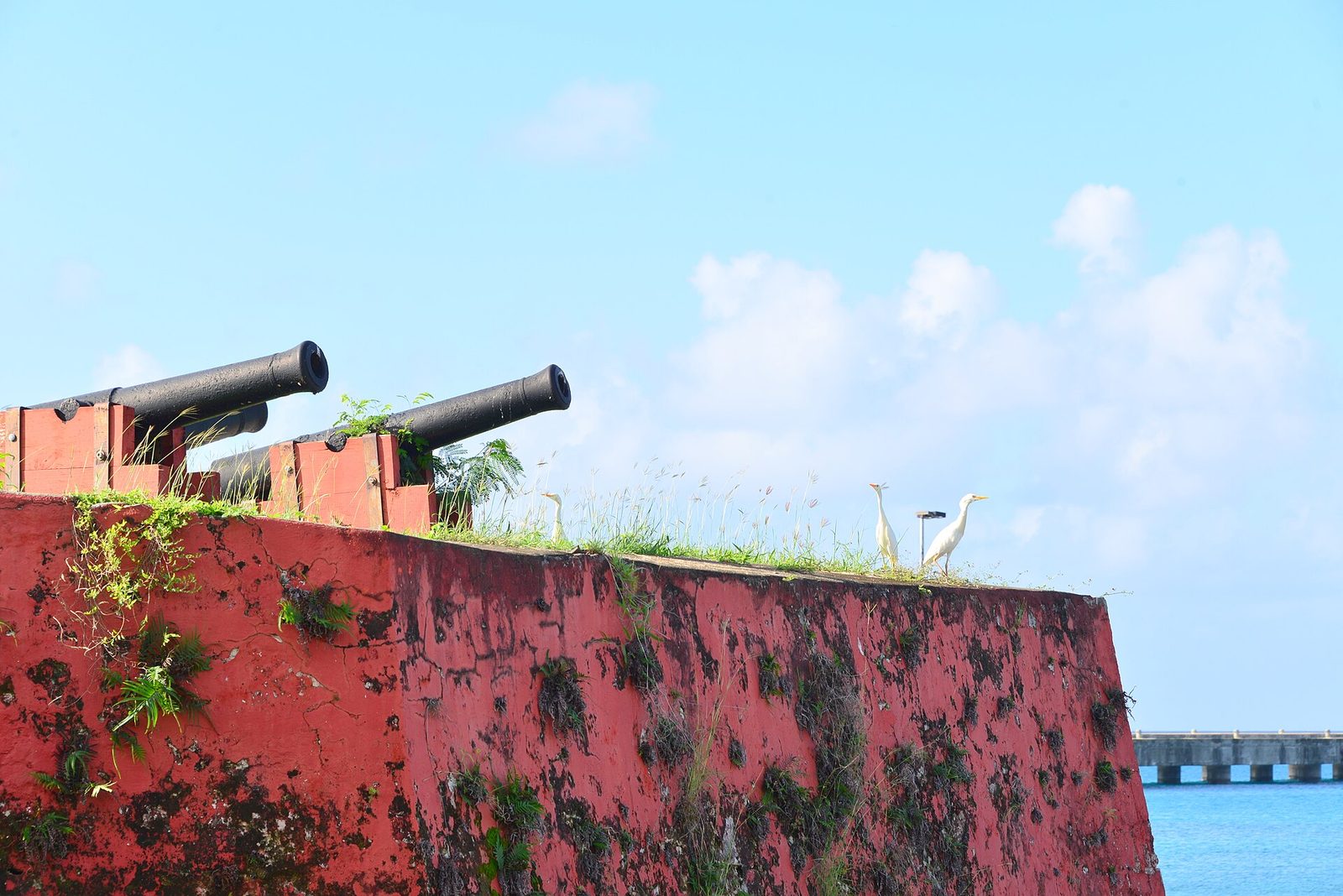
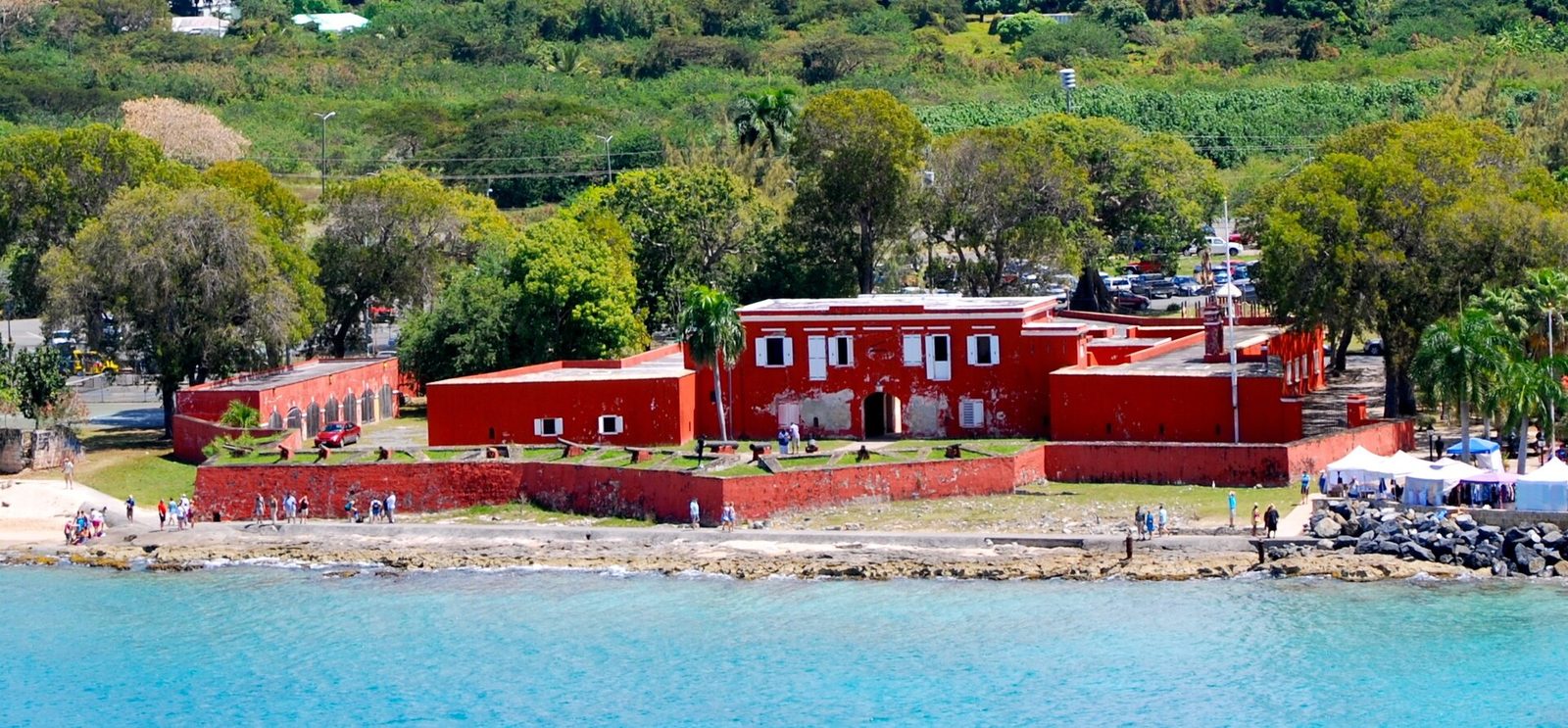
The fort is the reason the town exists and still the first thing you see from the pier. Fort Frederik was built by Denmark-Norway between 1752 and 1760 to guard the deep-water anchorage, ward off pirates, and defend the economic interests of the port. It is painted a deep red with white trim, the opposite of Fort Christiansvaern's yellow. It sits at the water's edge just north of the pier, with the town beach running away from it to the north, and it is a low, plain, business-like fort: courtyard, ramparts, cannon, a handful of rooms. You will be through the buildings in an hour.
The fort's most famous claim is the least certain, and it deserves an honest telling. The story, repeated in most guidebooks, is that in 1776 the fort's guns answered a salute from an American brigantine flying the new flag, making Fort Frederik the first foreign soil to salute the United States. The claim comes with caveats: the salute was fired to an American vessel in the roadstead, and it violated Denmark-Norway's neutrality, an act by a local commander rather than a policy of Copenhagen. The usual tellings do not name the ship or the day.
The salute with the paperwork, the one historians generally credit as the first official foreign salute, is the one Fort Oranje on Dutch St. Eustatius gave the Andrew Doria on November 16, 1776. Frederiksted's version may be earlier and is certainly local; it is a good story to hear on the rampart, told with the word "claim" attached.
What is not disputed is 1848. The proclamation of emancipation was read here on July 3, 1848, and that is the event the museum inside is built around; we have written the whole day in its own guide, July 3, 1848 at Fort Frederik, and we will not repeat it here beyond the next section. The fort went onto the National Register on October 8, 1996, and became a National Historic Landmark on September 25, 1997.
The museum today is run by the territory, and as of 2026 it lists hours of Monday to Friday 8:30 am to 4 pm and Saturday 1 pm to 4 pm, plus openings when a cruise ship is in port. Admission is quoted at $5 by one listing and $10 by another, with children free with a paying adult on the first, so budget ten. The rooms hold the emancipation exhibits, changing art shows (spring 2026 brought one called "Still We Rise: Art Behind the Walls"), and the fort's own story. Call 340-772-2021 the day before; St. Croix hours change without notice, and a Saturday-afternoon slot is the easiest to lose.
Fort Frederik, the red Danish fort on Frederiksted's waterfront, built 1752–1760 and the place emancipation was proclaimed on July 3, 1848.Photo: Андрей Бобровский (CC BY 3.0)
1752–1760Fort built
July 3, 1848Emancipation
About 8,000Marchers
1997Landmark since
Mon–Fri 8:30–4, Sat 1–4Museum hours
July 3, 1848, in one paragraph
You should know the outline before you walk the ramparts, so here it is, kept short because the emancipation guide tells it properly. Denmark had scheduled a gradual end to slavery that would have kept adults in bondage for years. On the morning of July 3, 1848, thousands of enslaved people from the western estates, organized around a craftsman named John Gottlieb, or Moses Gottlieb, and remembered as General Buddhoe, put down their tools and walked on Frederiksted. That year the island had about 17,000 enslaved people and 5,000 free Black residents; roughly 8,000 marched, surrounded the fort and demanded freedom now. Governor-General Peter von Scholten came from Christiansted and, from the fort, proclaimed all the unfree in the Danish West Indies free from that day.
Two details belong in this town guide because you can still stand in front of them. The first is the church bell: the parish history of St. Patrick's, a few blocks inland at Prince and Market Streets, records that its south-tower bell rang out for freedom that day, and that the founding pastor, Father Timothy O'Ryan, worked to secure emancipation and calm the crowd. The second is that the freedom proclaimed in 1848 was hedged in by contract-labor rules that helped bring on the Fireburn thirty years later; the town's Victorian streets are, in a real sense, the second act of the same story.
How to be a decent visitor to this: read the exhibits, take the ramparts slowly, and treat the waterfront as the ground where a people freed themselves. Emancipation Day, July 3, is a territorial holiday with commemorations at the fort and in town; if your dates land on it, go, and expect crowds. The rest of the year the place is quiet enough that you can hear the sea from the walls.
Buddhoe Park, the Freedom statue and the customs house
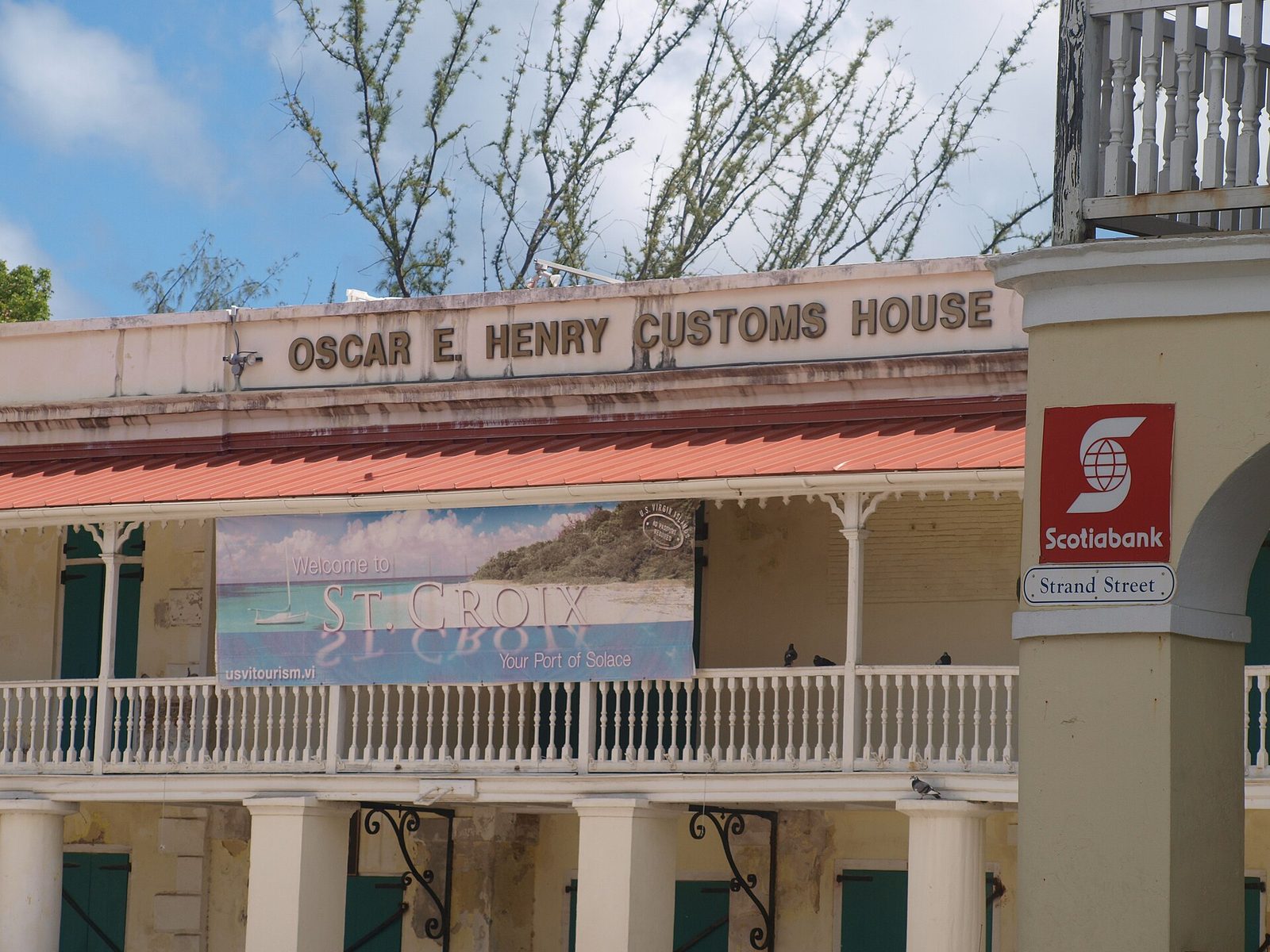
Walk out of the fort and you are in the small waterfront district that grew up around the pier. Buddhoe Park is the green with the bandstand at Custom House Street and Strand Street, right by the pier landing, and it holds the town's most-photographed sculpture: a bronze bust of General Buddhoe, made in 1998 by the Ghanaian-American sculptor Bright Bimpong for the 150th anniversary of emancipation. It stands in the Freedom Fountain, installed for the same anniversary in front of the customs house.
Bimpong made two other pieces that year, a bust of the labor leader D. Hamilton Jackson and a full statue called Freedom, a man blowing a conch shell with a cane knife raised in his other hand; the Freedom figure stands on the Frederiksted waterfront near the fort, and copies of all three were later given by the islands to museums in Denmark.
The conch is not decoration. The Danish museum that now holds a copy of the Freedom figure describes it as a man blowing a conch shell with his sugar knife raised, standing for the release of the enslaved and the struggle for freedom; the conch as the signal that called the estates out is part of the 1848 story you will hear at the fort. It is a portrait of the morning of July 3 without a single named face. Stand with it for a minute and then look at the fort walls, which is where the crowd was looking.
The Oscar E. Henry Customs House is the two-story building with the long upper gallery facing the park. It is an eighteenth-century Danish customs house, the marker says, with the second-story gallery added in the nineteenth century, and it is named for a Crucian who spent 24 years with the U.S. Customs Service. A historical marker was placed in 2006 by the St. Croix Historic Preservation Commission. In recent years the building has housed the visitors' bureau, and the pier's own visitor center, the Claire L. Roker Visitors Center, is at the pier facility next door; if either is open, they are the right place to ask what is happening in town that day, and to pick up a printed map.
South along Strand Street is Verne I. Richards Veterans Memorial Park at 12 Strand Street, the waterfront green where the monthly Rhythms at Sunset concert sets up. The parks together are the town's front porch, and on a no-ship afternoon they belong to pelicans, a few fishermen and whoever is waiting for the sun.
The pier and the ships
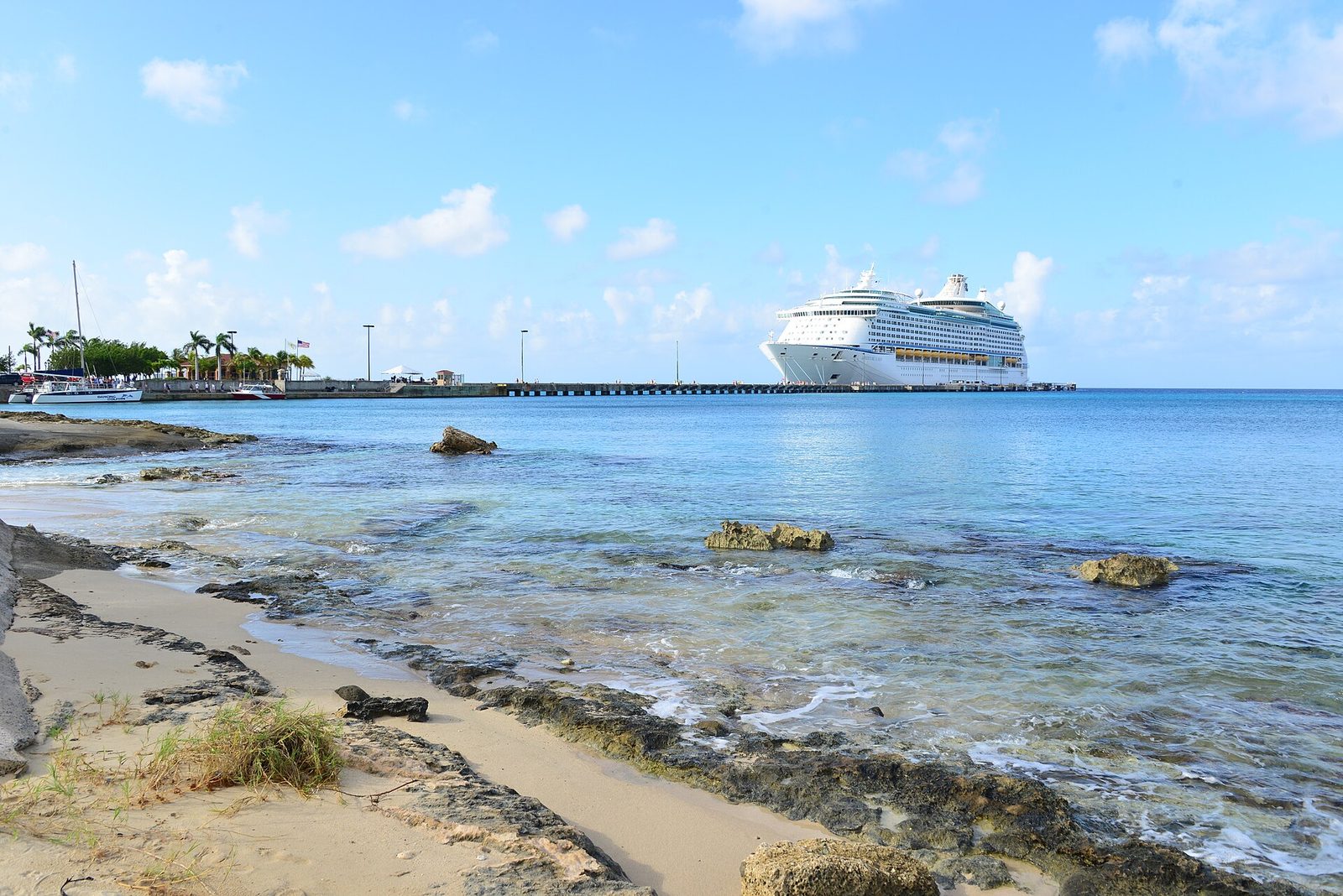
The pier is the town's landmark and its economy. Officially it is the Ann E. Abramson Marine Facility, 1,526 feet long according to the Virgin Islands Port Authority, with 29 feet of water on the north side and 36 on the south, enough for Voyager-class ships on the south berth and smaller ships on the north. It is named for a former Public Works commissioner and Port Authority board member credited with much of the rejuvenation of the Frederiksted waterfront.
The Port Authority's own history is worth knowing when you walk out on it: the original pier dates to the early 1900s; Hugo wrecked it in 1989; it reopened for cruise ships in 1994; Marilyn hit in 1995; and most of the old pier was taken apart and used to build the one under your feet.
For most visitors the pier is a walk, generally open to walkers and fishermen when no ship is in, and the end of it is one of the island's best places to stand at sunset. For divers and snorkelers it is a great deal more: the pilings have grown a vertical reef of sponges and corals that shelters seahorses, frogfish and octopus, and the pier is regularly ranked among the Caribbean's best macro and night dives. Snorkelers can work the pilings from the shore on calm days for free. All of that is in our Frederiksted Pier guide, with the shops that run it.
What the pier does to the town is the thing to plan around. St. Croix gets far fewer cruise calls than St. Thomas, and Frederiksted usually hosts one ship at a time, but when a ship is in, everything changes for about six hours: taxis line Strand Street, vendors set up by the park, the fort opens for the passengers, Fort Frederik Beach and Rainbow Beach fill with day-trippers, and the restaurants run at full tilt from late morning to mid-afternoon. Then the passengers walk back down the pier and the town exhales. Both versions are worth seeing; they are simply different towns.
The ship days are public: schedule sites for the U.S. Virgin Islands list Frederiksted's calls by date, and a white wall of ship at the end of Strand Street settles it from the road. For the busy, festive version, arrive around noon on a ship day and eat late. For the quiet one, pick a day with no ship, or come after 3 pm on any day and stay for the sunset, which is our standing recommendation for guests coming from the East End.
The Frederiksted pier, officially the Ann E. Abramson Marine Facility: 1,526 feet long, the island's only cruise berth, and a famous dive under the pilings.Photo: Андрей Бобровский (CC BY 3.0)
The Cerulean
Plan it from the villa.
Five bedrooms, a private swimmable beach, and all of this within a day trip.
The historic district: Victorian streets after the Fireburn
The Frederiksted Historic District is the whole old town, roughly bounded, in the National Register's words, by Fisher Street, the cemetery and Fort Frederik. It was listed on August 9, 1976, and its architecture is classed as Late Victorian, Georgian and Gothic Revival. That mix is the town's signature. Christiansted is a Danish town that survived; Frederiksted is a Danish grid that burned in 1878 and was rebuilt by people who had seen the fashions of the late nineteenth century. So the ground floors are often the old Danish masonry, and the upper floors and galleries are Victorian: turned posts, fretwork, deep verandas over the sidewalk, tall shuttered doors, the occasional gable with gingerbread trim.
The way to see it is slowly, on foot, looking up. Strand Street, the waterfront, has the largest buildings and the best-kept ones, some now restaurants and galleries and shops, some empty. King Street, one block in, is the old commercial spine, and Queen Street and Prince Street behind it were more residential; the further from the water you walk, the more the town becomes a neighborhood of small houses, churches and yards. Look for the arcaded sidewalks, where the upper floor rests on masonry arches over the walkway, and for hurricane shutters folded back against the walls.
Some buildings you can put a name to. Victoria House, on the waterfront, is late-eighteenth-century and is used for events, so you may see it open. The customs house and the fort we have covered. St. Patrick's Church, below, is the district's Gothic Revival anchor. The town's public library and its other churches are on the walk too, but we have not verified their opening hours, so treat them as facades unless a door is open.
An honest note. Frederiksted has been through Hugo (1989), Marilyn (1995) and Maria (2017), and it shows: some Victorian fronts are beautifully restored and some are roofless behind their arches, and the town is quieter and poorer than the cruise brochures suggest. Walk it as you would any small working town, friendly and unhurried, and do not skip it for that reason; the bones of a Danish-Victorian port town are all here, on flat streets, and there is nowhere else on St. Croix quite like it.
Three blocks inland from the pier, at Prince Street and Market Street, St. Patrick's is the building that tells you the town's other history. The Catholic mission on St. Croix began in 1752, according to the parish's own history, when the planter Nicholas Tuite petitioned Rome for missionaries, and a Danish royal decree of 1754 granted religious freedom to Catholics on the islands. St. Patrick's cornerstone was laid in 1844; the church was consecrated on June 15, 1846, by Bishop Richard Smith of Port of Spain; and it was built, in the parish's words, principally by the parishioners under Father Timothy O'Ryan, out of coral stone that a 1972 restoration exposed again.
It is Gothic Revival, which is unusual on an island of plain Lutheran and Anglican masonry, with a south tower that holds the bell, and it has been patched by every generation since: a renovation after a fire in 1937, the major 1972 restoration rededicated on March 12 of that year, a new roof after Hurricane Hugo in 1989. The graves in the churchyard go back to the eighteenth century. The parish's history says the church may be toured every day; in practice, be respectful of Mass times and funerals, dress as you would for any church, and step out if a service begins.
The reason to make the walk, though, is the bell. On July 3, 1848, when von Scholten proclaimed freedom from the fort, the bell in St. Patrick's south tower rang out for freedom, and Father O'Ryan, the priest who had built the church with his parishioners, worked to secure the emancipation and calm the crowd. It is one of the few places in town where a specific object from that day still does its job. From the church, King Street brings you back to the waterfront in five minutes; if you only have time for one thing beyond the fort, make it this.
The Caribbean Museum Center for the Arts
CMCArts is the best free hour on the west end. The Caribbean Museum Center for the Arts is at 10 Strand Street, in a historic waterfront building it has occupied since 2003, and it is open Tuesday through Saturday, 9 am to 4 pm, with free admission, as of 2026. It has been going about thirty years, runs an artist-in-residence program and classes for all ages, hosts school field trips, and says it reaches more than 40,000 visitors a year across its two sites, the second being on Dronningens Gade in Charlotte Amalie, St. Thomas.
The exhibitions rotate every couple of months, so what you see depends on when you come; in August 2026 the St. Croix galleries were showing "Our Soil, Beyond Materiality," a project with the Soil Museum of the Caribbean, and the calendar runs to opening receptions, lectures and concerts. The galleries are seaside and open-air, and the historic building is part of the visit. Expect Caribbean and Crucian artists you have not heard of and will remember.
Two practical points. It is closed Sunday and Monday, which is a real trap if you planned the west end for a Sunday; the fort is closed Sunday too, so a Sunday Frederiksted is beach, bars and sunset, which is fine, but not this. And its hours end at 4 pm, before the sunset crowd arrives, so put it in the middle of your afternoon between the fort and the beach. Check cmcarts.org for the current show; the site is kept up. If you have artists or teenagers in the group, ask about the classes and residencies. For everyone else it is thirty to sixty minutes, free, and a reason to be on Strand Street at 2 pm.
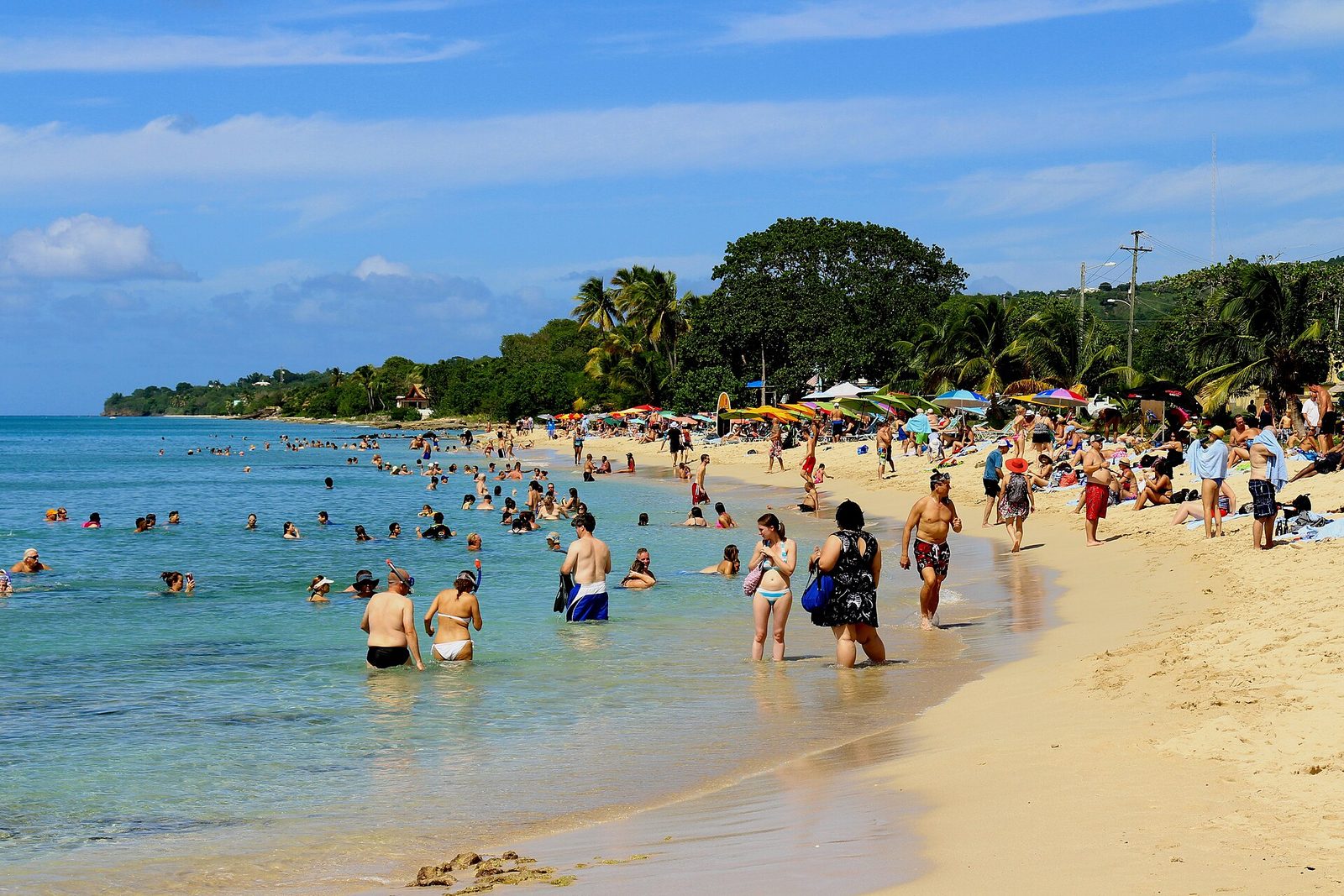
The town has its own beach, and it is better than a town beach has any right to be. Frederiksted Beach, which locals also call Fort Frederik Beach because it starts at the fort's north wall, runs north from the fort along the shore: soft sand, calm water over a sandy bottom, a few trees, and the pier and the fort as its backdrop. It is the most easily accessible beach from the cruise-ship pier, which is why it fills on ship days. On any other afternoon it is a local beach with a swimmer or two and someone walking a dog.
Three things it does well. It swims: the west coast is the sheltered side, so the water is usually flat, and children can wade a long way out. It gives up sea glass: the sand by the fort has been a sea-glass beach for years, and a slow walk at the waterline with your eyes down is a genuine Frederiksted ritual. And it faces the sunset squarely, so a towel here at 6 pm is as good a seat as any bar in town, and free.
The waterfront walk is the beach's inland twin. From the fort south past Buddhoe Park and the pier, Strand Street runs along the water with the parks, benches and, further south, The Fred and its neighbors on the sand. Keep going and Strand becomes Veterans Shore Drive, which runs south past the fish market to Dorsch Beach and Sand Castle on the Beach, ten minutes by car; go north on the coast road instead and Rainbow Beach is a mile or so up. Both are in our west end beaches guide.
Facilities are thin: the Port Authority lists public restrooms near the pier entrance, and the beach bars will let paying customers use theirs, but do not count on lifeguards or rentals on the town beach itself. Bring your own shade, water and mask. On a ship day the beach fills by 11 am; on any day it empties by 4 pm and refills at 6 for the sun. Time it accordingly.
Where to eat and drink, verified for 2026
Frederiksted's dining scene is small and honest, and it changes, so this list is what we could confirm as open in summer 2026, with hours as listed then; call before you drive an hour for dinner. Polly's at the Pier, at 3 Strand Street, is the town's living room: coffee, breakfast and lunch, listed as roughly 7 am to 3 pm on weekdays, 8 to 3 Saturday and a Sunday brunch to about 1 pm. Turtle's Deli, on Strand Street toward the south end, makes the oversized sandwiches the island has been eating for years; listed hours are 11 am to 4 pm Monday to Thursday and to 6 pm Friday through Sunday, and it is the right lunch to carry to the beach.
Louie & Nacho's Beach Bar, at 38 Strand Street, next door to The Fred and upstairs from Turtle's, is the reliable dinner: tacos, burgers, salads, vegan options and crushed-ice cocktails from an open-air upstairs bar with a straight view of the pier, listed as daily 11 am to 8 pm as of 2026. It opened in December 2017 and has become the default answer to "where do we eat in Frederiksted."
The Fred, at 605 Strand Street, is the adults-only beachfront hotel next door, named for King Frederik V; its poolside grill and bar serve non-guests, day passes are sold through a resort-pass service, and it is a fixture of the sunset hour. Adults only means it: 21 to book, 18 to accompany a guest.
North of town, Rhythms at Rainbow Beach is the beach bar of the west end, on the sand about a mile north of the pier on the coast road, open every day 11 am to 7 pm, with a live-music calendar and a request that parties of eight or more call ahead, which a villa of twelve is. South of town, Beach Side Cafe at Sand Castle on the Beach serves lunch on weekdays, dinner nightly and weekend brunch on an oceanfront terrace, with live music on Saturday evenings; it is the quiet dinner with the sunset in front of it. Our restaurant directory keeps the whole island's verified names in one place.
Now the closures, because old guidebooks will send you to them. Blue Moon, the Cajun-Caribbean dinner-and-jazz restaurant at 7 Strand Street, is closed as of June 2026, and other listings say another restaurant has taken the address. Villa Morales, the Puerto Rican and Crucian landmark, closed in 2019, though the family has cooked pop-up nights at Sand Castle. If a name is not in the table below and you cannot reach it by phone, assume it is gone until proven otherwise.
Place
Where
What it is
Hours as of 2026
Polly's at the Pier
3 Strand St, by the pier
Coffee, breakfast, lunch
About 7 am–3 pm weekdays, 8–3 Sat, brunch Sun to 1
Turtle's Deli
Strand St, south end
Big sandwiches, take-out or picnic tables
11–4 Mon–Thu, 11–6 Fri–Sun
Louie and Nacho's
38 Strand St, next to The Fred
Tacos, burgers, cocktails, pier view
Daily 11 am–8 pm
The Fred
605 Strand St
Adults-only hotel bar, pool, day passes
Poolside grill by day, confirm hours
Rhythms at Rainbow Beach
Rainbow Beach, about 1 mile north
Beach bar and grill, live music
Daily 11 am–7 pm
Beach Side Cafe
Sand Castle on the Beach, south of town
Oceanfront terrace, weekend brunch
Lunch weekdays, dinner nightly
Blue Moon
7 Strand St
Closed as of 2026
Do not plan on it
Third Fridays: Sunset Jazz and Rhythms at Sunset
Frederiksted's signature evening is the third Friday of the month, and it has two names depending on who is telling you and which year they last came. The long-running one is Sunset Jazz, a free family-and-pets waterfront concert sponsored by the Frederiksted Economic Development Association at the Buddhoe Park pavilion just north of the pier, 6 to 9 pm on the third Friday, with local, Caribbean and visiting jazz musicians, and generations of visitors have timed a west-end evening around it.
The one with published dates as of 2026 is Rhythms at Sunset, a monthly gathering run by Our Town Frederiksted, Inc. at Verne I. Richards Veterans Memorial Park, 12 Strand Street, on the waterfront: every third Friday during the season, 6 to 9 pm, free entry, with food, drinks and local vendors for sale and local performers on stage. The published schedule runs October 16, November 20 and December 18, 2026, then January 15, February 19, March 19, April 16 and May 21, 2027, which tracks the high season and skips the summer.
What to do with that: if your dates include a third Friday between October and May, plan Frederiksted for that afternoon. Arrive by 3, do the fort and a swim, eat early or graze the vendors, and let the concert carry you past sunset. Check a local events calendar for that specific month before you go, because sponsors and parks have shifted over the years and any given Friday can be rained out or moved. And bring cash for the vendors, a folding chair if you own one, and patience for the drive home in the dark.
A walking route with real street names
The town is a grid you cannot get lost in, so what follows is just the order to walk it in. Park near the waterfront; on a no-ship day there is street parking along Strand Street and around the parks, and on a ship day you park a block or two inland on King Street or Queen Street and walk. Everything below is flat and within about a mile and a half of loop, and the whole thing takes two to three hours with the fort and the museum, or forty-five minutes if you only walk it.
Begin at the pier landing. Buddhoe Park, the bandstand and the customs house are right there at Custom House Street and Strand Street; find the Buddhoe bust in its fountain, then the Freedom figure with the conch, and read the marker on the customs house. Walk the few steps north to Fort Frederik and give it its hour. Come out the way you went in and keep going north along the shore onto Frederiksted Beach for the sea glass and, if you brought a mask, a swim, then come back through the park.
Now walk south on Strand Street with the water on your right. This is the historic waterfront: the museum at 10 Strand, Polly's by the pier, Victoria House, the galleries and shops in the arcaded buildings, Veterans Memorial Park, and further along The Fred and Louie & Nacho's, which is where you will end up. Turn inland on Market Street and walk three blocks up, crossing King Street and Queen Street, to St. Patrick's at Prince Street, near the inland edge of the old town. Come back toward the water on King Street, one block behind Strand, which was the commercial spine and has the best Victorian upper floors.
The order matters more than the streets: fort and museum before 4 pm, because they close; beach and bar after 4, because the heat drops and the light comes around; the pier last, because it points at the sunset. If a ship is in, run it backwards, inland streets and beach while the passengers are on Strand, then Strand Street after 3 when they leave.
Frederiksted on foot in an afternoon
Park by the waterfront and start at the pier landing: Buddhoe Park, the bust, the Freedom figure, the customs house marker.
Fort Frederik next door: an hour for the museum and the ramparts, and confirm the hours before you leave the villa.
North along the shore onto Frederiksted Beach for sea glass and a swim while the sun is still high.
South on Strand Street: CMCArts at number 10, Polly's, Victoria House and the arcades, closed by 4 pm at the museum.
Inland on Market Street to St. Patrick's at Prince Street, then back toward the water on King Street.
Dinner at Louie and Nacho's, The Fred, or Rhythms a mile north, then sunset from the pier, the beach or the bar, then the drive home east.
Sunset on the west end
St. Croix is a long island lying east to west, and the geometry decides where you watch the day end. From the East End, and from The Cerulean's veranda, the sun comes up out of the sea and goes down behind the island's spine. Frederiksted is the one town where it goes down into the water, and that is the simplest reason to be here at the end of the day rather than the start. Sunset is around 6:45 pm in mid-August and before 6 pm in December; look up the day's time before you leave the villa and be in place twenty minutes early.
The seats, in order of our preference: the end of the pier on a no-ship evening; the sand by the fort, free, with a towel; the upstairs bar at Louie & Nacho's, which looks straight down the pier; The Fred's pool bar next door, if you are all adults; Rhythms at Rainbow Beach a mile north, the social choice, which closes at 7; and the Beach Side Cafe terrace at Sand Castle south of town, the quiet dinner with the sun in front of it. On a clear evening the light is amber, then pink, then gray, and it is over in about half an hour.
The trade for the sunset is the drive home: about 50 minutes back to the East End on roads with few streetlights, driving on the left, with the usual island hazards of potholes, unlit pedestrians and the occasional cow. Whoever is driving stays sober. Leave within half an hour of sunset, take Centerline Road or the Melvin Evans Highway rather than the north-shore roads in the dark, and you are back at the villa by nine with the evening still ahead of you. One more honest note: the sunset is a real reason to come, but come for the town and stay for the sun, not the other way round.
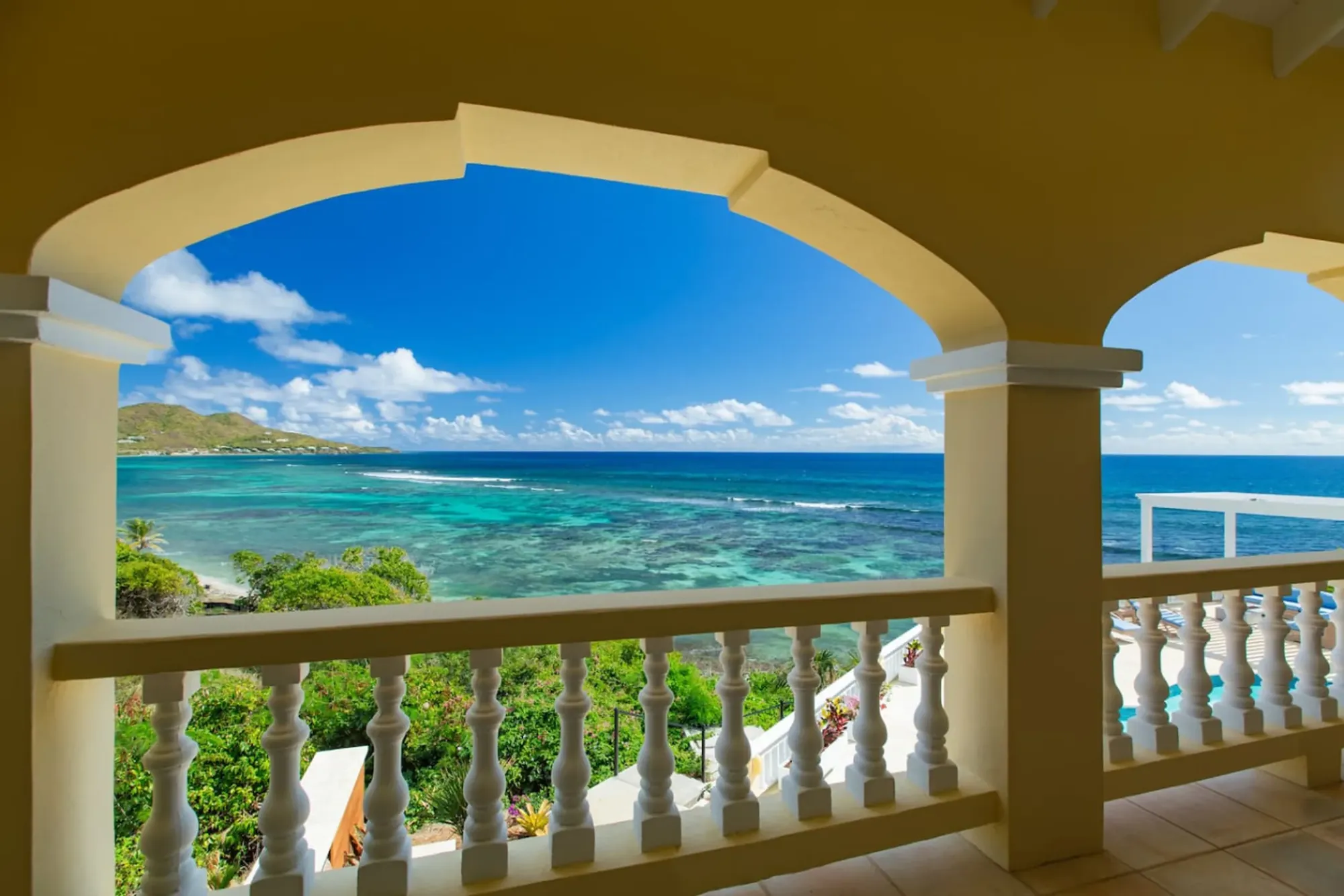
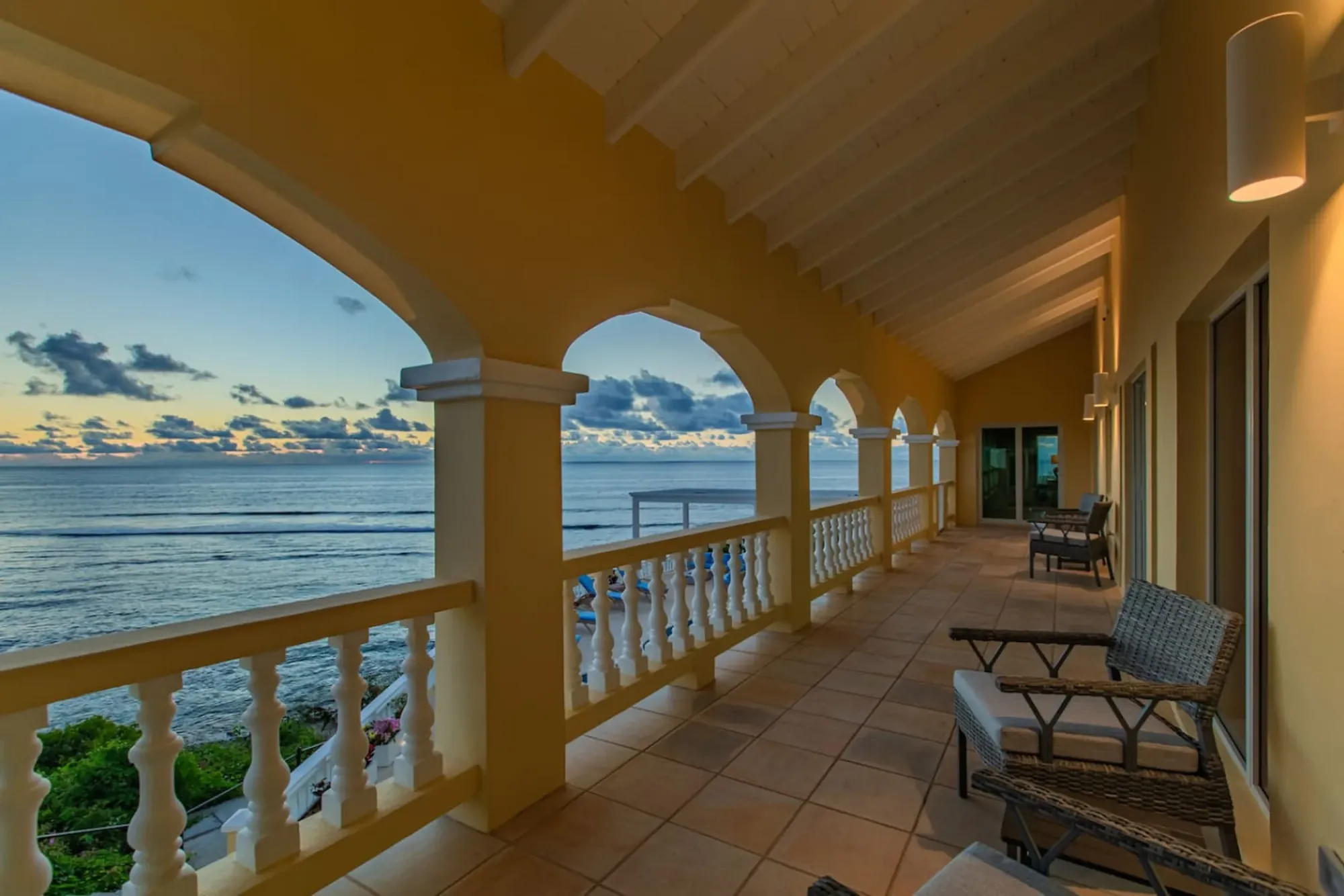
The Cerulean's veranda faces east: sunrise over the sea at the villa, sunset over the sea in Frederiksted, and the whole island between them.Photo: The Cerulean
Frederiksted with kids and with a group of twelve
With children this is one of the easier town days on the island, because it comes with a beach attached. The fort is small enough that a seven-year-old will not revolt, there are cannon and ramparts to climb, and the story of the march is one children understand; the museum listing that puts children under 16 free with a paid adult helps too. Buddhoe Park has a bandstand and open grass, the town beach has calm water over sand, and the sea glass hunt occupies any age. Feed them at Turtle's Deli or Louie & Nacho's, both of which are casual and quick, and skip The Fred, which is adults only.
What to watch: the sun, which is fierce on flat streets between 11 and 3; the traffic on Strand Street on ship days, when taxis and safari buses come and go from the pier; and the pier itself, which is a working dock rather than a boardwalk and is a place to hold hands. If your children snorkel, the pier's pilings are a real treat on a calm day, but only from the shore side, with an adult in the water, and not on a ship day. Our St. Croix with kids guide has the island-wide version.
With a full villa of twelve, the west end works best as a caravan with a plan: two cars, because someone will want the museum while someone else wants the beach, and a booked dinner, because Rhythms asks parties of eight or more to call ahead and the smaller places will be happier to hear from you in the morning than to see twelve of you at 6:30. If part of the group is adults-only, The Fred's bar and day passes are their afternoon; the rest go to Rainbow or the town beach.
The villa's kitchen is the other lever. Frederiksted's dining closes early by mainland standards, so a group that wants a long, late meal should eat lunch on the west end, watch the sunset, and drive home to a dinner waiting in the chef's kitchen; our private chefs directory covers how to set that up.
Mistakes to avoid
Coming on a Sunday or a Monday for the museums. CMCArts is closed both days and the fort is closed Sunday, so a Sunday Frederiksted is beach and bars only; if the fort and the art are your reason, come Tuesday through Saturday and before 4 pm. Coming at 10 am from the East End on a ship day: you arrive with the passengers, share the fort with a tour group, and leave before the town gets good again. Reverse it. Planning dinner from an old blog post: Blue Moon and Villa Morales are closed, and other names come and go; check the table above and call.
Underestimating the drive. Fifty minutes is real, and it stretches with traffic through Christiansted and with the slower Centerline Road; leave the villa by 2 pm for a proper afternoon. Forgetting the museum hours end at 4 and the fort's Saturday hours are 1 to 4 only, which is a narrow door. Expecting to stroll or snorkel the pier when a ship is in: on ship days it is a working cruise berth, and the dive shops schedule around the ships. Expecting Christiansted: Frederiksted has fewer restaurants, fewer shops and quieter streets, and that is the point of it, not a flaw.
Wearing the wrong shoes: the sidewalks are old and the beach is next to the fort, so sandals you can swim in beat anything else. Missing St. Patrick's because it is three blocks from the water: it is the best building in town after the fort. Treating the town's poverty as scenery: it is a working town of a few hundred people, so be a guest. And leaving before the light comes around: if you have driven an hour, you have earned the sunset.
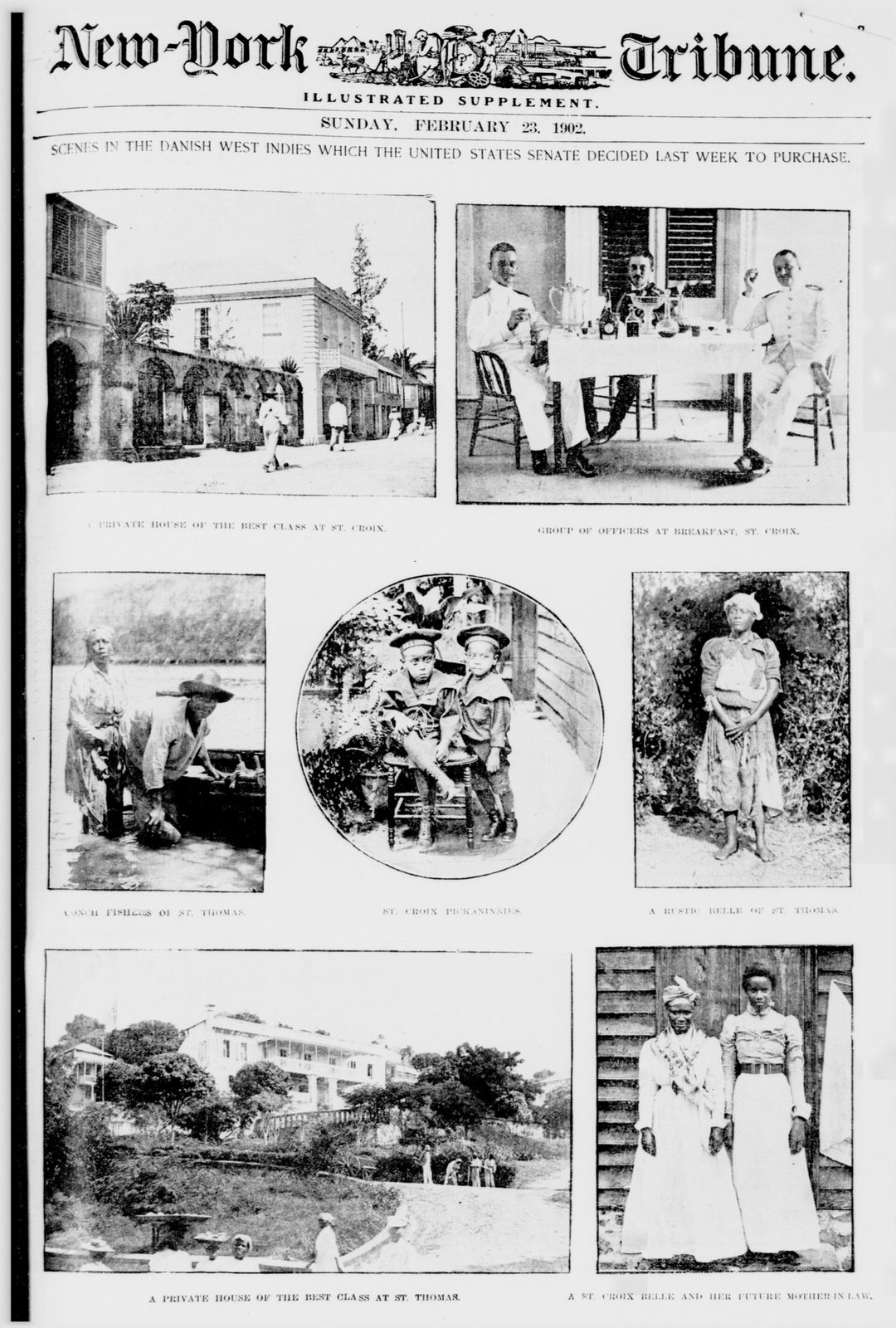
St. Croix photographed for the U.S. Farm Security Administration in 1941, a generation after the islands became American.Photo: Jack Delano (Public domain)
Nearby pairings
Frederiksted is the hub of the west end, and the best day out here pairs the town with one or two of the places around it. The closest is Estate Whim, the St. Croix Landmarks Society's sugar-plantation museum on Centerline Road a few minutes east of town, with its restored great house and mill complex; it is the economy 1848 ended, preserved and explained, and it belongs on the same afternoon as the fort. The Cruzan Rum distillery at Estate Diamond, also on the way in, runs weekday tours with tastings by reservation, and the St. George Village Botanical Garden sits among plantation ruins nearby; both are morning stops if you leave the villa early.
The beaches are the other pairing, and the west end beaches guide covers Rainbow, Dorsch, Sprat Hall and Butler Bay, all within about four miles of the pier. On a weekend from September through March, Sandy Point, the two-mile refuge beach at the island's southwest tip, is open 10 to 4 and is fifteen minutes from town; it is closed April through August for turtle nesting and closed weekdays year-round, so check before you plan around it. Divers and snorkelers pair the town with the pier, and the west-end dive shops are in the pier guide.
North of Frederiksted the coast road runs past Rainbow and Sprat Hall toward Ham's Bay, and the Ham's Bluff lighthouse walk and the Mahogany Road rainforest, with the Domino Club and its beer-drinking pigs, are each about fifteen to twenty minutes from town; either makes a good morning before a Frederiksted afternoon. The one pairing we would not force is Frederiksted and Christiansted on the same day: they are an hour apart and each is an afternoon. Do Christiansted from the villa on a morning, since it is fifteen minutes away, and give Frederiksted its own afternoon and evening later in the week.
Doing it from The Cerulean
From the villa the drive is about 50 minutes: west along the East End road, around or through Christiansted, then across the island on Centerline Road (Route 70) through the middle, or the Melvin H. Evans Highway (Route 66) along the south past the airport, both of which end near Frederiksted. Centerline is slower and passes Estate Whim and the rum distillery; the highway is quicker. You drive on the left, and if you have not done it before, our driving guide is worth ten minutes the night before. Leave the East End by 2 pm on a museum day, or by 3 if you are only coming for the beach and the sunset.
The plan we give guests: lunch at the villa or a picnic from Turtle's Deli, the fort and Buddhoe Park at 3, the museum at 4 if you made it, the beach and the sea glass at 4:30, dinner at Louie & Nacho's or Rhythms around 6, sunset from the pier or the sand, home by 9 with the pool deck and the fire pit for the end of the evening. Guests who want the fort's exhibits at length should go earlier and eat lunch on Strand Street. Guests with children should think beach first, fort second, and skip nothing else.
The concierge can help with the parts that need a phone call: a table for twelve at Rhythms, a private chef waiting at the villa when you get back, a car for a group that does not want to drive home in the dark, or a guided pier snorkel or dive with one of the west-end shops timed to your afternoon. Ask a day ahead, especially in the winter season and on third Fridays.
The rest of the island's history is on the way: Christiansted's fort and waterfront as you pass, the north coast where Columbus's fleet anchored at Salt River in 1493, and Frederiksted, where the whole colonial story turned in 1848. A week at The Cerulean can hold all of it, with the sunrise from the veranda every morning and one evening, this one, spent watching the sun go the other way.
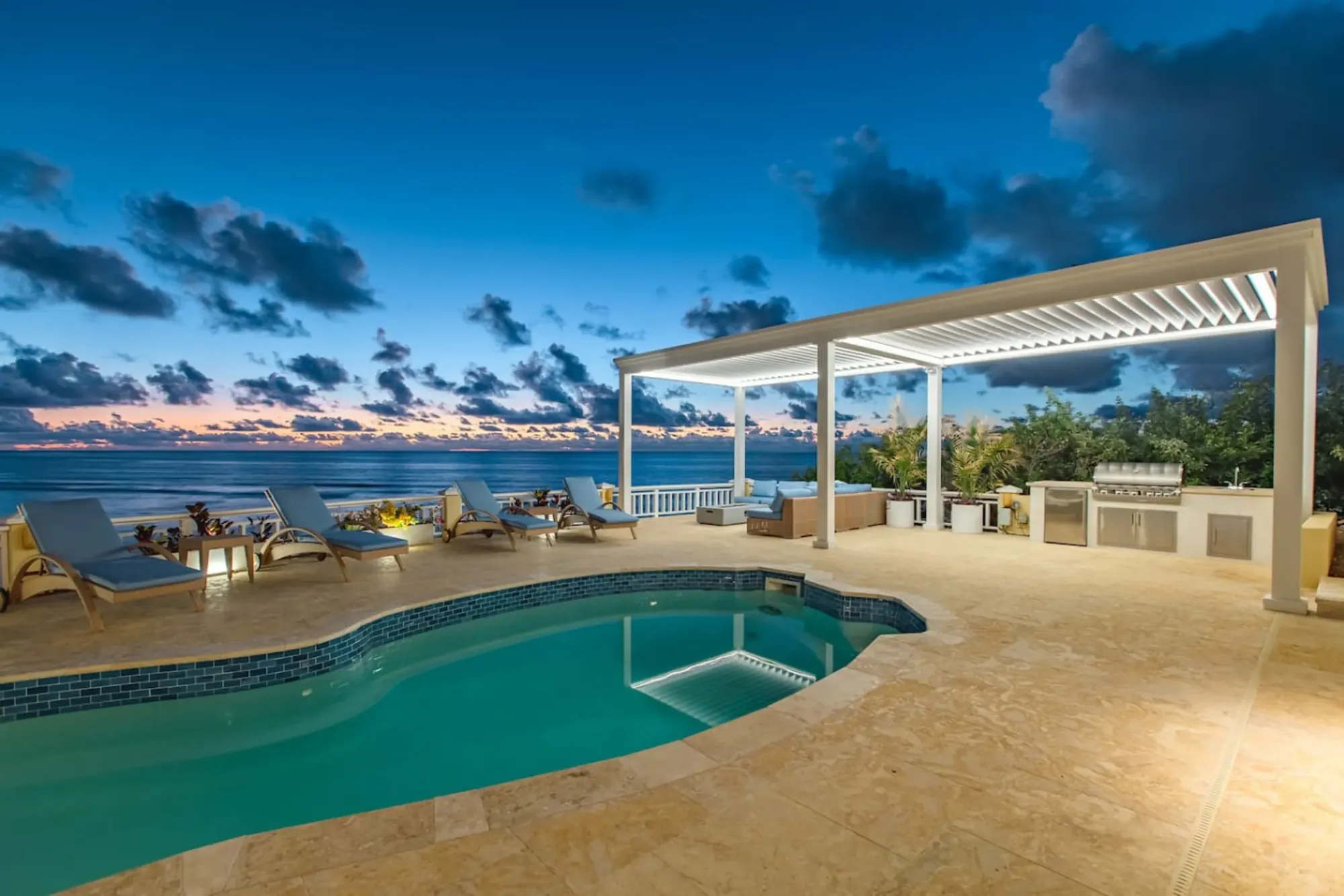
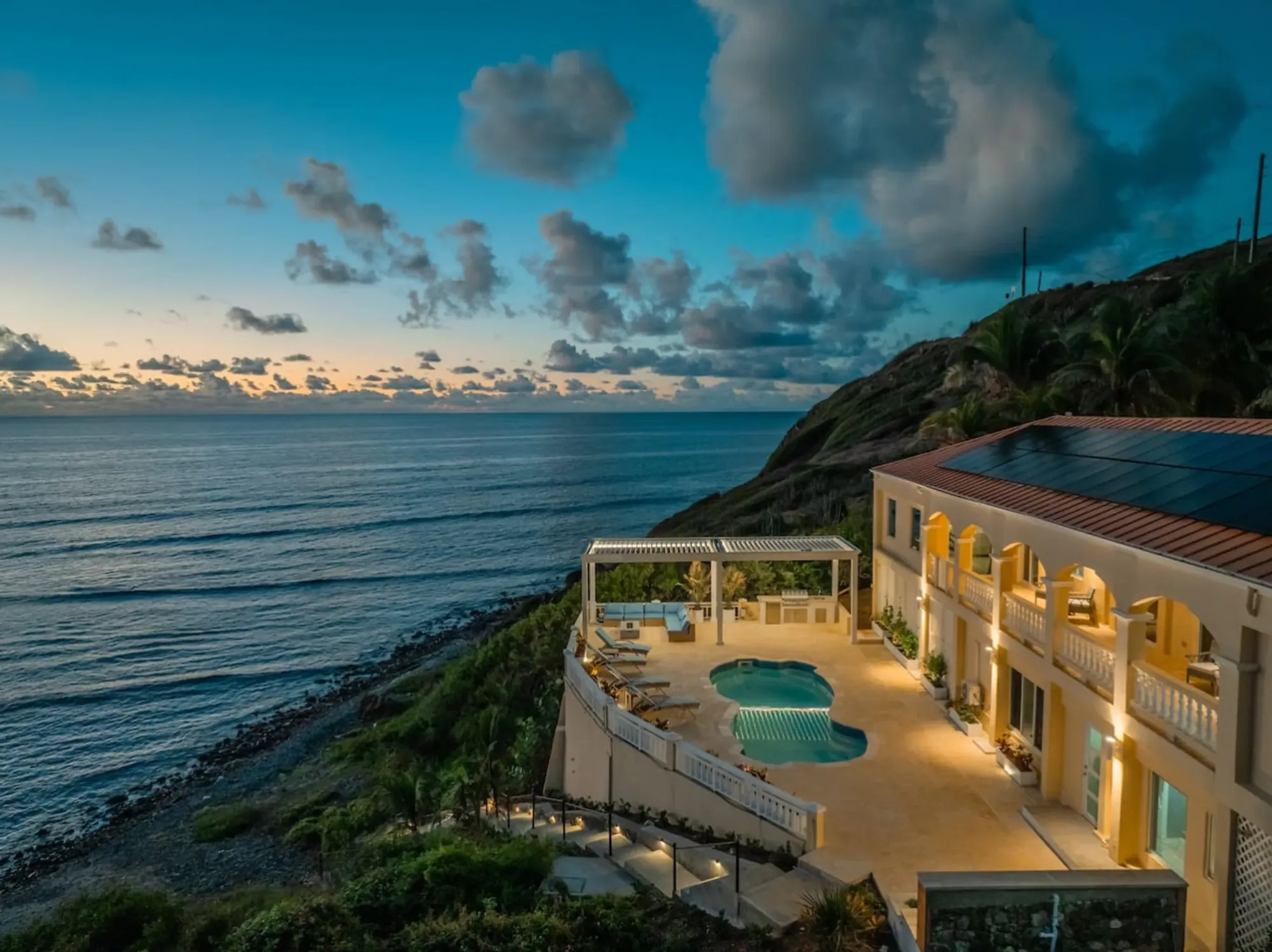
Back at The Cerulean, the pool deck sits above the sea on the East End, about 50 minutes from Frederiksted's waterfront and facing the opposite horizon.Photo: The Cerulean
The Cerulean
Twelve of you, one private beach.
The Cerulean sleeps twelve on St. Croix's quiet East End — check your dates.
Is Frederiksted worth visiting if I am staying on the East End?
Yes, once, and ideally as an afternoon-into-sunset trip. The drive is about 50 minutes each way, so a quick stop is not worth it, but a half day is: the fort and Buddhoe Park, a walk through the Victorian streets, the free art museum, a swim off the town beach, dinner on Strand Street or at Rainbow Beach, and the only sunset on St. Croix that goes down over open sea. The villa faces sunrise; Frederiksted is where you go for the other end of the day.
What are Fort Frederik's hours and admission?
As of 2026 the museum lists Monday to Friday 8:30 am to 4 pm and Saturday 1 pm to 4 pm, plus openings when a cruise ship is in port. Admission is quoted between $5 and $10 depending on the listing, with children free with a paying adult on at least one of them. Hours on St. Croix change without much notice, so call the fort at 340-772-2021 the day before, especially for a Saturday or a holiday.
Why is Frederiksted called Freedom City?
Because on July 3, 1848, about 8,000 enslaved people from the western estates marched on the town, surrounded Fort Frederik, and Governor-General Peter von Scholten proclaimed emancipation for the whole Danish West Indies from the fort. The nickname is local, not a marketing line. The bust of General Buddhoe, the leader of the march, stands in Buddhoe Park by the pier, and July 3 is a territorial holiday.
Is the Caribbean Museum Center for the Arts free?
Yes. CMCArts at 10 Strand Street lists free admission and hours of Tuesday through Saturday, 9 am to 4 pm, as of 2026. It shows rotating exhibitions, runs an artist-in-residence program and classes, and has a second location on St. Thomas. It is closed Sunday and Monday, which matters if you planned the west end for a Sunday; check the site for the current show before you drive over.
Which Frederiksted restaurants are actually open in 2026?
Verified as of summer 2026: Polly's at the Pier (coffee, breakfast, lunch), Turtle's Deli (sandwiches, until 4 or 6 pm depending on the day), Louie & Nacho's Beach Bar next to The Fred (daily 11 am to 8 pm), The Fred's poolside bar (adults only, day passes), Rhythms at Rainbow Beach (daily 11 am to 7 pm) and Beach Side Cafe at Sand Castle on the Beach south of town. Blue Moon on Strand Street is closed, and so is Villa Morales. Hours change; call before a group dinner.
Is there still Sunset Jazz in Frederiksted on the third Friday?
The third-Friday waterfront concert is a Frederiksted tradition, and as of 2026 the one with published dates is Rhythms at Sunset, run by Our Town Frederiksted at Verne I. Richards Veterans Memorial Park on Strand Street, 6 to 9 pm, free, roughly October through May (Oct 16, Nov 20 and Dec 18, 2026, then monthly to May 21, 2027). The older Sunset Jazz series at the Buddhoe Park bandstand was also a third-Friday event; check a local events calendar for the month you are here.
What happens in Frederiksted on a cruise-ship day?
A ship ties up at the Ann E. Abramson pier, usually one at a time, and from late morning to mid-afternoon Strand Street, the fort, the town beach and Rainbow Beach fill with passengers, taxis and vendors; the fort opens for the ship even if it would otherwise be closed. By late afternoon the passengers are back aboard and the town is quiet again. Ship days are listed on public schedule sites; if you want the sleepy version, come on a day with no ship or arrive after 3 pm.
Can I walk everywhere in Frederiksted?
Yes. The historic town is a compact grid, roughly bounded by Fisher Street, the cemetery and the fort, and everything in this guide sits on Strand Street or within a few blocks of it: the fort, Buddhoe Park, the customs house, CMCArts, the restaurants, and St. Patrick's Church at Prince and Market Streets. Park once near the waterfront and walk; the whole loop is under two miles, flat, and best done before 11 am or after 3 pm to dodge the heat.
Sources
Facts in this guide were checked against these primary sources in 2026. Hours, prices and schedules change — confirm before you go.