Drive any road on St. Croix and the past flags you down: conical stone towers on the hilltops, arches standing alone in cattle pasture, a brick chimney over a cane field that has not been cut in sixty years. They are sugar mills, and every one marks a plantation. Under Denmark this island was a sugar factory with a coastline, and the whole engine ran on the labor of enslaved Africans. One estate, Whim, just east of Frederiksted, is kept whole by the St. Croix Landmarks Society, and it is the key that decodes every other ruin on the map. This guide covers the economy, the people, the machinery, the museum, and the ruins you can see or drive past.
Estate Whim Museum is a twelve-acre piece of a Danish-era sugar plantation on Centerline Road (Route 70), a few minutes' drive east of Frederiksted on the island's west end. The address is 52 Estate Whim. On it stand the plantation's great house, its windmill, the site of its animal mill, its steam mill with a Glasgow-built engine, the cookhouse, a watchhouse, workers' houses, the foundations of the factory, and two exhibit halls the Society added for the telling. The St. Croix Landmarks Society has managed the site since 1954, when the twelve acres containing most of the original buildings were leased to it, and it is the island's best single stop for understanding what the towers on every hill were for.
What you see is a working diagram. Cane came in from the fields, was crushed by wind, animal or steam power, and its juice ran downhill to a boiling house where it was reduced to crystal in a row of kettles; the sugar cured, the molasses went to a still, and the whole thing was worked by people who were owned. At Whim the pieces are close enough together that you can walk the sequence in fifteen minutes and then spend two hours on the details.
Two practical things first. As of August 2026 the Society's own page lists the museum open Wednesday through Saturday and on cruise-ship days, 10 a.m. to 3 p.m., with adult admission around $10; some listings give Wednesday and Saturday only, so call (340) 772-0598 before you commit a morning to the drive. And the great house, the furnished showpiece of the old tours, was badly damaged by Hurricane Maria in 2017 and has not been reliably open inside since. The grounds, the mill complex and the exhibits are the reason to go; treat the interior as a bonus if it is open on your day. From The Cerulean on the East End it is about 50 minutes to an hour by car.
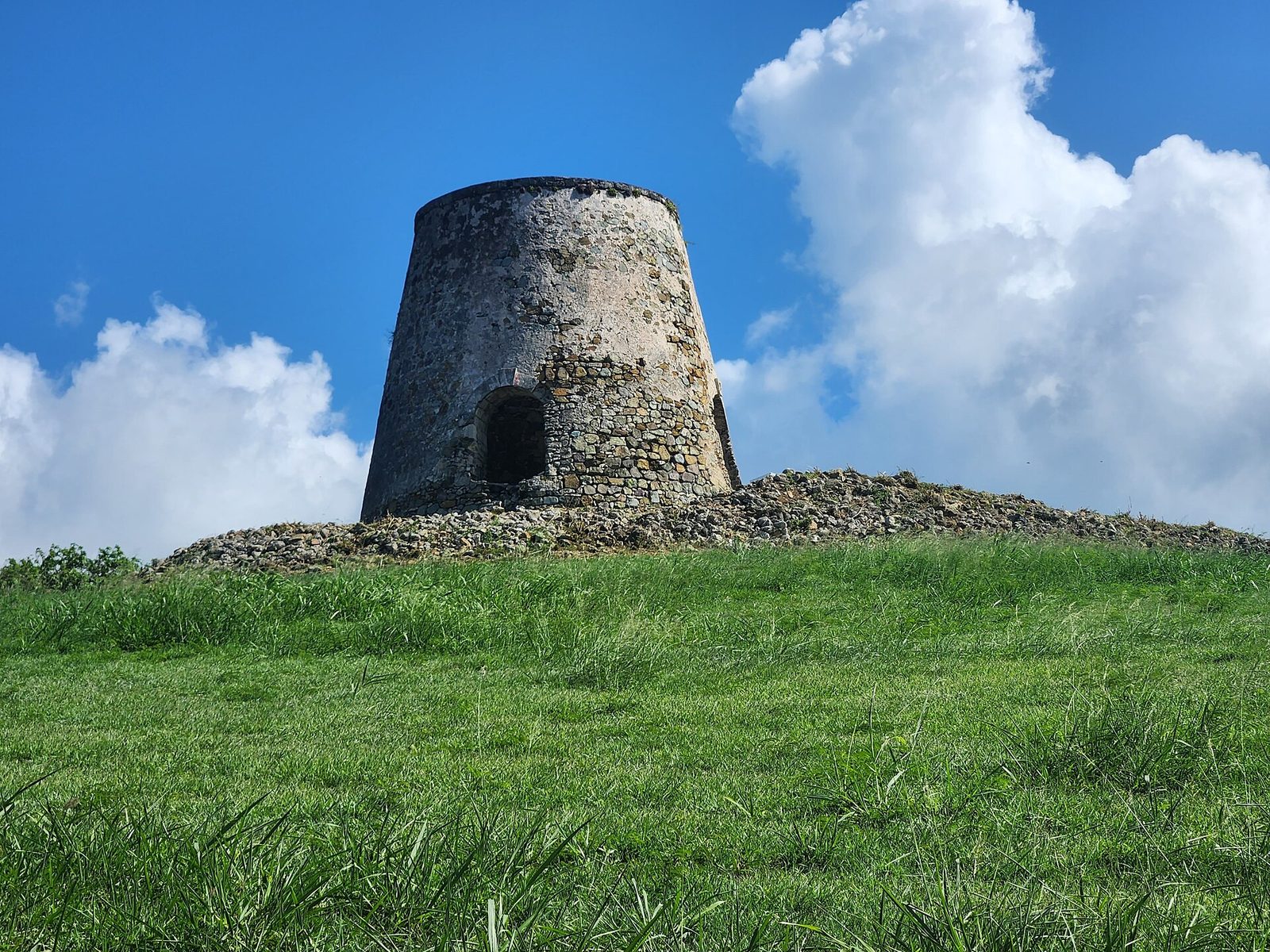
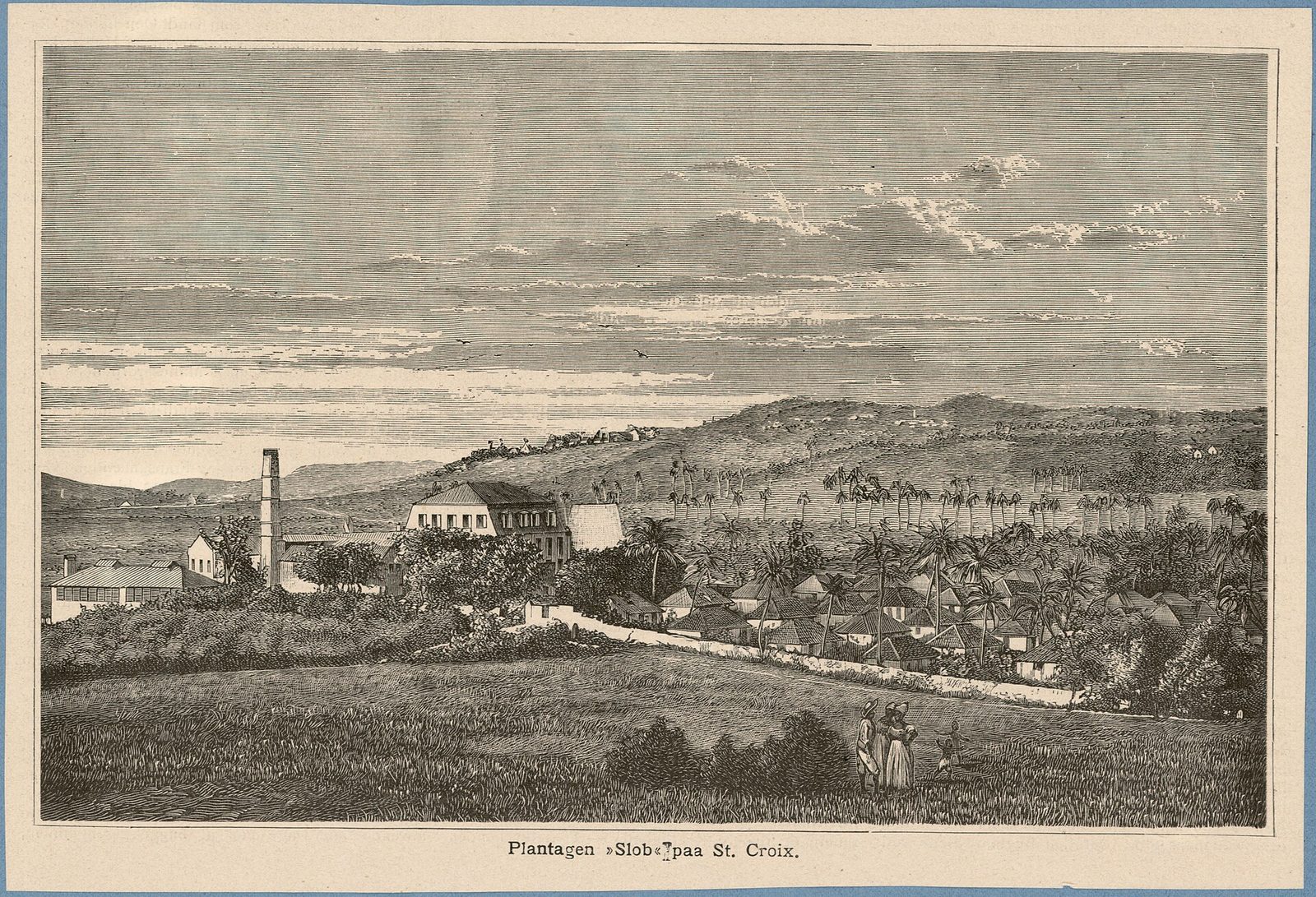
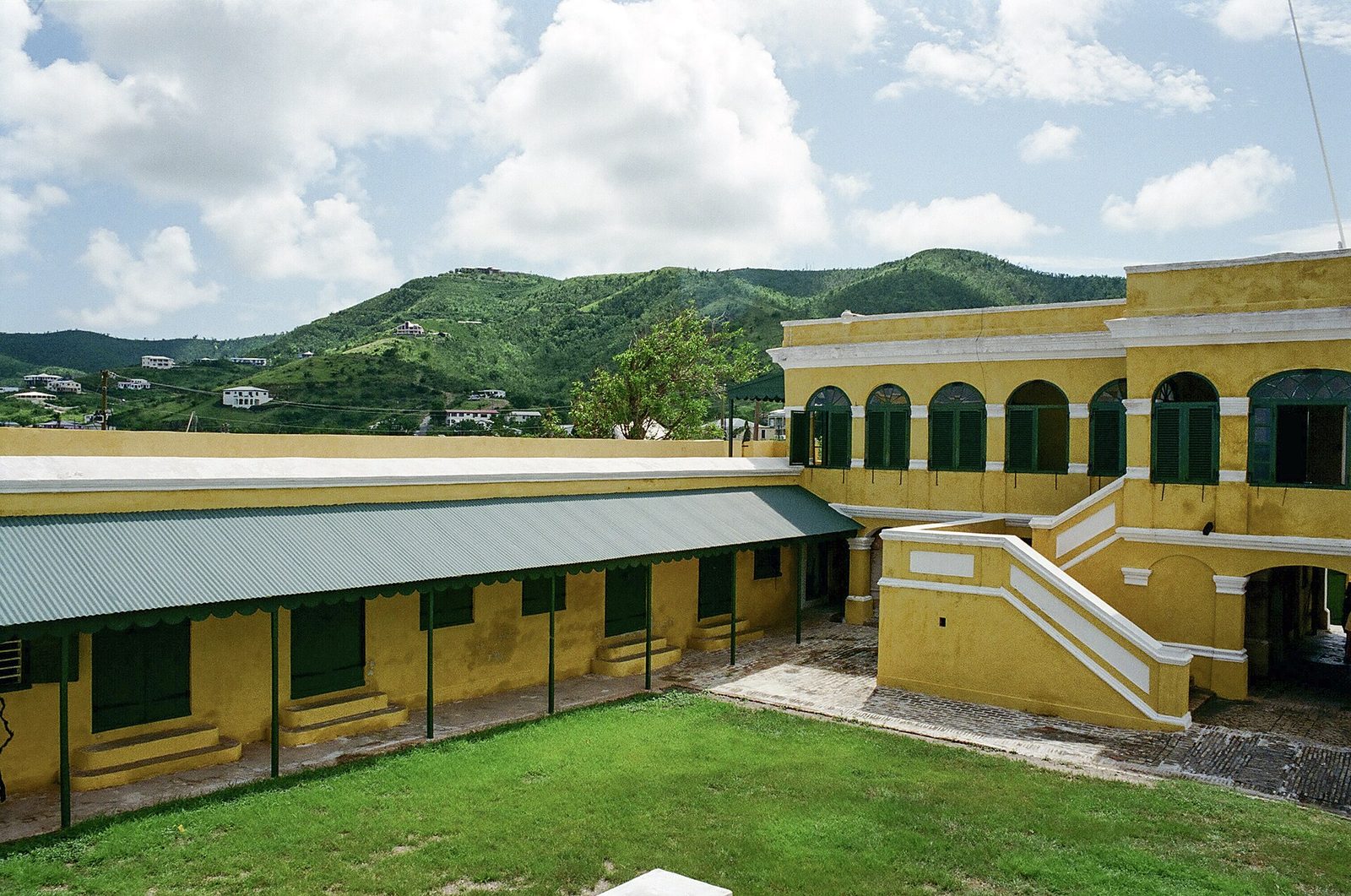
St. Croix's mills on paper and in stone: the Historic American Buildings Survey drew Estate Whim's windmill and its steam engine, and towers like Whim's stand across the island.Photo: CaptJayRuffins (CC BY-SA 4.0)
The island as a sugar machine
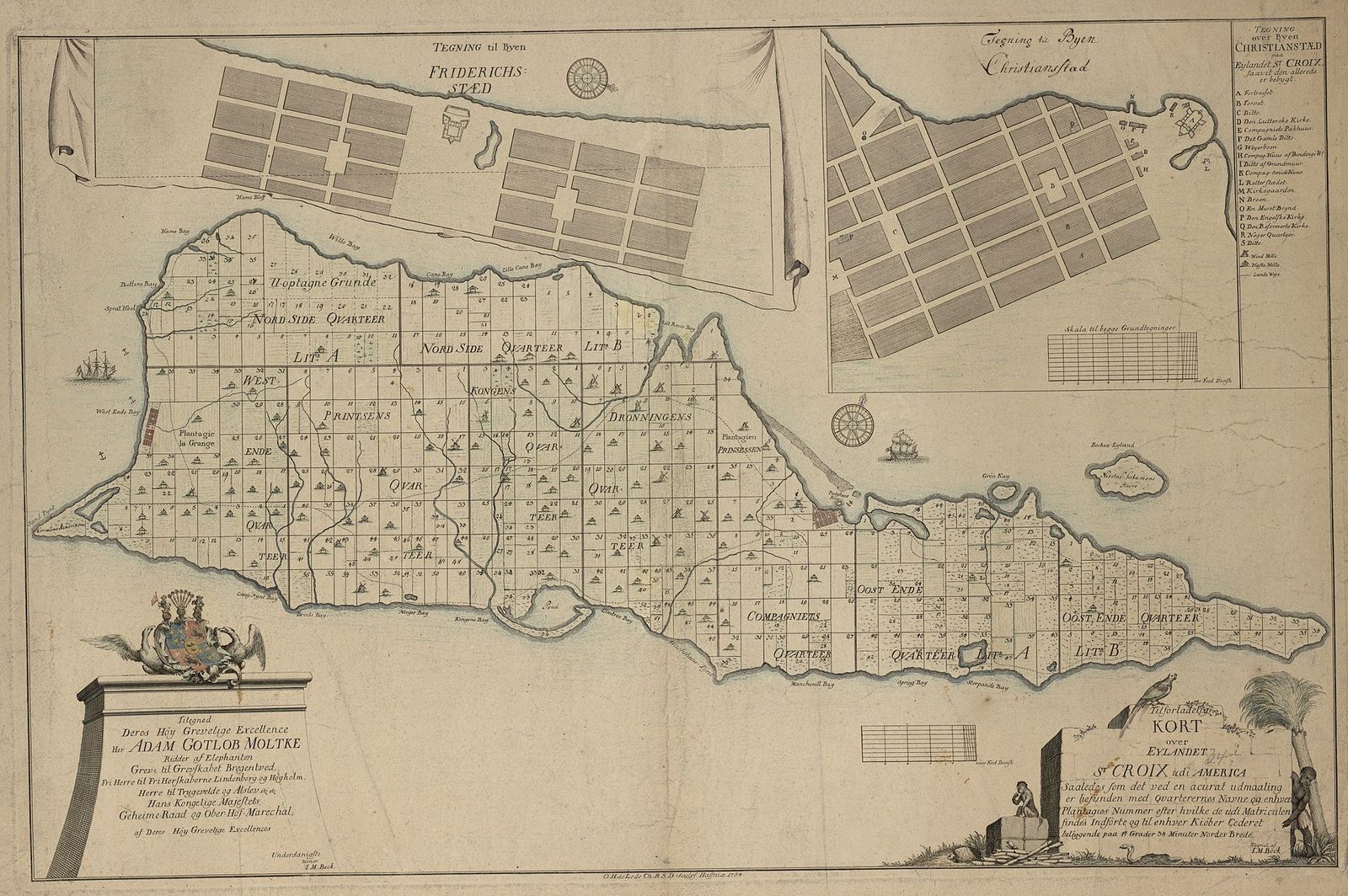
Denmark bought St. Croix from France on June 15, 1733, for 750,000 livres, through the Danish West India and Guinea Company. What the company wanted was flat land, and St. Croix has more of it than its mountainous neighbors: a long southern plain and a wide central valley that could be surveyed, gridded and sold as estate plots. The 1750 map by Cronenberg and Jægersberg, the first Danish map of the island, already shows the grid, and Beck's 1754 map and Kueffner's 1768 map of the major plantation owners follow the same logic. The names on those sheets are the names on the road signs today: Whim, Diamond, La Grange, Bethlehem, Sion Farm, Judith's Fancy, Lower Love, Little Princess. When a Crucian gives you directions by estate, that is a Danish survey talking.
The speed of it is the thing to grasp. The 1742 census, nine years after the purchase, counted 120 sugar plantations, 122 cotton plantations, 1,906 enslaved Africans and 360 whites. By 1754, when the bankrupt company handed the islands to the Danish crown, the enslaved population was 7,566. At the height of the trade in the mid-to-late 1700s, the enslaved population stood between 18,000 and 20,000 against 1,500 to 2,000 whites, more than 58 percent of the island's land was under cane, and the Danish National Archives counts about 250 plantations divided into nine quarters — Company, King's, Queen's, Prince's, West End, Northside A and B, East End A and B. With more than 150 sugar mills, St. Croix was one of the wealthiest sugar islands in the West Indies.
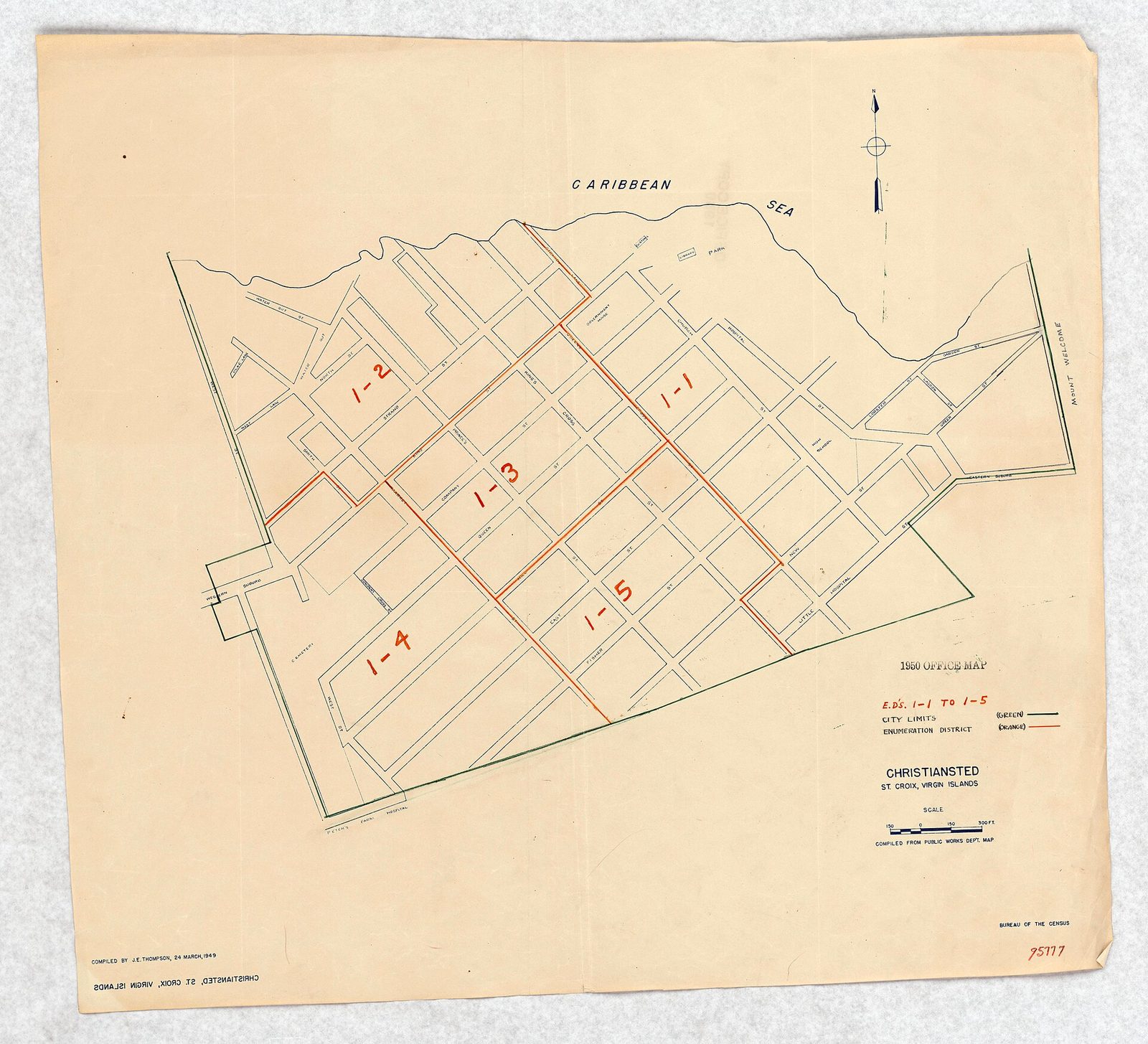
The wealth is why the two towns look the way they do. Christiansted's arcades and yellow-brick fort, Frederiksted's waterfront and Fort Frederik, the great houses on the ridges — all of it was paid for by sugar and rum shipped to Copenhagen and beyond. The seven flags guide tells the political story of how Denmark came and went, and the Christiansted guide walks the streets the sugar built. This guide stays out in the cane, where the money was made and where the towers are.
120Sugar plantations in 1742
1,906Enslaved people in 1742
18,000–20,000Enslaved at the peak
About 250Estates on Danish St. Croix
58%Land under cane at the peak
1966Last cane crop
The people who were forced to make it
Every figure in the section above is a count of people, and the plain version is this: the sugar economy of St. Croix was built and run by Africans who were bought on the West African coast — the "Guinea" in the company's name is the coast it traded from — shipped across the Atlantic, and held for life, along with their children, on estates like Whim. In 1742 there were 1,906 of them. At the peak there were as many as 20,000, outnumbering the whites who owned them roughly ten to one. That ratio is the reason the towns have forts and the estates had watchhouses.
The work was the work of a factory that never closed in crop season. Cane was planted by hand in holes dug across the fields, weeded and cut with a machete, carried or carted to the mill, and fed between rollers that took hands and arms when people slipped; the mills ran through the night when the wind blew or the cattle could be driven, because cut cane sours quickly. In the boiling house the heat came off a row of kettles over a single long fire, and the boiler's judgment — when to skim, when to add lime, when the syrup would strike — decided the estate's income. None of that is romance. It is the description of a job done under threat of the whip by people who did not own their own bodies, and the estate's ruins are, first of all, the ruins of their workplace.
Denmark is often described as the first European state to outlaw the slave trade, and the claim is true only narrowly: a 1792 decree ended Denmark's transatlantic trade, it took effect only on January 1, 1803, and it freed nobody already here. Slavery on St. Croix lasted forty-five more years, and it did not end by decree. On July 3, 1848, some 8,000 enslaved people marched on Frederiksted behind the man remembered as General Buddhoe, and Governor-General Peter von Scholten, at Fort Frederik, declared all unfree in the Danish West Indies emancipated. That day has its own guide, July 3, 1848 at Fort Frederik, and Whim and the fort should be visited together.
At Whim itself, the Society keeps a research library and archives on the grounds for genealogical and historical research, and the "My Granny House" exhibit and the Living Museum days, when tradition bearers demonstrate Crucian music, food and crafts, are built around the culture the enslaved and their descendants made in spite of the estates. If your family traces to St. Croix, write to the library ahead of your visit; it works by appointment. If it does not, walk the workers' houses before the great house. It is the right order.
The method used on St. Croix was the standard Caribbean one, and Whim shows every stage of it. Cane is a tall grass; a field was planted from cuttings, took a year or more to ripen, was cut in the dry months and then re-grew from the stubble (a ratoon crop) for several years before it was replanted. Cut cane went to the mill within a day or so, because the juice ferments fast, and that urgency is why every estate needed its own mill rather than sharing one — and why, on a flat island where wind is the one free power source, so many towers went up. Most of the old mills you see were built between 1750 and 1800, according to the Landmarks Society.
The mill crushed the cane between rollers and the juice ran by gravity to the boiling house, the low building beside or below the tower. There it went through a line of kettles set in masonry over one long fire, largest to smallest, ladled from one to the next as the water boiled off — the arrangement the trade called a Jamaican train. The boiler added lime, skimmed the scum, and judged the moment the syrup would crystallize, then "struck" it into a cooler. The Historic American Engineering Record documented one of these trains on St. Croix, at Estate Belvedere on the north side, as HAER VI-9: a set of cast-iron kettles used for boiling the cane extract, photographed after 1968 when the field survey came through. Whim's factory foundations are the same idea in outline.
The wet sugar was packed in hogsheads in the curing house, where the molasses drained out through holes in the barrels over weeks, leaving brown muscovado that was shipped to Europe for refining. The molasses did not go to waste: it went to the still house and became rum, the estate's second income, and the crushed cane stalks (bagasse, or trash) were dried and burned under the kettles. Sugar, rum and the fuel to make both came out of the same plant, on the same estate, and that closed loop is why the ruins cluster: tower, boiling house, curing house, still, all within a shout of each other, with the great house upwind of the smoke.
Cane to crystal, the estate way
Plant cane cuttings in holed fields
harvest in the dry months, then cut ratoon crops from the stubble for several years.
Cart the cut cane to the mill within about a day and crush it between rollers turned by wind, animals or, after 1816, steam.
Run the juice by gravity to the boiling house and boil it down through a line of kettles over one fire — the Jamaican train — adding lime and skimming as it goes.
Strike the thickened syrup into a cooler, then pack the wet sugar in hogsheads in the curing house so the molasses drains out over weeks.
Send the molasses to the still house for rum
dry the crushed stalks and burn them under the kettles.
Ship muscovado sugar and rum out through Christiansted or Frederiksted, and start the next field.
Wind, animals and steam
Three kinds of mill crushed cane on St. Croix, and Whim has all three, which is one reason the Society's site is the right classroom. The windmill is the tower everyone photographs: a stone cone with a timber cap and sails on top that turned to face the wind, driving vertical rollers inside through gearing. The animal mill was a round platform where mules or cattle walked in a circle harnessed to a sweep that turned the rollers; the Landmarks Society's history says early ones produced 300 to 350 gallons of juice an hour, and later versions using up to ten mules made some 500 gallons an hour. Wind was free but unreliable; animals were reliable but slow and had to be fed. Many estates kept both.
Steam came late and unevenly. The first steam mill on the island ran at Estate Hogensborg for the crop of 1816, and by the Society's account it was so balky and broke down so often that other planters stayed unconvinced. That changed after emancipation, when the labor that had turned the animal mills' sweeps and hauled the cane could no longer be compelled: just four years after 1848, the Society says, there were some fifty steam engines on the island. Whim's is one of them, documented by the Historic American Engineering Record as an overhead-crank steam engine and cane mill built by P. and W. McOnie of Glasgow, and the Record's isometric drawing of it is one of the images in this guide's photo set. The engine explains the brick chimneys you see beside some towers: a steam mill needed a boiler, and a boiler needed a stack.
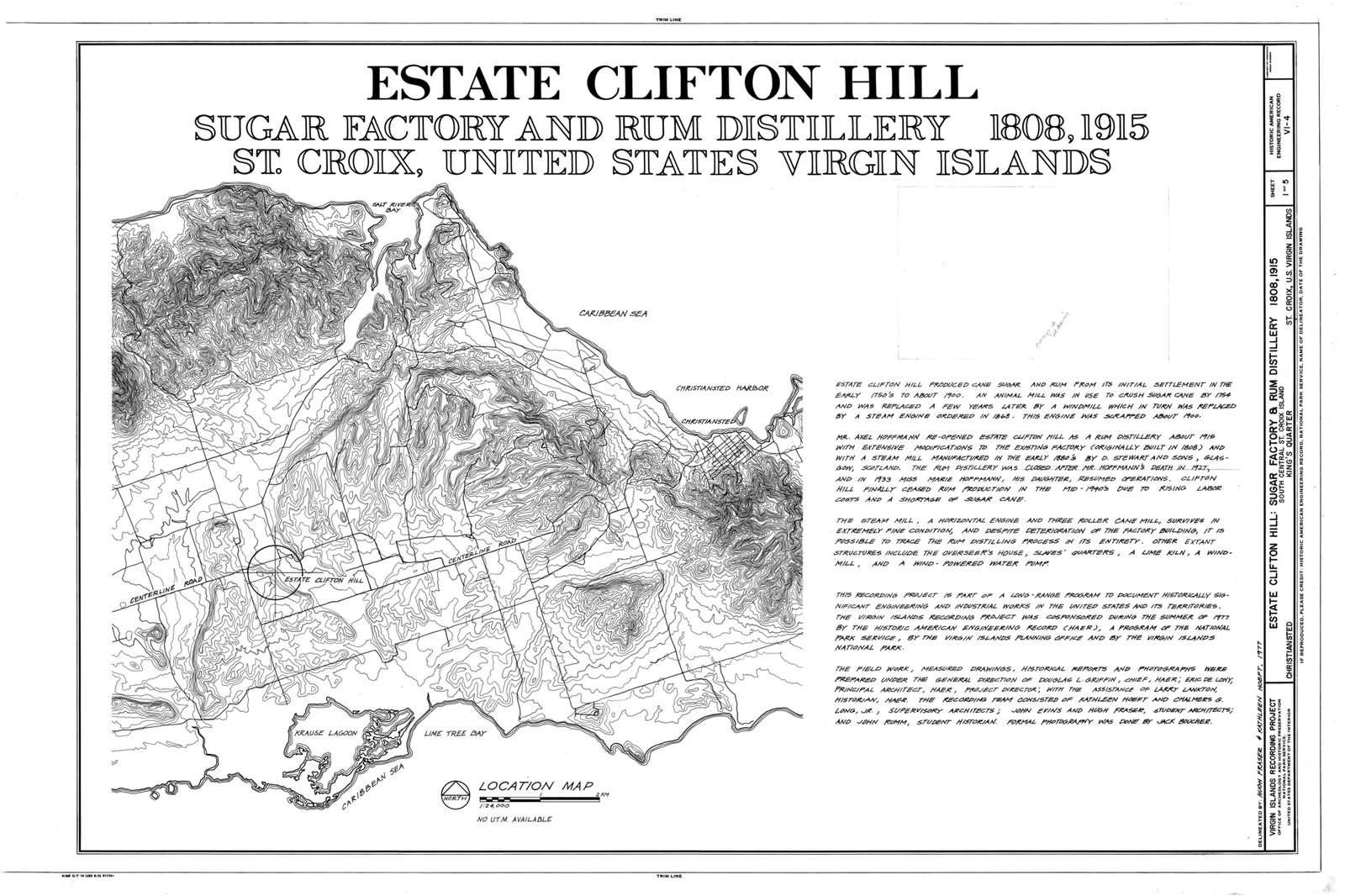
Once you know the three types, the roadside ruins organize themselves, and there is a field guide to them further down. For the pattern in one image, look at Estate Høgensborg, the first steam site, as Frederik von Scholten drew it in June 1838 — mill, works and houses laid out exactly as the pattern says. The drawing is in this guide's photo set.
The Cerulean
Plan it from the villa.
Five bedrooms, a private swimmable beach, and all of this within a day trip.
Emancipation on July 3, 1848, removed the forced labor the estates were built on, but it did not end the plantation. The Labor Act of 1849 bound the freed to the estates on yearly contracts at fixed, low wages, with October 1, Contract Day, the annual date on which the contracts turned over. For thirty years that system held. Steam mills spread, sugar prices fell, estates consolidated, and in 1876 the Danish government underwrote five large cane-crushing stations, at Estates Fair Plain, Glynn, Barren Spot, La Grande Princess and Peter's Rest, an early move toward central factories that would grind cane for many estates at once. It was too little, too late, for the laborers still bound by the 1849 contracts.
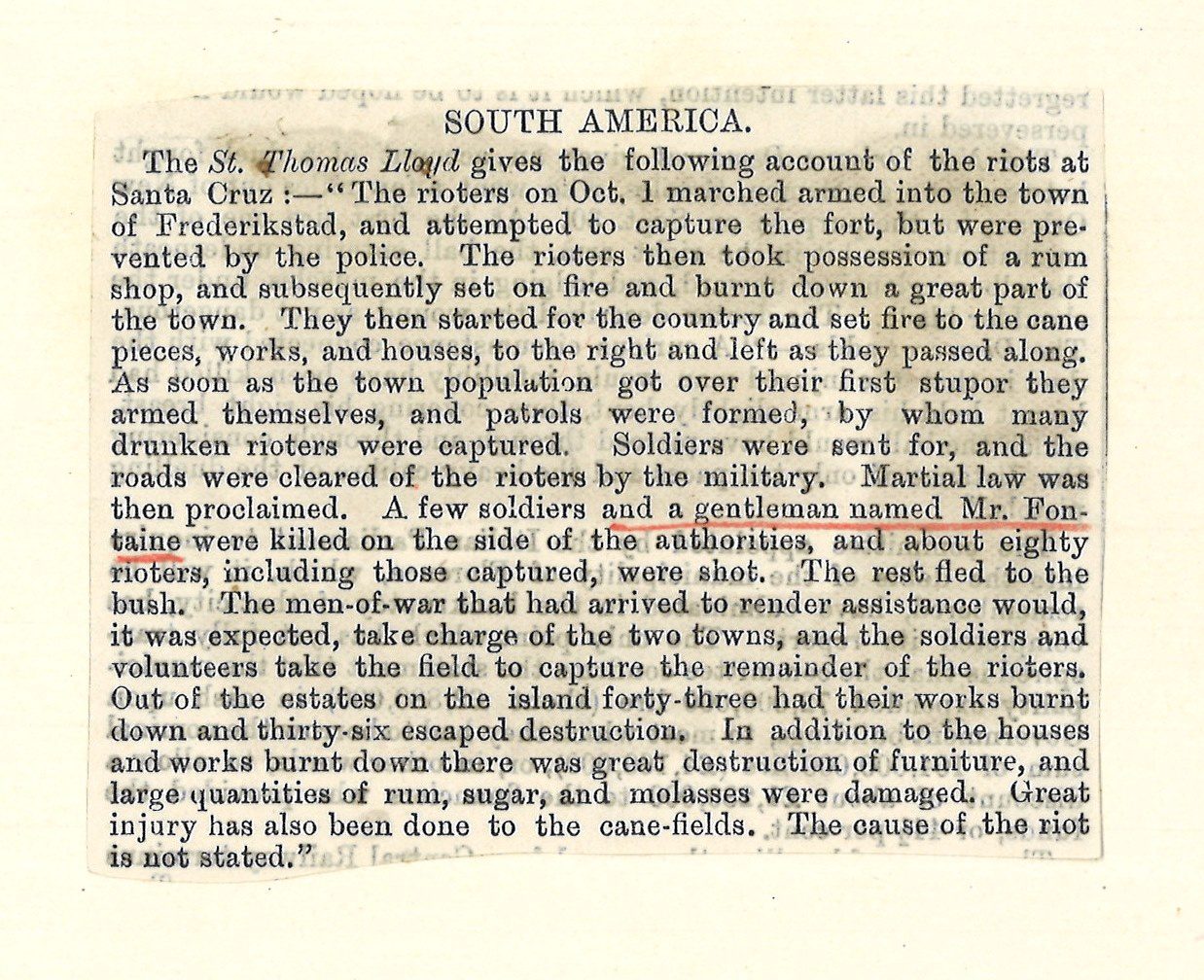
On October 1, 1878, Contract Day, laborers gathered in Frederiksted to demand better wages and terms. The gathering turned violent after word spread that a laborer taken to hospital had been mistreated and had died in police custody, and what followed is remembered on St. Croix as the Fireburn. Much of Frederiksted burned; so did dozens of estates across the west and center of the island, around fifty by the common count. The dead numbered about 60 Black laborers, two soldiers and 14 women killed in an explosion, and on October 5, 1878, twelve laborers were hanged. Four women were imprisoned as leaders and are remembered as the Queens: Mary Thomas ("Queen Mary"), Axeline Salomon, Mathilda McBean and Susanna Abramsen; the first three served sentences in Denmark.
The Fireburn did what thirty years of petitions had not. The labor contracts were no longer enforced, laborers were able to buy land, and labor unions began to form. Frederiksted was rebuilt in the Victorian gingerbread you see there today, which is why the town looks younger than Christiansted. The estates never fully recovered. Denmark tried three times to sell the islands to the United States and finally did in 1917, for $25 million, and by then sugar on St. Croix was a shrinking business run from a handful of central factories rather than two hundred estate mills.
1733Denmark buys St. Croix from France for 750,000 livres
1742Census counts 120 sugar and 122 cotton plantations, 1,906 enslaved people and 360 whites
1754Sugar becomes Whim's main crop
1816The island's first steam mill runs at Estate Hogensborg
1848Emancipation, forced by the July 3 march on Frederiksted
1878The Fireburn begins on October 1, Contract Day
1903The Lachmann family builds the central sugar factory at Lower Bethlehem
1932The U.S. government buys the whole Whim plantation for homesteading
1954Twelve acres at Whim are leased to the St. Croix Landmarks Society
1966The last commercial cane crop is processed at Bethlehem
Bethlehem and the last cane
Sugar did not end with a bang on St. Croix; it consolidated, shrank and finally stopped in the middle of the island, at Bethlehem. Sugar had been made at Estate Lower Bethlehem, the Old Works, since the mid-1700s, soon after the colony was founded. In 1903 the Lachmann family built a modern central sugar factory there and connected it by a narrow-gauge steam railway to their other estates at Bethlehem Middle Works and Friedensburg, so cane from a wide stretch of the central plain could be hauled to one mill instead of two dozen towers. That is the shape the industry took everywhere in the Caribbean in the twentieth century: a few big factories, and estate mills left to the goats.
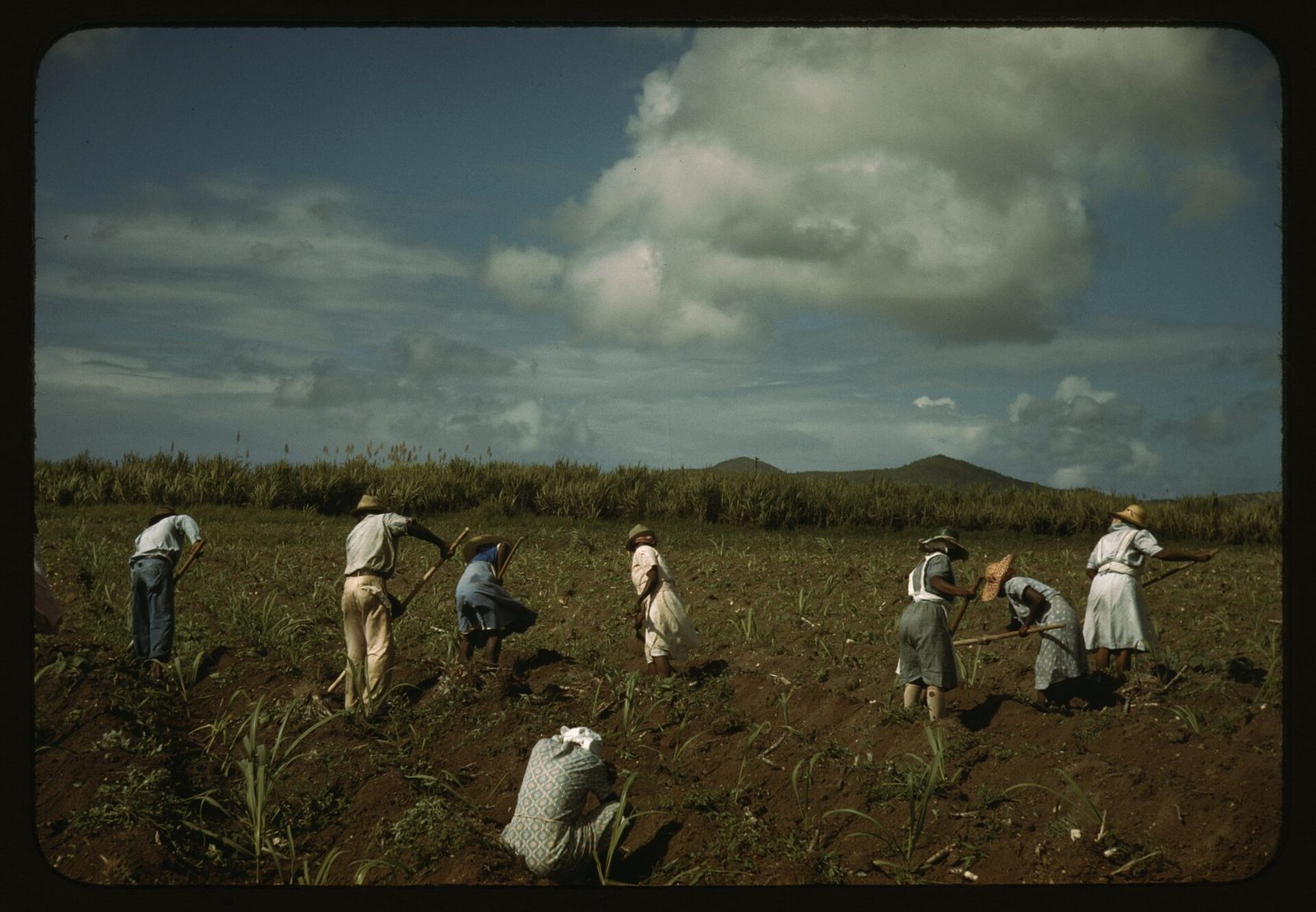
The United States, which bought the islands in 1917, took over the Bethlehem factory in 1934, and the West Indian Sugar Factory became the Virgin Islands Company (VICO), later the Virgin Islands Corporation (VICORP) — a federal operation of the Depression years that kept the fields planted. That is the Bethlehem in the 1941 photographs Jack Delano made for the Farm Security Administration: cane being cultivated on Virgin Islands Company land near Bethlehem, a company housing project, cane fields on the northwest of the island and sugar farms along the north coast, all in December 1941. The pictures are the last look at the island as a working cane country, and they are in this guide's photo set.
In 1966 the last crop was taken off for processing at the Bethlehem mill. Soon after, the mill was dismantled and sold to a Venezuelan company, and the Landmarks Society's history says it plainly: the commercial grinding of cane on the island has come to a final stop after more than three hundred years. The land went to cattle, to the industrial plants that came to the south shore in the 1960s, and to housing. What is left at Bethlehem is a historic district at the Middle Works — the workers' village, the overseer's house, animal pens and stables, a windmill, and the sites of the animal mill and the original factory — visible from public roads on the central plain. There is no visitor program that we could confirm as of 2026; look, photograph, and do not go through fences.
Bethlehem Middle Works, on St. Croix's central plain: the workers' village, animal pens, overseer's house and mill sites of an estate once linked by rail to the Lower Bethlehem central factory.Photo: W. Chapman (Public domain)
Estate Whim's own story
The Landmarks Society's history of the estate starts in 1743, when the first records of ownership show cotton growing at Whim. By 1754 sugar was the main crop, and it stayed the main crop, remarkably, until the 1920s, long after most of the island's estate mills had gone dark. Then, in the Society's words, sugar, long since an unprofitable industry on the island, gave way to cattle. In 1932 the United States federal government purchased the entire plantation and spent fifteen years trying to turn it into homesteads. In 1954 twelve acres holding the remains of most of the original plantation buildings were leased to the Landmarks Society to manage, and the museum you visit grew from that lease.
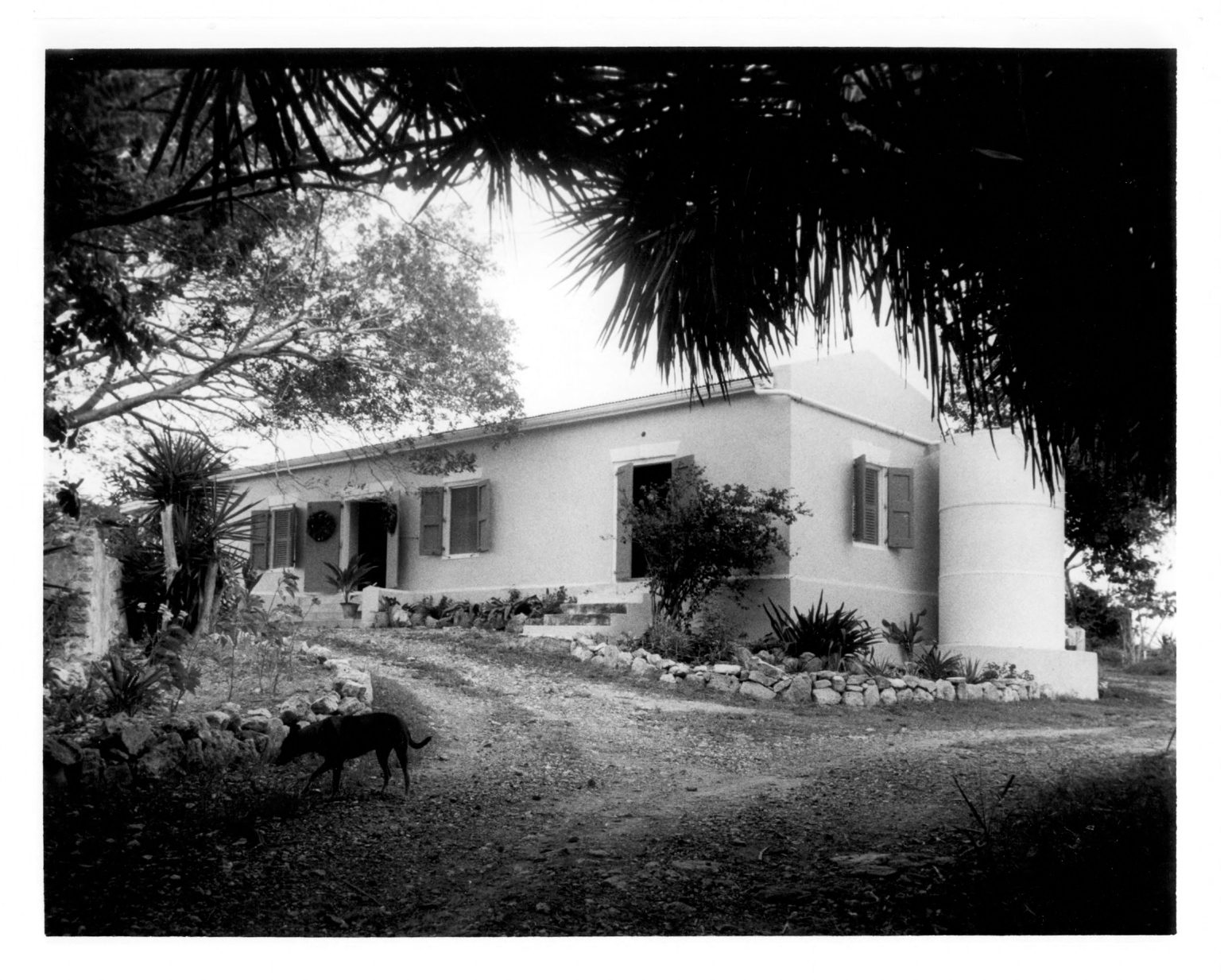
The great house is the building the estate is famous for, and its date is genuinely uncertain. Guidebook summaries call it a coral-walled house of the 1760s; the Historic American Buildings Survey, which recorded it as HABS VI-49-A, associates it with Christopher MacEvoy Jr., who owned the property until 1824, and dates its construction to about 1794. Either way it is late-1700s work, thick-walled, with curved ends and cooled, curving rooms. The windmill beside it was most likely built in the 1770s and was measured and drawn by HABS as well; it is the only reconstructed windmill on St. Croix, meaning the tower has been made whole rather than left as a shell. The steam engine and cane mill, by P. and W. McOnie of Glasgow, were recorded by the Historic American Engineering Record.
The restoration came fast once the Society had the lease. By 1961 its director, Cyril Marshall, could describe the restored great house as "beautiful to behold," and in 1962 the Society bought furnishings for it at the auction of the Pentheny Hotel in Christiansted, which is where the furniture you may or may not get to see came from. For half a century the furnished great house was the tour; the mill complex, the cookhouse and the workers' houses were the grounds you walked between the house and the parking lot. Hurricane Maria in 2017 reversed that. The house was badly damaged, and since then the grounds and the works have carried the visit.
“beautiful to behold”
Cyril Marshall, St. Croix Landmarks Society director, on the restored great house, 1961
Walking the twelve acres
Start at the mills, because the estate did. The windmill is the tall stone cone: walk around it and look for the arched doorways at the base where cane went in and crushed stalks came out, and picture the sails on the cap above turning the rollers inside. A few steps away is the site of the animal mill, the round platform where mules walked their circle when the wind failed. Then the steam mill, the latest of the three, with its Glasgow engine — the machinery of the steam age, which spread across the island after emancipation, when planters could no longer compel the labor that had turned the sweeps. Three technologies, one job, all within a hundred paces.
Downhill of the mills are the factory foundations, the footprint of the boiling house and curing house where juice became sugar and sugar dripped molasses. Read them with the "cane to crystal" steps above in your head: the line of the kettles, the room where hogsheads stood, the way the whole complex sits below the mills so the juice could run by gravity. Then the cookhouse, standing apart from the great house as kitchens usually did on estates, for the fire risk and the heat; the privy and bath house; the watchhouse, which tells you what the owner was afraid of; and the carriage house.
The workers' houses are the part most visitors walk past on the way to the great house, and the part you should slow down for. These small buildings, and the "My Granny House" exhibit the Society built, are where the estate's people lived after emancipation and where the culture that survived slavery — the food, the music, the language you hear on the island today — was made. The North and South Exhibit Halls hold the interpretive material and, on Living Museum days, the tradition bearers: people demonstrating Crucian arts, music and foodways. If one of those days lines up with your trip, plan around it.
Finish at the great house, whatever state it is in. Even from outside, the curved ends, the thick coral-stone walls and the low profile explain how a house without air conditioning was kept livable on the hot side of a hot island: mass, shade and cross-breeze. If the interior is open, the Pentheny Hotel furnishings give you the planter's side of the ledger, worth seeing precisely because you have just seen the other side in the yard. Allow an hour and a half for all of it, more with the library.
Hours, admission, the library and events
Everything in this section is as listed by the St. Croix Landmarks Society in August 2026, and all of it can change; treat it as a starting point and confirm. Hours: Wednesday through Saturday and cruise-ship days, 10 a.m. to 3 p.m., with the note that some listings say Wednesday and Saturday only. Admission: about $10 for adults and teens 13 and up, $5 for children 6 to 12, $8 for seniors 65 and over and for groups of ten or more, and free for Society members and active-duty military. The address is 52 Estate Whim, Frederiksted, VI 00840, on Centerline Road; the phone is (340) 772-0598 and the general email is info@stcroixlandmarks.org.
The research library and archives on the grounds are the part of Whim most visitors never hear about. The Society holds them for genealogical and historical research, and they open by appointment; the contact is library@stcroixlandmarks.org. If you have Crucian ancestry, or an interest in a particular estate — the one whose tower you can see from your rental, say — write before you fly. Fridays at Whim are offered by reservation for student and teacher groups, and the Living Museum programming brings tradition bearers to the site to demonstrate Crucian culture, music, arts, food and customs; ask when the next one is.
The Society is a membership nonprofit that also runs the Apothecary Hall museum in Christiansted, an 1820 Danish pharmacy opened as a museum in 1987, so a membership bought at Whim pays off in town too. The museum lists itself open on cruise-ship days as well as its regular days, and it will be busier when a ship is at the Frederiksted pier; if you have a choice, go on a non-ship day and go early. Bring cash for admission, wear real shoes for the mill yard, and bring water; there is not much shade between the buildings at midday.
Whim has no restaurant that we could confirm, so eat in Frederiksted before or after. Directions are the easy part: Centerline Road runs the length of the island and Whim is on it, a few minutes before the road reaches Frederiksted, and the driving guide covers the left-hand-side rules and the roundabouts you will meet on the way.
Once Whim has taught you the anatomy, the rest of the island becomes legible, and the temptation is to stop at every tower. Some you can walk up to; most you cannot, because they stand on private land, in cattle pasture, on resort grounds or in someone's yard. The table below is our honest sort of the ones worth knowing, with what you will actually see and how close you can get. It leans on the Society's list, the Library of Congress survey records and the photographs in this guide's pools; where we could not confirm access, we say so. When in doubt, the rule is simple: a gate is an answer, and a road is a viewpoint.
Ruin
Where
What you see
Access
Estate Whim
Centerline Road, just east of Frederiksted
Great house, reconstructed windmill, animal-mill site, steam mill and Glasgow engine, cookhouse, workers' houses, factory foundations
Museum. Wed–Sat and cruise days, 10–3, about $10 (confirm)
St. George Village Botanical Garden
Estate St. George, near Frederiksted
Plantation village and factory ruins with gardens planted among them
Open daily, roughly 9–3 (confirm), admission
Cruzan Rum Distillery
Estate Diamond, west end
An old mill tower on the distillery grounds and a working rum plant
Weekday tours by reservation
Estate Little Princess
Northwest of Christiansted
A 1738 estate on 25 remaining acres: great house and factory ruins, trails to the shore, The Nature Conservancy's office
Ask TNC about walks or tours before you go
Bethlehem Middle Works
Central plain, mid-island
Workers' village, overseer's house, animal pens, stables, windmill, sites of the animal mill and original factory
Historic district. View from public roads, no visitor program confirmed
The wharf mill, Christiansted
The boardwalk, Christiansted harbor
A mill tower on the waterfront, used as restaurant space in recent years
Walk up to it any time
Rust op Twist
North shore above Cane Bay, off Route 80
Windmill tower and factory ruins on a hillside, worked from 1755 to about 1900, HAER-recorded steam engine and cane mill
Private. View from the road only, owners ask visitors not to come up
Estate Clifton Hill
Near Christiansted, King's Quarter
A sugar factory and rum distillery with its own great house, recorded by HAER
Roadside look. No visitor facilities we could confirm
Estate Annaly
Northwest coast, above Annaly Bay
The estate of von Scholten's drawing and an 1861 print, cane country turned pasture
Private farmland. Know it from the art and from the tide-pool trail
Grove Place
The village of Grove Place, west-central
Steam-mill smokestack and ruins with a historic marker, on the National Register
Roadside, in a living village. Be a guest
Estate Mount Washington
West end, at the rainforest edge
Animal mill, rum-factory ruins, bell tower, cistern, great house
Private. Owners have allowed access to the ruins, ask locally first
A few notes the table cannot hold. Rust op Twist is the tower in most photographs of Cane Bay: it sits on the hill above the North Shore Road with the sea behind it, it worked from 1755 into the early 1900s, and the Historic American Engineering Record recorded its steam engine and cane mill. It is private, and the owners have asked that visitors not come up; the view from Route 80 is the visit, and the Cane Bay guide tells you where to park for the beach below. Estate Belvedere, also on the north side, holds the Jamaican train HAER photographed; know it from the survey, not a trespass.
Estate Little Princess is the sleeper. It began as a 200-acre grant from the Danish West India Company to Governor Frederik Moth in 1738, five years after the purchase, which makes it one of the oldest estates on the island; it went on the National Register in 1980, and The Nature Conservancy owns the 25 acres that remain. Earlier reports describe walking trails through the ruins to the shore and historical tours; we could not confirm a current public schedule, so ask the Conservancy before you go. Annaly, on the northwest coast, is the estate in Frederik von Scholten's painting and in an 1861 lithograph, both in this guide's photo set; the estate is private farmland, but the tide-pool hike from Carambola ends at the bay that carries its name.
How to read a ruin, and how not to trespass
Here is the field guide in one paragraph. A tapering stone cone, hollow, with a doorway or two at the base and a ring of small openings near the top: a windmill, the base of one, and the openings held the timbers of the cap. A round platform, sometimes with a low stone curb, near it: the animal mill. Long, low walls with heavy round-arched openings, often on the downhill side: the boiling and curing houses. A square brick chimney: steam, and therefore mid-1800s or later. A larger building with a hipped roof or its ruin, on the rise upwind: the great house. Small foundations in a row, downwind, near the works: the village where the estate's people lived. Put those together and you can date and diagram most ruins from the car window.
What you should not do is walk in. Most of the island's mill ruins are on private land, and Crucians are patient with visitors up to the point where a rental car is parked in a cattle gate. Beyond manners there is safety: these are two-hundred-year-old rubble-and-lime walls, many of them shaken by Hugo in 1989 and Maria in 2017, and stone comes off them. Do not climb a tower. Do not let children into a doorway you have not looked into first. Watch for cattle and the wire that keeps them in, and for the drop on the downhill side of a boiling house.
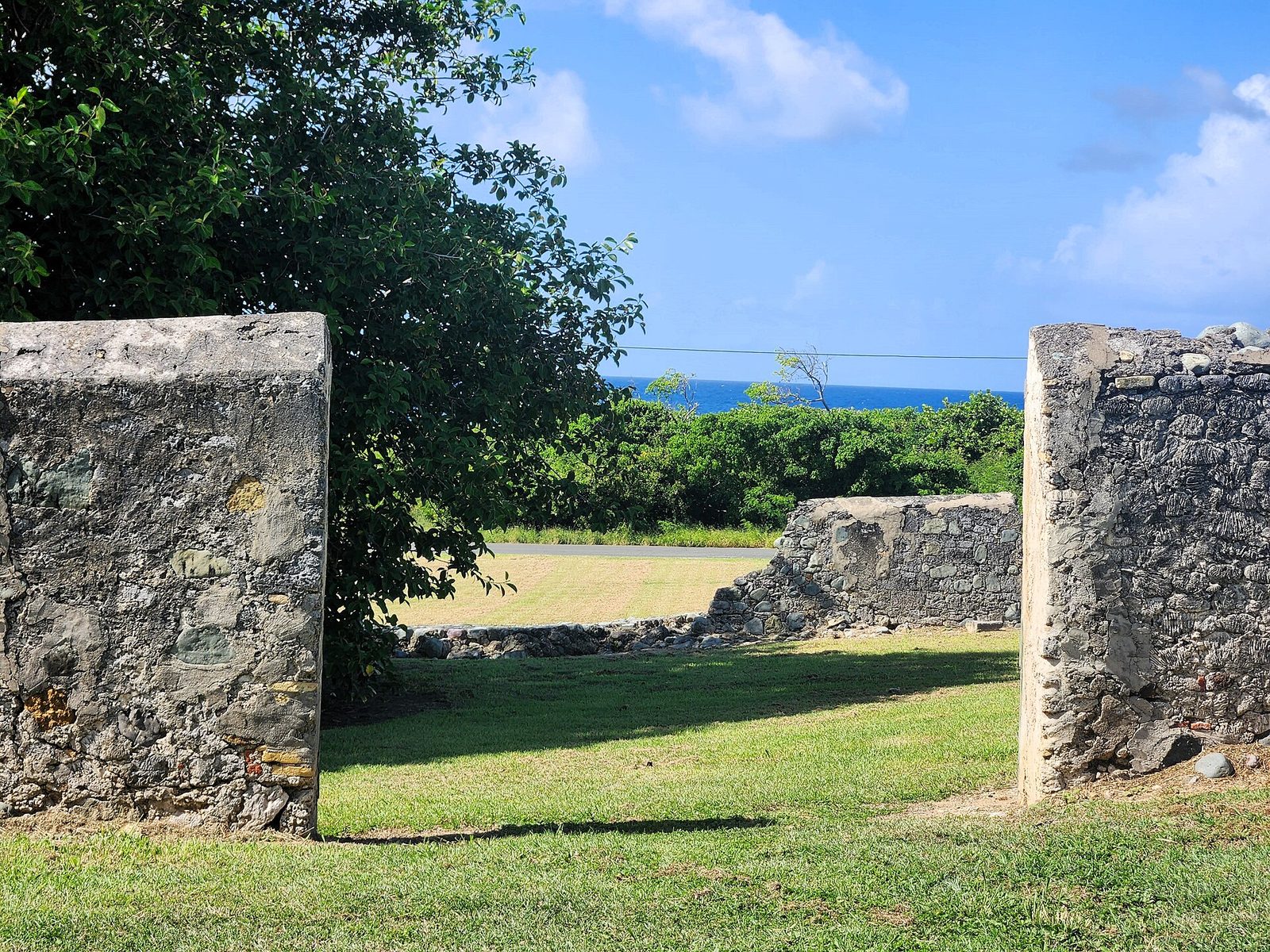
The rewards for behaving are considerable, because St. Croix does not hide its ruins: some of the best silhouettes are along Centerline Road and in the northwest hills, and a few stand in golf fairways and resort lawns now, which is its own commentary. The photograph you want is a tower at first or last light, when the stone goes amber and the cone throws a shadow across the pasture. Morning is better on the north shore, evening on the west end.
The rum thread
Every estate had a still house, because molasses was money and rum kept better than sugar, and that side of the works never closed on St. Croix. Cruzan Rum's distillery at Estate Diamond, a short drive from Whim on the same west end, is the direct descendant of the estate stills, run under the Nelthropp family line, and it keeps an old mill tower on its grounds where visitors line up to photograph the seven flags. Tours with tastings run on weekdays, at 12:00, 1:30 and 3:00 as of 2026, and reservations through the official site are the current policy; book from home, not from the parking lot. The Cruzan guide covers the tour, the pour and the history, so we will not repeat it here.
What belongs in this guide is the connection. The molasses that ran out of the hogsheads in Whim's curing house went to a still exactly like the ones whose ruins you see at Clifton Hill and Mount Washington, and the product went down the same roads to the same two harbors. Rum is the one line of the plantation ledger that is still being written, and standing at Whim in the morning and at Diamond in the afternoon puts the two ends of it in one day. The island's other distilleries — the Captain Morgan visitor center, weekdays only, and Sion Farm's breadfruit spirits, with free weekday tours — are listed with hours in our distilleries directory. Assign the driver at breakfast; the tastings are real.
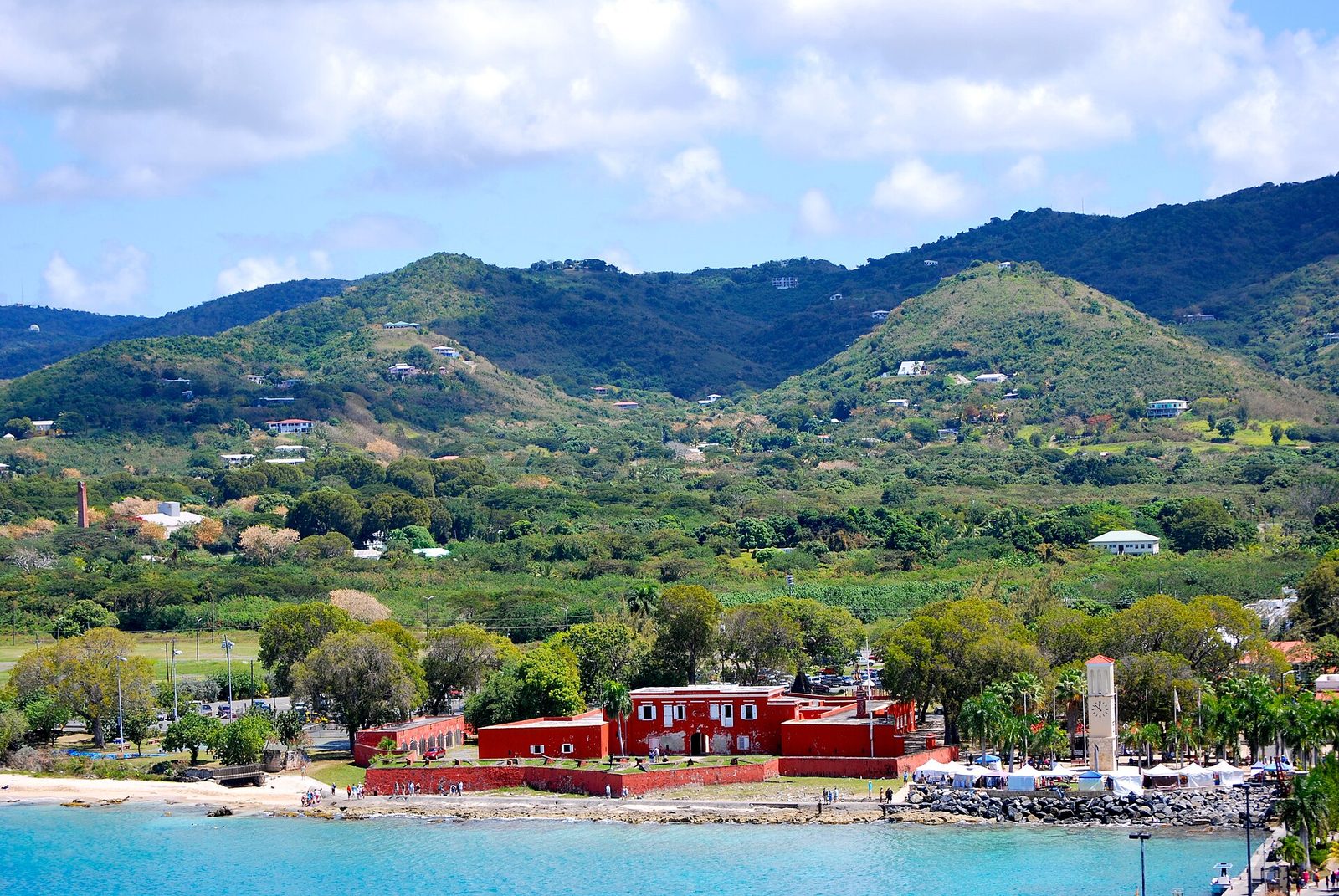
St. Croix's working countryside and towns in the sugar industry's final decades, from federal Farm Security Administration and Danish archive photographs.Photo: Jack Delano (Public domain)
With kids, with a group, and the mistakes people make
Whim works with children better than most museums because most of it is outdoors and none of it is behind glass. A windmill you can walk around, a mill yard, a cookhouse, small houses, twelve acres of shade trees, and, on the right day, people demonstrating music and cooking: that holds a nine-year-old for an hour, which is what you need. Two things help. Tell children before you arrive, in plain words, that the people who built and worked this place were enslaved, and let the site do the rest; the workers' houses and the "My Granny House" exhibit make it concrete without being frightening. And pair it with something physical afterward — the St. George Village Botanical Garden a few minutes away, with plantation ruins among the plants, or a west-end beach. Our kids guide has the rest of the island's options.
For a group of ten or twelve — the size The Cerulean sleeps — the group rate of about $8 a head applies to ten or more, and the yard absorbs a dozen people better than a furnished house ever did. Split into two cars for the drive west; nobody wants to sit in a fifteen-passenger van on Centerline Road. If anyone in the party has Crucian roots, the library appointment is the thing to arrange weeks ahead, and it can turn a museum stop into the reason the trip mattered. Multi-generation groups should note the walking is on grass and gravel and the shade is patchy: a hat and water each, and the earliest start the hours allow.
The mistakes are predictable. Driving out on a Monday or Tuesday, when the museum is closed. Expecting the furnished great house of older guidebooks and leaving disappointed at the yard, which is the better half. Skipping the workers' houses. Treating Rust op Twist as a hike rather than a view. Arriving at one in the afternoon, into the hottest hour, with the museum closing at three. Not booking the Cruzan tour ahead. And, most common, doing Whim as a fifteen-minute photo stop between the beach and lunch; it is a two-hour site inside a full west-end day.
A west-end history day
Whim is on the far end of a long island, and the way to make the drive pay is to build the whole day around the west end. Here is the version we would do. Leave the East End early — the drive to Frederiksted runs about 45 minutes to an hour, mostly on Centerline Road, and the morning is the cool part of it. Read the estate signs as you go — every one is a plantation name from the Danish grid — and by the time you reach Frederiksted you have driven through the whole story. Be at Whim when it opens at ten, on a Wednesday-through-Saturday day you have confirmed by phone, and give it the two hours it deserves, mills first, house last.
Frederiksted for lunch. The Frederiksted guide lists what is open in 2026, and it also holds the town's own half of this story: Fort Frederik, where emancipation was proclaimed on July 3, 1848, and where the Fireburn began thirty years later on the same waterfront. The fort museum has kept weekday and Saturday-afternoon hours in recent years; confirm before you count on it. Buddhoe Park, in front of the fort, is where to sit with a cold drink and put the two dates together. Then the Cruzan tour you booked, at 1:30 or 3:00 on a weekday, at Estate Diamond a few minutes back up the road.
The afternoon and evening are the beaches, and this is where the west end pays you back for the drive: the west coast faces the sunset, the East End does not. Our west-end beaches guide sorts them; Rainbow Beach north of town is the easy answer, with a bar and a swim. Watch the sun go, then drive back east — about 45 minutes to an hour to the East End, on roads that are dark in stretches and dotted with roundabouts, so the driver stays on water at the beach.
Questions people ask
Is Estate Whim Museum open in 2026?
Yes, as far as the St. Croix Landmarks Society's own listing shows in August 2026: the museum at 52 Estate Whim on Centerline Road posts hours of Wednesday through Saturday and cruise-ship days, 10 a.m. to 3 p.m., with the research library and archives by appointment. Some listings give Wednesday and Saturday only, so call (340) 772-0598 before you drive across the island. Parts of the site were badly damaged by Hurricane Maria in 2017 and access to the furnished great house has been limited since; ask what is open that day.
How much does Estate Whim cost?
As of 2026 the Landmarks Society lists admission at about $10 for adults and teens (13 and up), $5 for children 6 to 12, $8 for seniors 65 and over and for groups of ten or more, and free for Society members and active military. Prices change; treat these as a guide and bring cash in case the card reader is down. Membership in the Society is worth a look if you plan to visit more than once or use the archives.
Can you go inside the great house at Estate Whim?
Not reliably. After Hurricane Maria in 2017 the great house suffered extensive damage, and visitors can no longer tour its furnished rooms, though the grounds, the sugar-factory ruins, the windmill and the exhibit halls remain open. The Society's own page still lists the great house among the site's features, so the situation may improve. Call ahead if the interior is the reason you are going; the mill complex is worth the trip on its own.
How many sugar mills are there on St. Croix?
Nobody agrees on an exact number, which is part of the fun of counting them. Historically the island had more than 150 sugar mills at the height of the trade; some estimates of the windmills ever built run past 200, while the earliest Danish maps of the 1750s show only a couple of dozen. Today well over a hundred mill towers survive in some state of ruin, most of them built between 1750 and 1800. Estate Whim's is described as the only reconstructed windmill on the island.
When did St. Croix stop growing sugar?
Commercial cane ended in 1966, when the last crop was processed at the Bethlehem central factory in the middle of the island; the mill was then dismantled and sold to a Venezuelan company. Sugar had been declining since emancipation in 1848, and the plantation economy that emancipation broke had already been shrinking as Estate Whim did, from sugar to cattle in the 1920s. Rum outlived sugar: Cruzan still distills at Estate Diamond on the west end.
What was the Fireburn?
The Fireburn was the labor revolt that began in Frederiksted on October 1, 1878, Contract Day, when laborers bound to the estates by the 1849 Labor Act gathered to demand better wages and terms. It turned violent after rumors that a laborer had died in police custody; much of Frederiksted and dozens of estates burned. About 60 laborers, two soldiers and 14 women in an explosion died, and twelve laborers were hanged on October 5. Its leaders, remembered as the Queens, are Mary Thomas, Axeline Salomon, Mathilda McBean and Susanna Abramsen.
Can I walk up to the sugar mill ruins on my own?
Some, not most. Estate Whim, the St. George Village Botanical Garden (built among Estate St. George's ruins), the Cruzan distillery grounds and the mill tower on Christiansted's wharf are open to visitors. Many others stand on private land, including Rust op Twist above Cane Bay, where the owners have asked people not to come up. Photograph from the road, do not climb walls that are two centuries old, and treat any gate as an answer.
Is Estate Whim a good stop with kids?
Yes, with expectations set. It is an outdoor site: a windmill you can walk around, factory ruins, a cookhouse, workers' houses and exhibit halls, on twelve shaded acres, so children who hate museums usually do fine here for an hour. Ask about the Living Museum days, when tradition bearers demonstrate Crucian music, food and crafts. Bring water and hats; go in the morning; and pair it with Fort Frederik or a west-end beach so the day is not all history.
How far is Estate Whim from Christiansted and the East End?
Estate Whim sits on Centerline Road (Route 70) just east of Frederiksted, on the far west end of the island. From Christiansted plan on roughly 35 to 45 minutes; from the East End, where The Cerulean is, figure about 50 minutes to an hour each way depending on traffic through Christiansted. Remember to drive on the left. It pairs naturally with Frederiksted, Fort Frederik, the Cruzan distillery and the west-end beaches, so make a day of it rather than a round trip.
Doing it from The Cerulean
The Cerulean sits on the East End, on the opposite corner of the island from Whim, and that is not the drawback it sounds like. The East End is where the sunrise is; the west end is where the sunset is; and a history day that starts with coffee on the veranda at first light and ends with the sun going down behind Frederiksted's pier is the best-shaped day St. Croix offers. Plan on about 50 minutes to an hour each way, through Christiansted and out Centerline Road, and read the driving guide before you go: left side, roundabouts, and a speed limit that is lower than the road looks.
The concierge can arrange a car or a driver, book the Cruzan tour, and call Whim to confirm the day's hours and Living Museum programming, which is worth doing the week before rather than the morning of. For a full house of twelve, two cars are the sane arrangement, and a driver for one of them means the tastings are not a problem for anyone. Ask the concierge about the Landmarks Society library appointment too, if anyone in the party is tracing family; the request has to go in ahead of time and it is the kind of thing that gets lost in the packing.
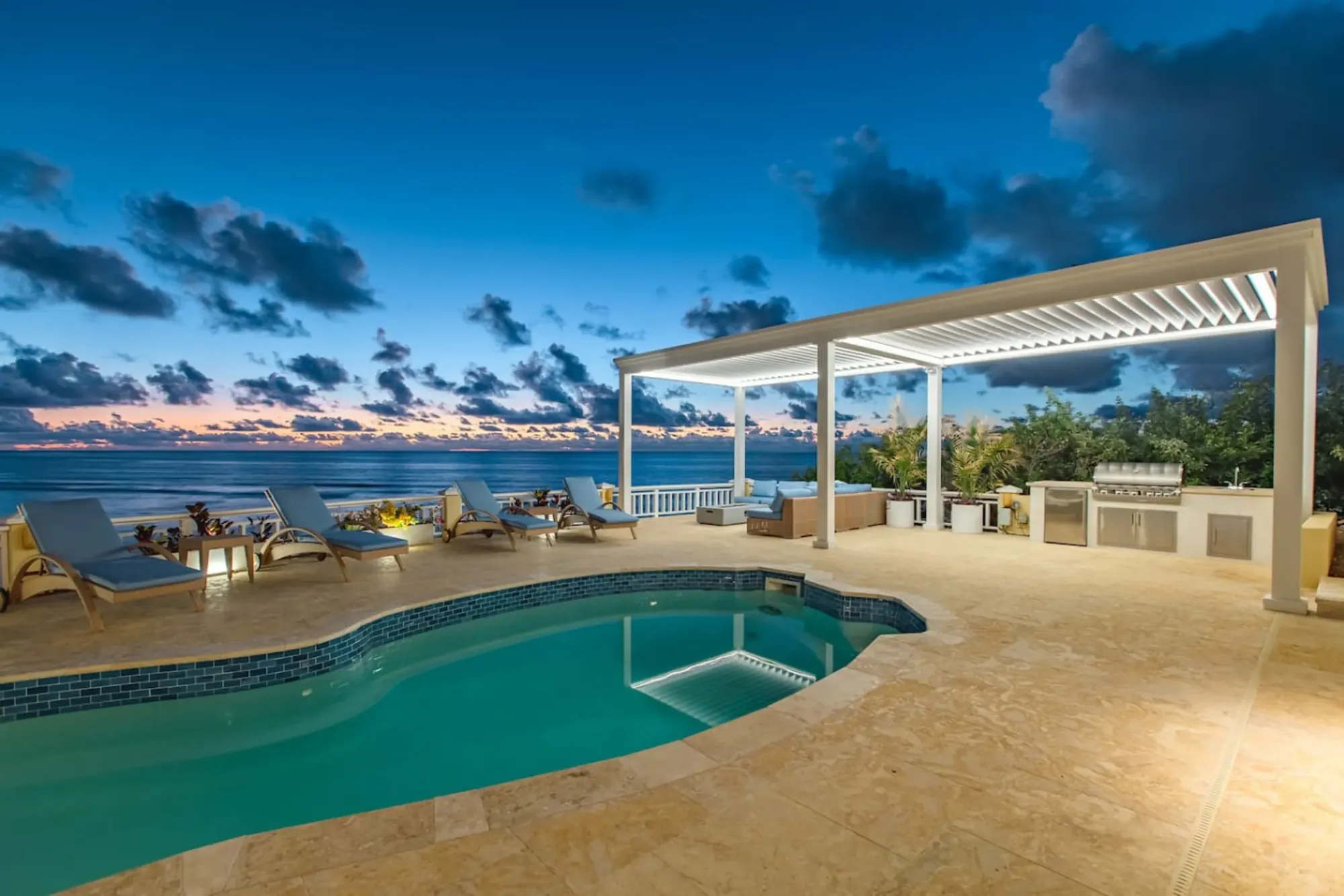
Come home to a kitchen full of food and a pool above the sea. Dinner on the deck after a west-end day has a shape of its own — someone will have bought a bottle at Cruzan, and Cruzan single barrel over one big cube is the island's house pour — and the conversation will be about what you saw in the mill yard, which is the point. In the morning, the sunrise from the private beach is the same one Whim's cane cutters were in the fields for; you get to watch it with a coffee.
Practical last things. Whim is a two-hour stop inside a nine-hour day, so do it on a full villa day, not an arrival or departure day. Wednesday through Saturday only, hours confirmed by phone. Real shoes, hats, water, cash for admission, and a booked Cruzan slot. And if the great house is open inside when you go, tell us; it will mean the Society has finished a repair the whole island has been waiting on since 2017.
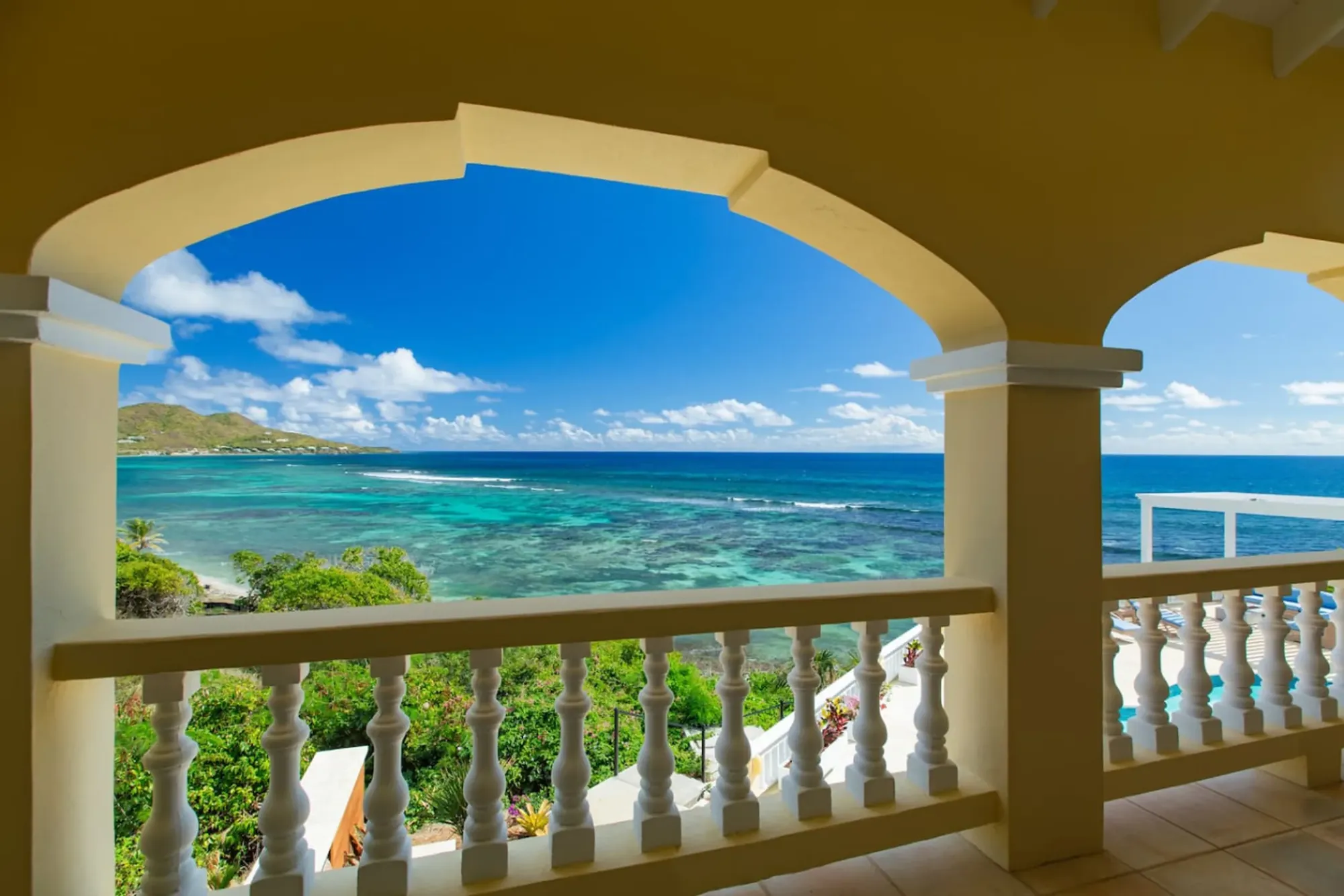
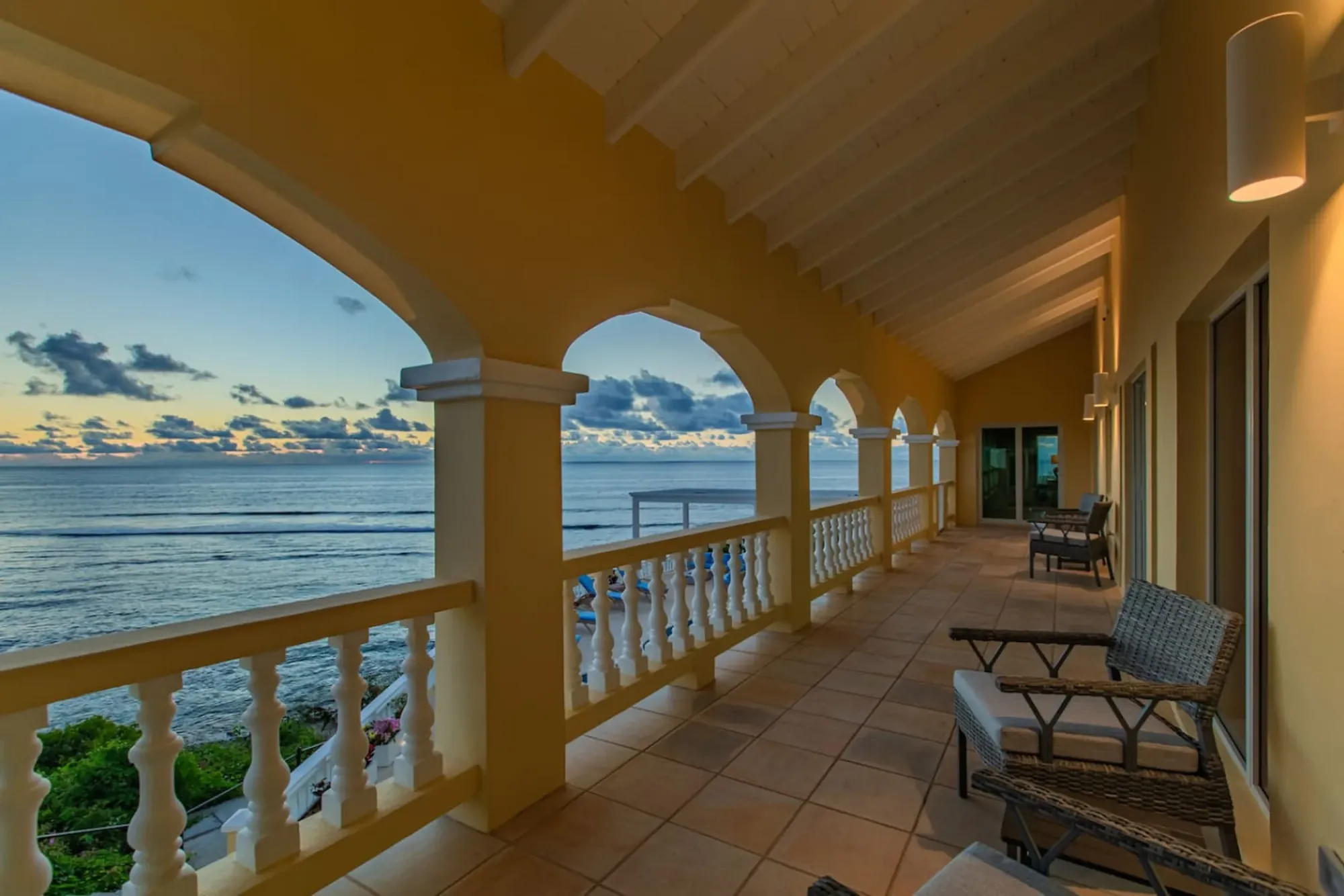
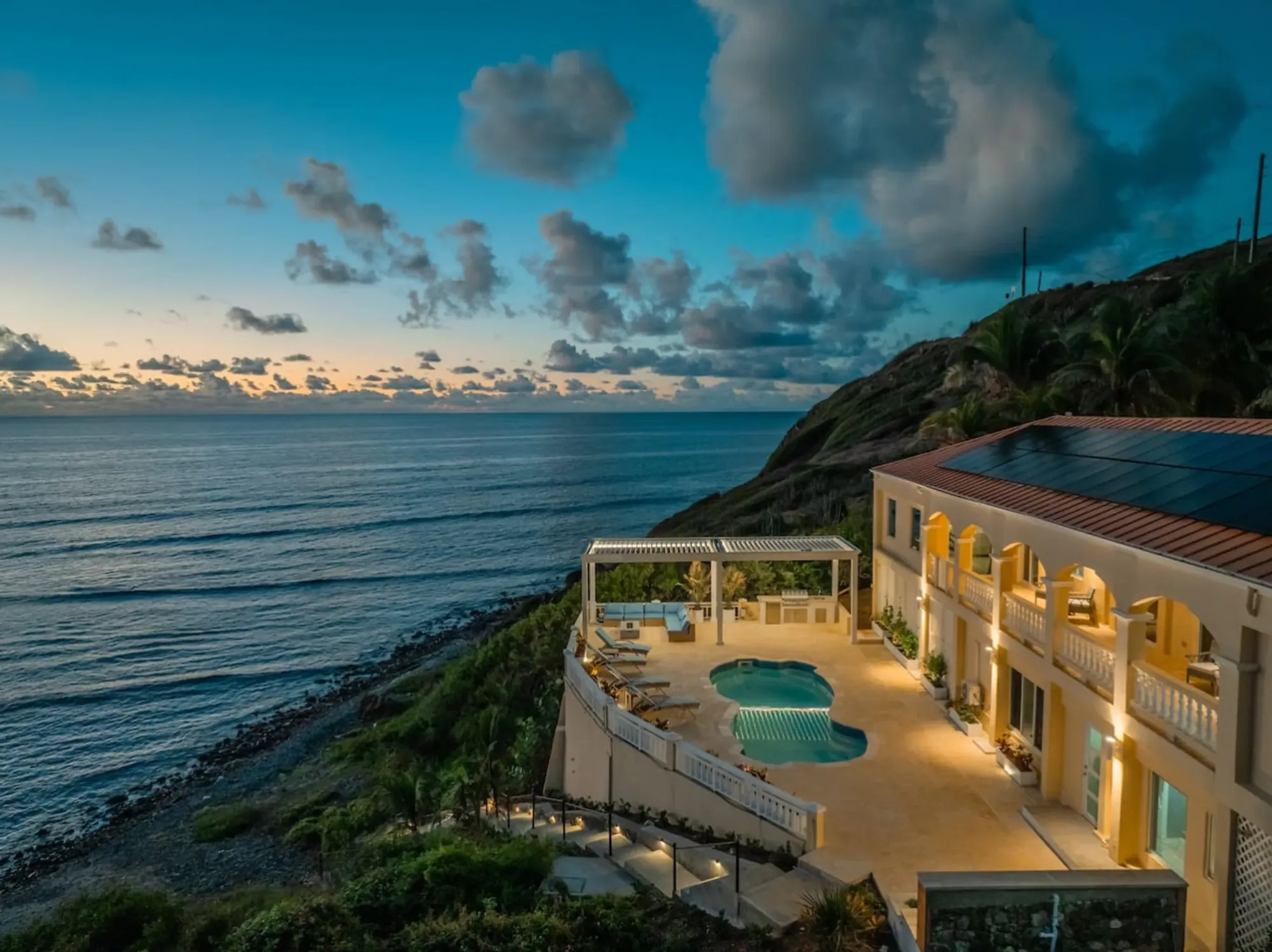
The arched veranda at The Cerulean at first light: the East End's sunrise is the start of a west-end history day, and the same coast the estates' cane cutters watched it from.Photo: The Cerulean
The Cerulean
Twelve of you, one private beach.
The Cerulean sleeps twelve on St. Croix's quiet East End — check your dates.