Agrifest: The Virgin Islands Agriculture & Food Fair on St. Croix
St. Croix guides · Culture & events26 min readUpdated Aug 2026
Presidents' Day weekend at Estate Lower Love: Senepol cattle, St. Croix sheep, kallaloo and pates, seedlings that sell out by Sunday, and the plan for doing it from the East End.
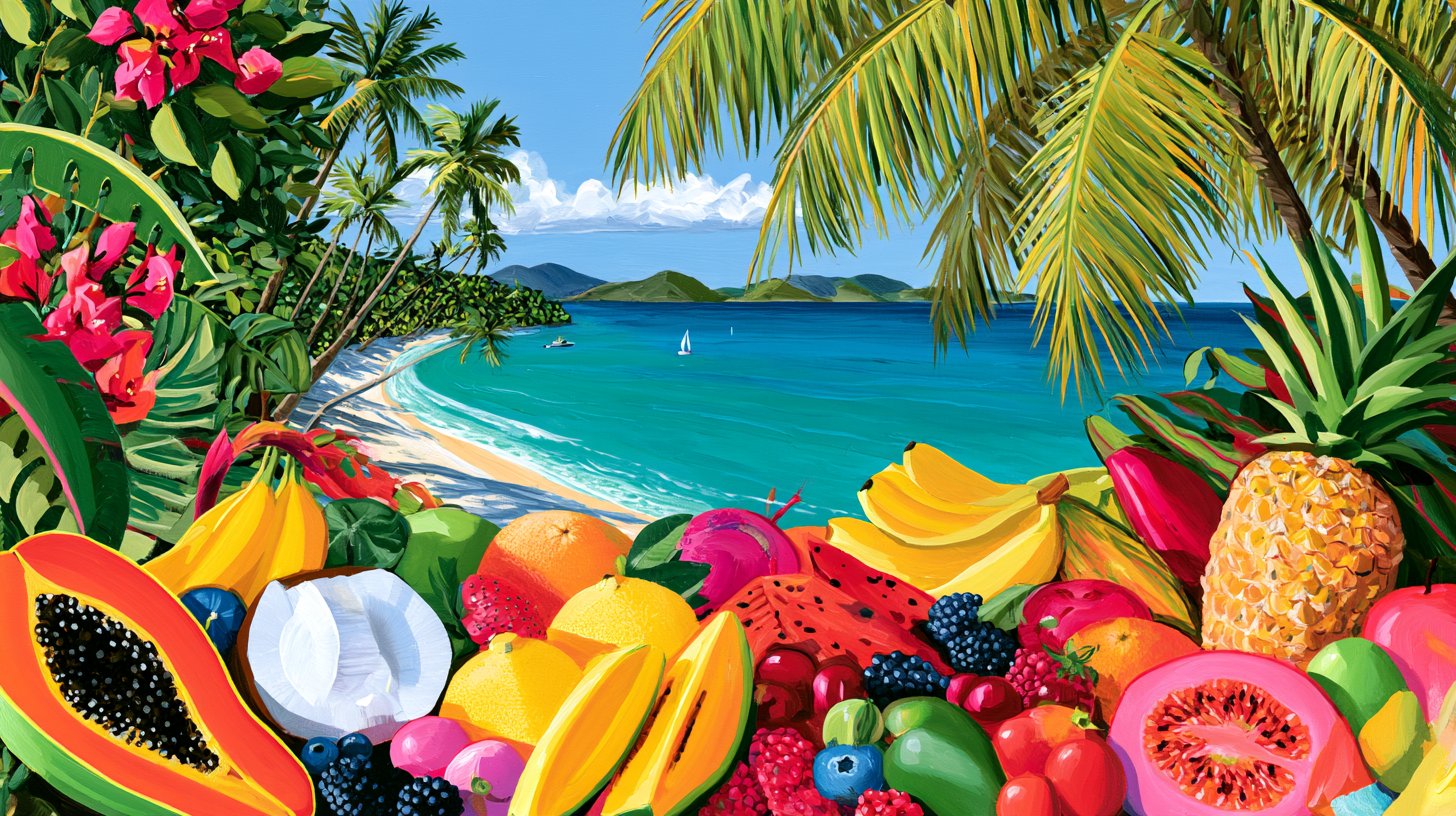
Original illustration
Agrifest is the Virgin Islands Agriculture and Food Fair: three days every Presidents' Day weekend when the territory's farmers, cooks, schoolkids, plant sellers, steel bands and stilt dancers take over the Department of Agriculture's grounds at Estate Lower Love, in the middle of St. Croix. It has run at Lower Love since 1971, it expected exhibitors from five other Caribbean nations in 2026, and it is the one weekend a year when the whole island shows up in the same field to eat. If your February villa week touches it, go. This guide covers the history, the animals, the food, the plan, and the farms you can visit the other 51 weeks.
Strip away the music and the fried food for a second and Agrifest is a real agricultural fair, the kind most American counties still hold in August: judged livestock, produce competitions, youth exhibits, farm-equipment displays, government booths, and a Farmer of the Year award handed out on the opening day. The formal name is the Virgin Islands Agriculture and Food Fair — the 2026 edition was billed as the 54th Annual Agriculture and Food Fair of the U.S. Virgin Islands — and it is organized by the V.I. Department of Agriculture with the University of the Virgin Islands School of Agriculture, with the V.I. Lottery as a major sponsor. The board president is the Commissioner of Agriculture, Dr. Louis E. Petersen, Jr.
What makes it different from a stateside county fair is the seasoning. The livestock pavilion holds cattle bred on this island and hair sheep named for it. The food booths serve kallaloo and roast pork and pates, not funnel cake. The stage runs steel orchestras, quelbe scratch bands and mocko jumbies. And the crowd is the whole territory: in 2026 the organizers expected visitors and exhibitors from St. Thomas and St. John as well as St. Croix, plus Antigua, Barbuda, St. Kitts and Nevis, Guyana, St. Lucia and Grenada. It is the largest agricultural festival in the territory, and nothing else on the island's calendar puts as many Crucians in one place in daylight.
The fair sits on Presidents' Day weekend, Saturday through Monday, at the Rudolph Shulterbrandt Agricultural Complex in Estate Lower Love — the Department of Agriculture's own grounds, mid-island, a few minutes from the airport road. Gates open at 9 am and close at 6 pm; the opening ceremony is at 10 am on Saturday. It is not a tourist event that locals tolerate. It is a local event that visitors are welcome at, which is a better thing to walk into, and it explains the deputy commissioner's line about people who miss Christmas at home but not the fair.
“If people don't come home for Christmas, they come home for AgriFest.”
Shamari Haynes, Deputy Commissioner of Agriculture, quoted by AFAR
The dates, the hours and what it costs
The 2026 fair ran February 14 to 16 — Saturday, Sunday and the Presidents' Day Monday — from 9 am to 6 pm each day, with opening ceremonies at 10 am on the Saturday and the Farmer of the Year presentations the same day. Gate admission was 8 dollars for adults, 5 dollars for children and 6 dollars for seniors. Those are the figures UVI and the V.I. Consortium published a week before the gates opened; plan around them until the 2027 announcement replaces them.
For 2027, Presidents' Day is Monday, February 15, so the fair should run February 13 to 15. Those dates are already listed online, with 10 am to 6 pm hours and a slightly older admission scale (6 dollars for adults, 4 dollars for children 12 and under, 5 dollars for seniors, and discounted weekend passes) that looks like a carry-over from an earlier year rather than a 2027 price list. Our advice: assume the 2026 hours and prices, expect a dollar or two of drift, and check the fair's Facebook page or the Department of Agriculture's release in late January.
Inside the gate, budget for cash. Most vendors are cash-only. A plate of food from a booth costs what a plate at a local restaurant costs; pates and juices are a few dollars each; a box of tarts and Vienna cake for the villa is a modest splurge; seedlings and produce are cheap by any standard. There are no published totals for how many people come through the gates, only the organizers' description of "thousands" from across the region — enough that the food lines are real by noon and the parking spreads out into the fields around the complex.
1971First fair at Lower Love
54th2026 edition
3Fair days
9 am–6 pmHours (2026)
$8Adult gate (2026)
12Acts on the 2026 stage bill
From field days at Anna's Hope to the fairgrounds at Lower Love
The fair is older than its numbering. According to the history the St. Croix Times has compiled, what we now call Agrifest began in the 1930s as agricultural field days at the former Agricultural Experiment Station at Estate Anna's Hope, east of Christiansted. They were held in February, and they had the bones of the modern fair already: produce, livestock, poultry and local products on display, music, speeches by officials, and awards for the farmers who had grown the best of the year. Farmers came to trade animals and knowledge as much as to compete. Then, for reasons the record does not spell out, the field days lapsed.
In 1971 the late Agriculture Commissioner Rudolph Shulterbrandt, with a group of others, restarted the fair — this time at Estate Lower Love, on Department of Agriculture land, and free to the public. From 1972 it operated out of a garage building on the grounds, showing fruits, vegetables, ornamental plants and food demonstrations under the name Field Day, then St. Croix Agricultural and Food Fair, and finally the Virgin Islands Agriculture and Food Fair it carries today. That is the line the 54-fair count runs back along, and it is why the whole complex now carries Shulterbrandt's name.
Two later dates matter. Hurricane Hugo, in September 1989, wrecked the island's farms; the fair was hit hard in 1990 and came back in 1991 with, in the Times' phrase, a renewed sense of vigor. And in 1995 Commissioner Arthur C. Petersen, Jr. rebuilt the physical fair — modular booths, exhibition tents, electrical hookups, bathrooms and entertainment spaces — and folded in University of the Virgin Islands exhibits alongside the Department of Agriculture's own displays. The fair you walk today, with its two exhibit warehouses, its livestock pavilion, its outdoor vendor rows and its stage, is that 1995 layout grown up. The count skips the years the fair could not be held, which is why 2026 was the 54th rather than the 56th.
1930sAgricultural field days begin at the experiment station at Estate Anna's Hope — produce, livestock, poultry, speeches and awards, every February
1971Commissioner Rudolph Shulterbrandt and others restart the fair at Estate Lower Love, free to the public
1972The fair settles into a garage building on the Department of Agriculture grounds: fruits, vegetables, ornamentals and food demonstrations
1989Hurricane Hugo devastates the island's farms
1995Commissioner Arthur C. Petersen Jr. adds modular booths, exhibition tents, power, bathrooms and stages, and brings UVI exhibits into the fair
2026The 54th fair, February 14–16, under the theme Agriculture and Technology
2027Expected February 13–15, Presidents' Day weekend — confirm with the organizers
Who runs it, and why there is a theme every year
Agrifest is a government-and-university fair, and that shapes it. The Department of Agriculture owns the grounds and the livestock competitions; the UVI School of Agriculture brings the research exhibits, the demonstrations, the youth programming and a good share of the organizing staff (the 2026 media contact was a UVI number); the V.I. Lottery writes a sponsorship check. There is a fair board, chaired by the commissioner, and the year's theme comes from it. Themes are not decoration — they set the exhibits. In 2026 the theme was Agriculture and Technology: An Ideal Mix in 2026, and Commissioner Petersen explained it as a nod to modern scientific innovations in farming and, just as much, to attracting the younger generation to careers in agriculture. In a technology year the exhibits lean that way; another year's theme steers them elsewhere.
The awards are the fair's ceremonial spine. Farmer of the Year presentations happen on the Saturday, after the 10 am opening ceremony, and they are taken seriously — being named a Livestock Farmer of the Year, as Sejah Farm's Dale and Yvette Browne were in 2006, is a credential a St. Croix farm carries for years. There are competitive events and games through the weekend, judged livestock and produce, and school and youth-group exhibits that get their own space and their own ribbons.
What this means for a visitor is that Agrifest has a program, not just a midway. The music schedule, the ceremony times, the judging and the fashion show are posted by the organizers each year, mostly on the fair's Facebook page and in the island press. Look at the schedule the night before you go and pick two things you will not miss; then let the rest of the day happen. Between the scheduled pieces the fair is a walk: pavilion, farmers' hall, food rows, bakers' hall, stage, kids' area, and back to the car with a bag of produce.
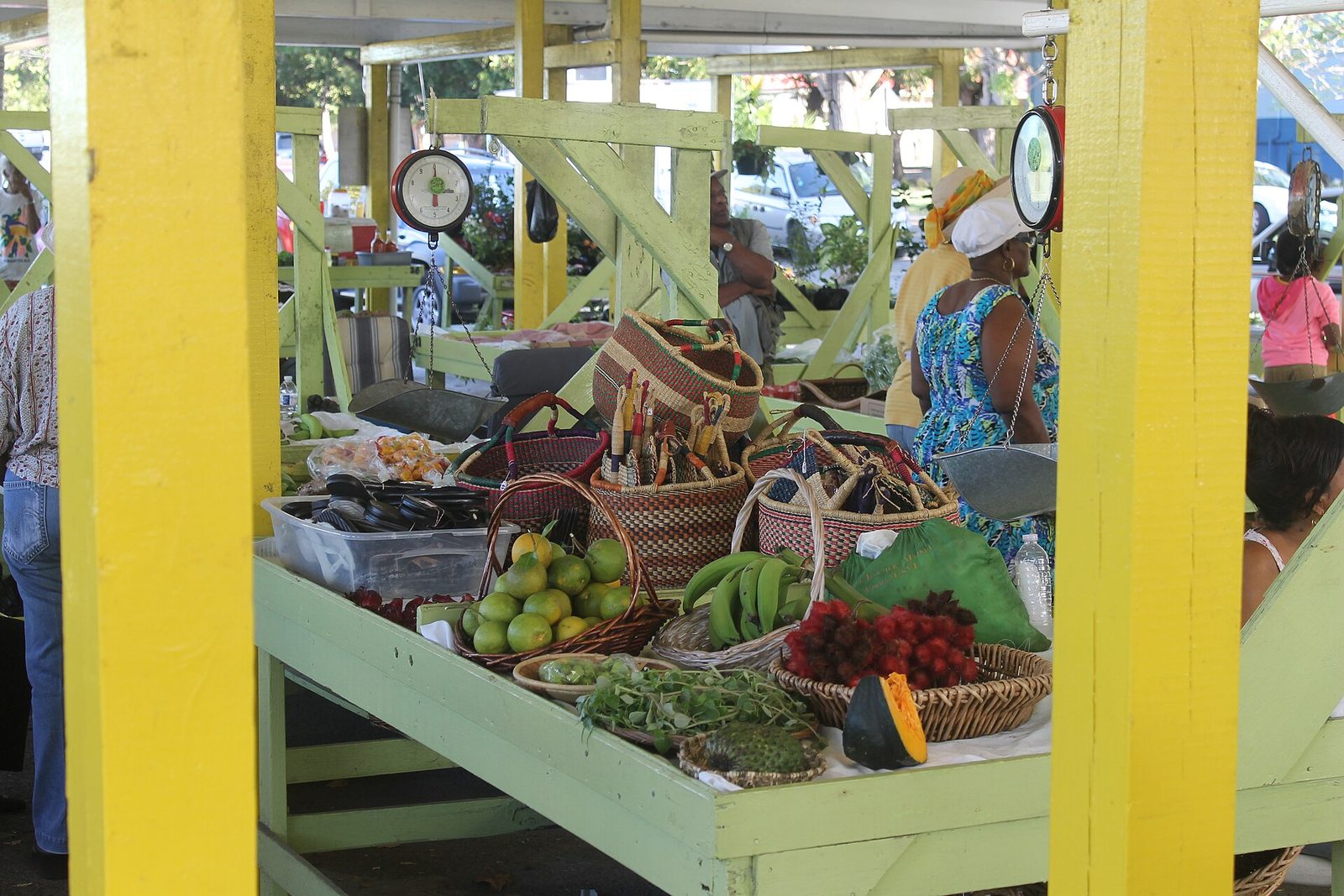
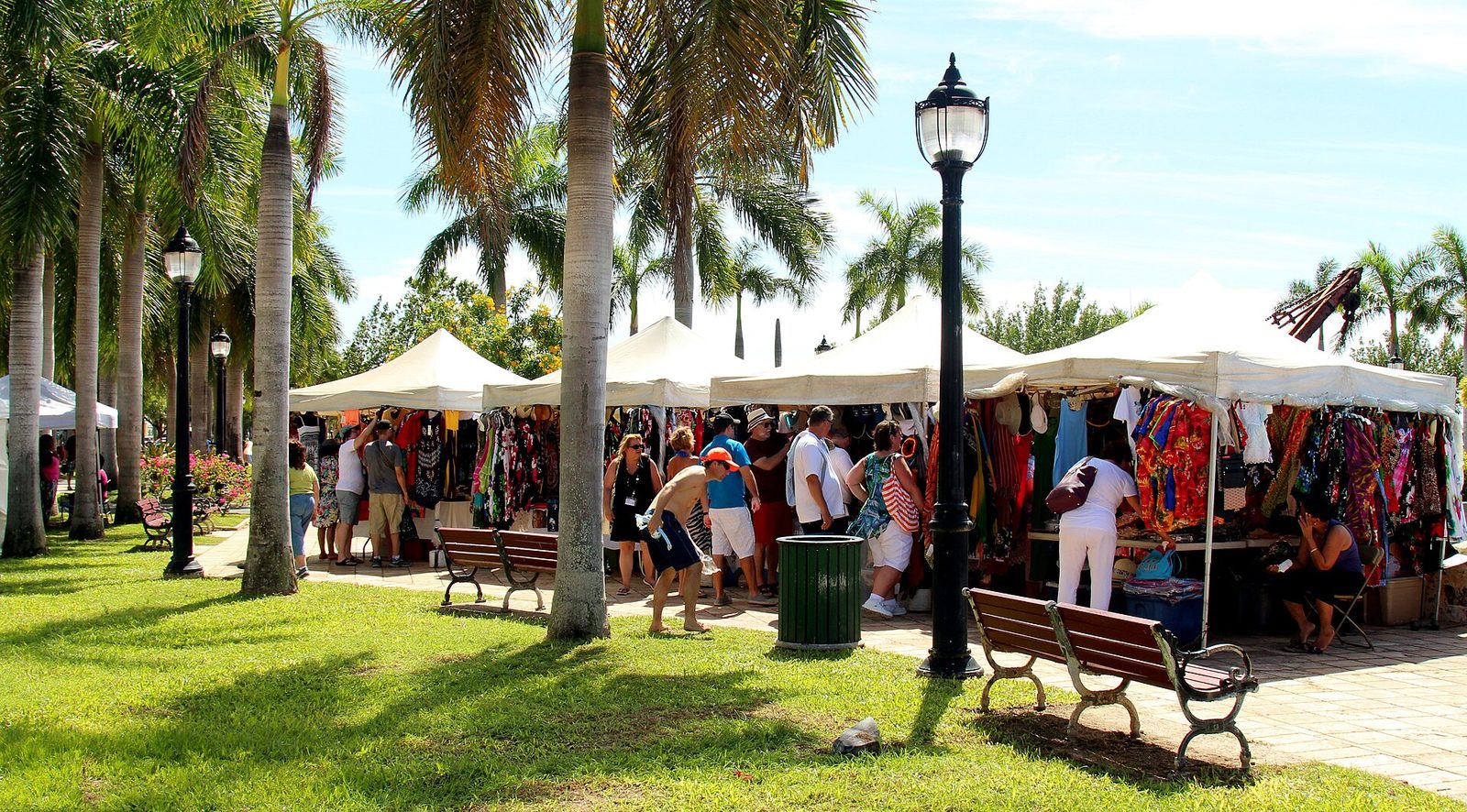
Produce, herbs, plants and bottled bush tea, sold by the people who grew them — the same growers who fill the farmers' hall at Agrifest sell at the island's markets the rest of the year.Photo: Connie Ma (CC BY-SA 2.0)
The livestock pavilion: Senepol cattle and St. Croix sheep
Go to the animals first. The livestock pavilion — formally the Frits E. Lawaetz livestock pavilion — holds cattle, pigs, sheep, goats, chickens, ducks, rabbits, and usually a few emus and peacocks for the children, and two of the breeds in it are the reason St. Croix has a place in world agriculture at all.
The first is the Senepol. In 1860, sixty heifers and two bulls of the N'Dama breed were shipped to St. Croix from Senegal; by 1889 Henry C. Nelthropp, at Granard Estates, had built one of the largest N'Dama herds anywhere, 250 purebred animals. In 1918 his son Bromley bought a Red Poll bull from Trinidad — the Red Poll being an English breed — to improve the cows' milk and to breed out their long horns; another Red Poll bull came from St. Thomas in 1942 with two locally raised Red Poll cows. The name Senepol was adopted in 1954 and a breed registry followed in the late 1960s. The result is a polled, short-haired animal, usually red, sometimes black or brown, that tolerates heat and shrugs off ticks and flies. Twenty-two cows went to the U.S. mainland in 1977; today there are more than 500 breeders and more than 14,000 registered Senepol, in Australia, South Africa, Venezuela, Mexico and Brazil as well as the Caribbean. Recent DNA work complicates the folk story: the breed reads as roughly 89 percent European taurine, about 10 percent zebu and less than 1 percent African taurine, so the Red Poll and Criollo lines did more of the work than the N'Dama name suggests.
The second is the St. Croix sheep, a hair sheep — no wool, so no shearing — believed to descend from West African sheep brought over on the slave ships. It is a small, hardy meat breed with unusual resistance to internal parasites, which university studies have documented against British breeds. Mainland Americans know it as the Virgin Island White, because the animals first exported north were selected for white coats; on the island they come white, brown, black and spotted. The U.S. flock traces to two ewes and a ram Michael Peil took to Maine in 1957 and to 22 ewes and three rams Dr. Warren Foote took to Utah State University in 1975. In the pavilion, the sheep and goats are the pens children park at; the Senepol are the animals the farmers stand around and argue over.
The Cerulean
Plan it from the villa.
Five bedrooms, a private swimmable beach, and all of this within a day trip.
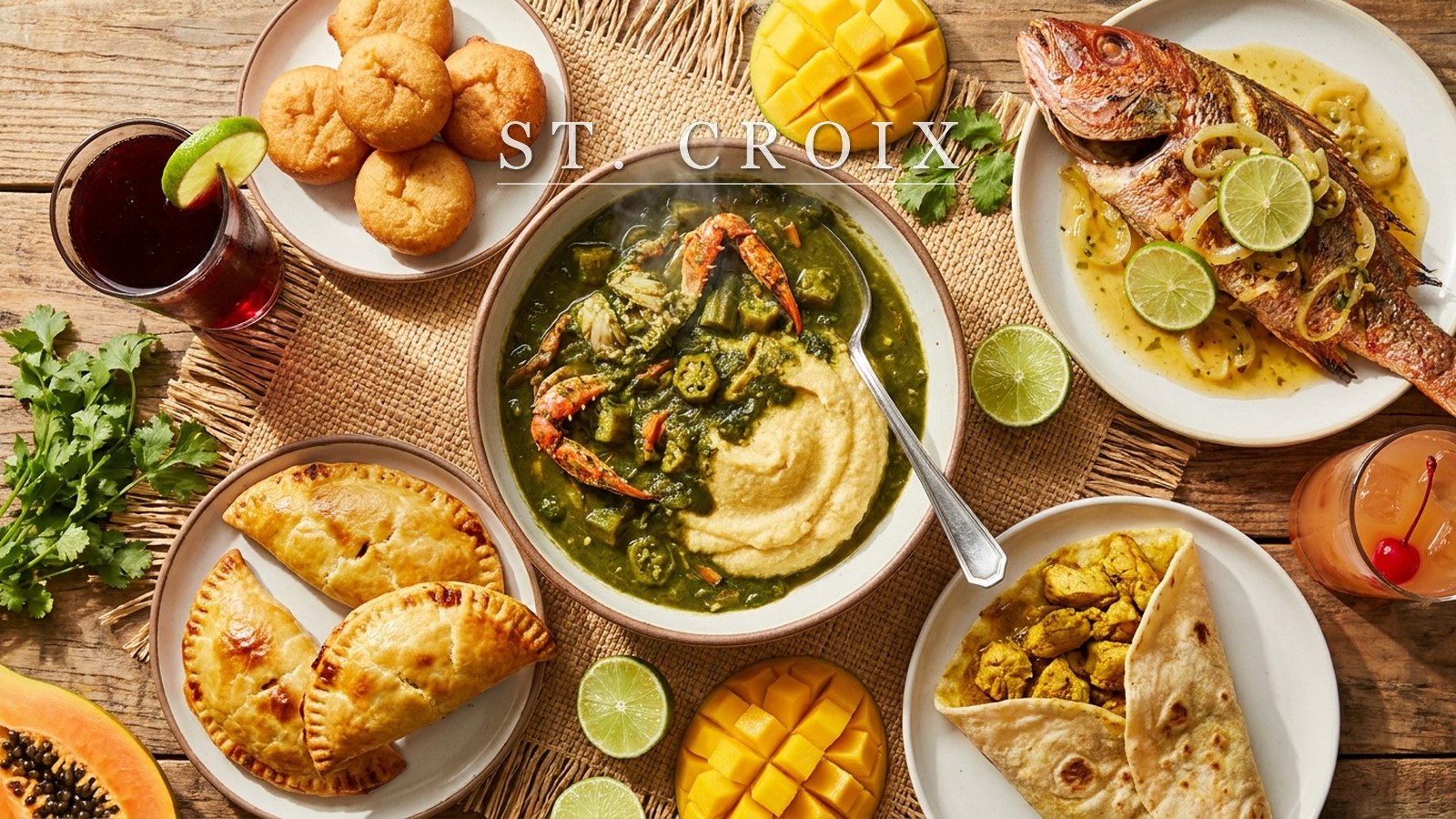
Agrifest is a farm fair, but for most people who go it is a food weekend, and it earns that. The booths and food trucks run in outdoor rows between the exhibit halls, and the range is the whole home kitchen of the island: fried chicken legs and pates; roast goat and roast pork, including pork done in stone ovens; kallaloo made with seafood or with pork; red peas soup; crab and rice; fish and fungi, the cornmeal side that goes with everything; stew chicken; conch in butter sauce with the Crucian trimmings; and johnny cakes to eat with any of it. The booths and trucks are run by local cooks and small food businesses, and the best plates come from the ones with a line of locals in front. Our Crucian food guide explains what each dish is and how it is supposed to taste, so this section sticks to the fair.
Eat in this order. A pate and a cup of juice on the first walk, standing up, because a pate is a walking food. A plate around 11, before the lines, and split it — Crucian portions assume you were farming that morning. Then the sweets: the bakers set up in their own hall, and the things to look for are Vienna cake (a many-layered cake with fruit preserves between the layers), guavaberry tarts, gooseberry and tamarind stews, tamarind balls, butter cookies and cocoa cheese, a fudge-like candy that has nothing to do with cheese. Buy a box for the villa; it keeps. Drinks are the island range — fresh sugarcane juice, tamarind, passion fruit, ginger beer, peanut punch, and bush tea, hot or as a lemonade — and worth ordering early, because a February afternoon in an open field makes you thirsty.
Two practical notes. First, cash: most vendors are cash-only, and the fair is not the place to test a card reader. Second, timing: the roast pork and the most popular plates run out on Saturday, sometimes before mid-afternoon, and the produce and seedlings in the farmers' hall thin out by Sunday. If food is the point of your visit, Saturday at opening is the day, and lunch is at 11.
What to eat or see
Where in the grounds
Tips
Pates, johnny cakes, fried chicken
Food booths and trucks in the outdoor rows
Buy one on the first walk and eat it standing — lines are shortest before 11
Kallaloo, red peas soup, crab and rice, fish and fungi, stew chicken
The plate-food booths
Share plates (portions are Crucian-sized) and look for the booth with locals in line
Stone-oven roast pork, roast goat
The roast-pig stands
Sells out first on Saturday — go early or accept it is gone
Sugarcane juice, local juices, ginger beer, peanut punch, bush tea
Drink stands throughout
Ask what is pressed fresh that day, and buy more than you think
Senepol cattle, St. Croix sheep, goats, pigs, emus, peacocks
The livestock pavilion
First hour, before the heat — read the breed cards
Produce, seedlings, fruit trees, nutmeg
The farmers' hall (the first exhibit warehouse) and outside rows
Seedlings sell out by Sunday — bring a bag and small bills
Youth and school exhibits, UVI and Department of Agriculture booths
The exhibit tents and halls
Good shade stops with kids — the technology booths change with the theme
Steel pan, quelbe, mocko jumbies, the fashion show
The stage
Check the day's schedule on the fair's Facebook page the night before
Donkey-cart rides, carnival rides, petting zoo
The kids' area
Small bills — go before the afternoon heat
The farmers' hall: produce, seedlings and what to carry home
The grounds are two main warehouses — one for agriculture and the farmers, one for the bakers and craftspeople — with the vendor tents and food trucks outside, and that is a good mental map. The farmers' hall is where the island's growers sell what February gives them, and February is the growers' high season on St. Croix: the dry, cool months from about December to April are when the lettuce, cabbage, tomatoes, herbs, peppers and salad greens come in, and the hall is full of them. There is fruit in season, honey, eggs, bottled hot sauces and seasoning blends, and fresh nutmeg grown on the island. There are also the plant tables — seedlings, herbs in pots, young fruit trees, ornamentals — that are the fair's original product line, going back to the 1972 garage building, and that still empty out by Sunday.
What to buy depends on where you are sleeping. If you are staying at a villa with a kitchen, the produce is the best purchase at the fair, full stop: a bag of tomatoes, greens, herbs and whatever fruit is in season, cooked that night in the villa kitchen, is the most local meal you will eat on the island, and it costs less than a round of drinks in Christiansted. Bring a bag; the vendors will not always have one. Bring small bills. And put a cooler in the car, because the walk back to the parking field is longer than you think and the afternoon is warmer than you think.
What not to buy, unless you have checked: plants and seeds to fly home. Baggage leaving the U.S. Virgin Islands for the mainland goes through agricultural inspection, and the rules on soil, live plants and fresh fruit are specific and change; a seedling bought on Saturday can be a problem at the airport on Friday. Bottled sauces, sealed jams, spice mixes and dried bush tea travel without drama. If you have fallen for a tree, ask the vendor — the growers here ship and sell all year, and they know the rules better than the fair does. Our provisioning directory covers the supermarkets and Seaside Market for everything the fair does not sell.
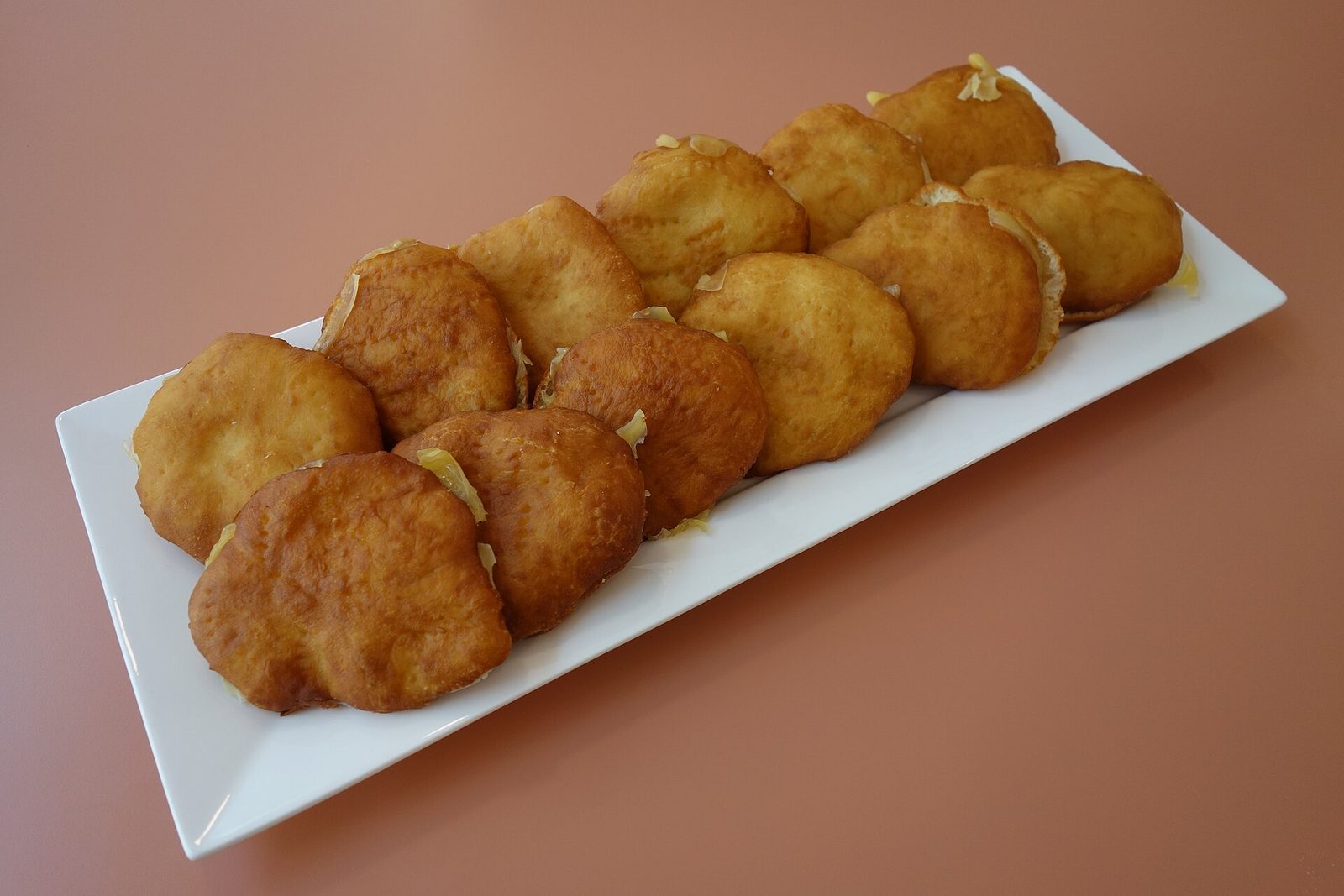
Local plates and juices — one-pot dishes, fried pates, roast pork and fresh-pressed juice — are the reason many people spend the whole day at a Caribbean agricultural fair.Photo: Dqfn13 (CC BY-SA 4.0)
Youth exhibits, school booths and the kids' side of the fair
The youth side of Agrifest is not an afterthought; it is half the reason the Department of Agriculture and UVI run it. Every year there are school and youth-group exhibits — 4-H clubs, school gardens, agriculture classes — with their own space and their own judging, and the 2026 theme was chosen, in the commissioner's words, partly to attract the younger generation to careers in agriculture. In practice the exhibits run from school-garden displays and posters to animals the youth clubs raised themselves and, in a year themed on technology, hydroponic and sensor demonstrations, with UVI booths explaining research trials in plain language. The Department of Agriculture and USDA booths sit in the same area, and they are the place to ask questions about the island's farming that a food vendor will not have time for.
For children who are there to have a day out rather than to learn, the fair delivers too. There are donkey-cart rides, carnival rides and a petting zoo, and the pavilion animals do the rest: emus and peacocks are reliably the exotic hit, the goats and St. Croix sheep are the ones a small child will actually touch, and the Senepol are big enough to be impressive from behind a rail. Competitions and games run through the weekend, and mocko jumbies on their stilts work the grounds between stage sets — a jumbie leaning down to a stroller is a St. Croix rite of passage, and children either love it or need a minute.
The kids' pacing is the adults' pacing, only shorter. Opening hour for the animals and the rides while it is cool; the exhibit halls as shade; a pate and a juice as the mid-morning bribe; the stage for one steel-band set; and out by early afternoon, before the sun and the crowds turn a good day into a long one. Our St. Croix with kids guide has the rest of the island's kid days for the week around it.
The stage: quelbe, steel pan, mocko jumbies and the fashion show
Agrifest is also a three-day concert, and the 2026 lineup shows the range the organizers aim for. It included the Superior Court Rising Stars Steel Orchestra and the St. Patrick's School Steelpan Orchestra, Partners for Strings of St. Thomas, the I-Land Boyz Pan Experience, Xpress Band, 411 Live Band, Hartatak International, La Fuerza VZ, and — the anchor for anyone interested in the island's own music — Stanley and the Ten Sleepless Knights, the elder statesmen of quelbe, the scratch-band music of the Virgin Islands built on banjo, fiddle, percussion and call-and-response singing. The Guardians of Culture Mokojumbies and the AY AY Cultural Dancers filled the cultural slots, and quadrille dancers, the set-dance the islands inherited from the French, turn up most years too. The Fair Wear Extravaganza is the fashion show among the fair's daily events; it is exactly what it sounds like, and it draws a crowd.
The mocko jumbies are the piece that first-time visitors remember. Stilt dancers with roots in West African masquerade, they walk the grounds as much as they perform on the stage, high on their stilts in bright cloth, bending down to shake hands with children and adults who did not expect it. We have a full mocko jumbie and quelbe guide that covers the history and where else to meet them — the Christmas Festival parades and the Christiansted Jump Up nights — so here it is enough to say that Agrifest is the daytime, family-hour version, and probably the easiest place on the island to photograph a jumbie against sky rather than streetlights.
The stage schedule is posted by the organizers each year, day by day, and it is worth checking the evening before: the steel orchestras and the school bands tend to play the daytime slots that suit a family visit, and Stanley and the Ten Sleepless Knights are the set to plan around if you want to hear quelbe played by the people who kept it alive. Sit in the shade at the edge of the stage crowd with a plate; it is the best hour of the fair.
Fair and festival culture on the islands: stilt dancers, steel pan and scratch bands work the same grounds as the livestock and the food booths.Photo: jalexartis Photography (CC BY 2.0)
Getting there, parking and the shuttle
The Rudolph Shulterbrandt Agricultural Complex is in Estate Lower Love, mid-island, on the Department of Agriculture's grounds off Centerline Road (Route 70), a few minutes from the airport and roughly halfway between Christiansted and Frederiksted. From the East End the drive is about 30 to 40 minutes: down to Christiansted, then west on Centerline through Sunny Isle and past the Sion Farm and La Reine turns. Signs and marshals appear on the approach on fair days; if you have not driven the island before, our driving on St. Croix guide covers the left-hand rule and the roundabouts, and the car-rental directory covers the pickup. If you would rather not drive, a taxi from Christiansted is the alternative and, in past years, the VITRAN bus has run a special Agrifest schedule between 9 am and 6 pm — the St. Croix Source reported one in 2020.
Parking is on the complex and in the fields around it, and it works the way county-fair parking works everywhere: the earlier you arrive, the closer you park, and by mid-afternoon on the weekend days you may be walking a while from a field along the road. Nobody publishes a parking map. Inside the gate, the grounds are big enough that a shuttle runs from one end to the other, which matters more than it sounds if you have a stroller, a grandparent, or a bag of produce and a box of tarts. Use it on the way out.
Once you are through the gate, orient yourself before you eat. The layout is roughly: livestock pavilion, the two exhibit warehouses (farmers first, bakers and crafts second), the outdoor vendor rows and food trucks between and around them, the exhibit tents, the stage, and the kids' area with the rides. Bathrooms exist — the 1995 rebuild put them in — but bring wipes and hand sanitizer anyway. Water is sold everywhere; carry a bottle regardless. And decide where the car is in relation to the gate before you walk away from it, because at 3 pm every parking field looks the same.
A first-timer's half day at Agrifest
Leave the East End by 8:15 with cash, hats, water, a bag and a cooler in the trunk, and be at the gate for the 9 am opening.
Livestock pavilion first — Senepol, St. Croix sheep, goats, the emus for the kids — while the animals and the air are cool.
Farmers' hall next: produce, herbs and seedlings before the good tables empty
walk the bag back to the cooler.
Eat at 11: a pate on the walk, then a shared plate — kallaloo, roast pork or fish and fungi — before the lines form.
Stage and exhibit tents through the noon heat: one steel-band set, the youth exhibits, the technology booths, a jumbie handshake.
Bakers' hall on the way out for Vienna cake and tarts
ride the shuttle to the gate and be back on the villa pool deck by 3.
When to go, what to bring, and how to pace it
The honest answer on crowds is that no one publishes attendance by day, so what follows is pattern, not data. The first hour after the 9 am gate is the quiet one, on any day. Saturday builds fast after the 10 am opening ceremony and the Farmer of the Year awards, and by early afternoon the food lines and the parking are at their weekend worst. Sunday is a family day and busy from late morning. The Monday holiday is often the calmer loop, though the produce and the roast pork have been picked over by then. If you want the best of the farmers' hall and the roast-pig stands, go Saturday at opening; if you want an unhurried walk with small children, go Monday at opening; if you can only go in an afternoon, eat first and see the animals last, and accept the lines.
What to bring is a short list, and every item on it matters more than it would at a stateside fair. Cash, in small bills, because most vendors do not take cards. A hat and mineral sunscreen — the U.S. Virgin Islands ban the common chemical sunscreens, so bring zinc or titanium — because most of the grounds are open field. Real walking shoes; the grounds are extensive and, after rain, soft. A refillable bottle. A cloth bag for produce and a cooler left in the car. Wipes. A phone photo of the day's stage schedule. And a plan for the afternoon that does not involve standing up, because a fair in the tropical sun is a half-day event even for people who love it.
February weather helps. It is the middle of the island's dry, cool season, with trade winds and passing showers rather than downpours, and the mid-island fairgrounds are a little warmer and stiller than the East End coast. Read our weather-by-month guide for the numbers; the short version is that a February morning at Lower Love is pleasant, a February 2 pm in an open field is hot, and both are why the plan above front-loads the walking and back-loads the shade.
Why the fair matters: farming on a post-sugar island
St. Croix was a sugar island for two centuries — the estates, the mills and the great houses along Centerline Road are the evidence, and our Estate Whim and the sugar plantations guide tells that story — and when sugar finally ended in the 1960s, the land it had held did not turn overnight into a farming economy. Much of it went to housing, industry and bush. The island that once fed a colonial economy came to buy nearly everything it eats from ships, and the small farms that stayed were family operations, working through drought, hurricanes and the price of imported feed. Hurricane Hugo, in 1989, wrecked most of them at once; the fair's own history records that it barely made it through 1990.
Agrifest is the annual muster of the people who kept farming anyway and of the institutions that back them. It is where the Department of Agriculture and UVI's School of Agriculture show what they are working on, where the Farmer of the Year gets named, where 4-H kids show the animals they raised, and where a farm like Sejah — founded in 1998 by Dale and Yvette Browne, who also founded the Virgin Islands Farmers Cooperative to push, in their words, the resurgence of the territory's agricultural industry — sells alongside the newest hydroponic start-up. The 2026 theme, agriculture and technology, was explicit about the goal: productivity, and a next generation willing to farm. When the commissioner talks about attracting the young to agriculture, the fairgrounds full of school exhibits is what he means.
For a visitor, the practical translation is simple. Every plate you buy from a booth, every bag of tomatoes from the farmers' hall, every seedling a 4-H club sells you is money that stays on a small island with a small farming sector, and the fair is the one place all of it is in one field. That is a better reason to spend 8 dollars at the gate than the emus, though the emus are good too. The rest of the year, the same growers sell at the Saturday market and from their own farm stands, which is where this guide goes next.
The chef's kitchen at The Cerulean — the place a bag of Agrifest tomatoes, greens and herbs ends up the same evening.Photo: The Cerulean
Farms and farm stands you can visit the rest of the year
Three St. Croix farms sell to the public on a schedule you can plan a morning around, and all three were operating in 2026. Sejah Farm is the one to start with. Dale and Yvette Browne established it in 1998 on about 15 acres in the island's interior, and it is a small working farm with a stand: fruits and vegetables, seedlings, and their own lamb, goat, pork, chicken and rabbits, plus eggs, spice mixes and sauces. The farm market has been open Monday to Friday from 10 am to 5 pm and Saturday from 7 am to 5 pm, per the farm's own listings; the Brownes were the Department of Agriculture's Livestock Farmers of the Year in 2006 and founded the Virgin Islands Farmers Cooperative, so a conversation at the counter is a short course in island farming. Call ahead (340-277-6046 as listed) if you are driving from the East End specifically for meat.
ARTfarm, on the South Shore Road between Ha'Penny beach and the Boy Scout camp, is Luca Gasperi's organic vegetable and fruit farm — salad greens, herbs, heirloom tomatoes, melons, pineapples, mangoes, papayas and hot peppers grown with organic and permaculture methods — and it sells through pop-up farm stands that open for one hour, two or three days a week, in season. In mid-2026 the pattern was Saturday 10:30 to 11:30 am and some Wednesday afternoons from 4:30 to 5:30; the farm posts each stand on its site and to an email list, and it describes itself as very seasonal, so check before you drive. From the East End it is the closest of the three.
Ridge to Reef Farm is on the far side of the island at Estate Little La Grange, in the hills above Frederiksted, and it is the one that is a destination rather than a stop: the only certified organic farm on St. Croix, with a farm stand — the tienda — that has been open Wednesday and Saturday from 11 am to 3 pm for seasonal fruit, vegetables, sauces and jams, plus a CSA, farm tours on foot of half an hour to two hours, farm stays, and pasture-raised hogs. It is run alongside the Little La Grange farm and the Lawaetz Museum, in the estate's 18th-century great house. VisitUSVI's listing shows daily hours; the farm's own site was not reachable when we checked, so phone first (340-473-1557 as listed). It is about an hour from the East End, and it pairs with a west-end beach afternoon. St. Croix Times' farm-stand list also names Crescent Farms VI on Windsor Road at Glynn (call for availability) and the Southgate Corner market on the East End, which runs regular and pop-up markets with fruit, honey, eggs, goat cheese and plants.
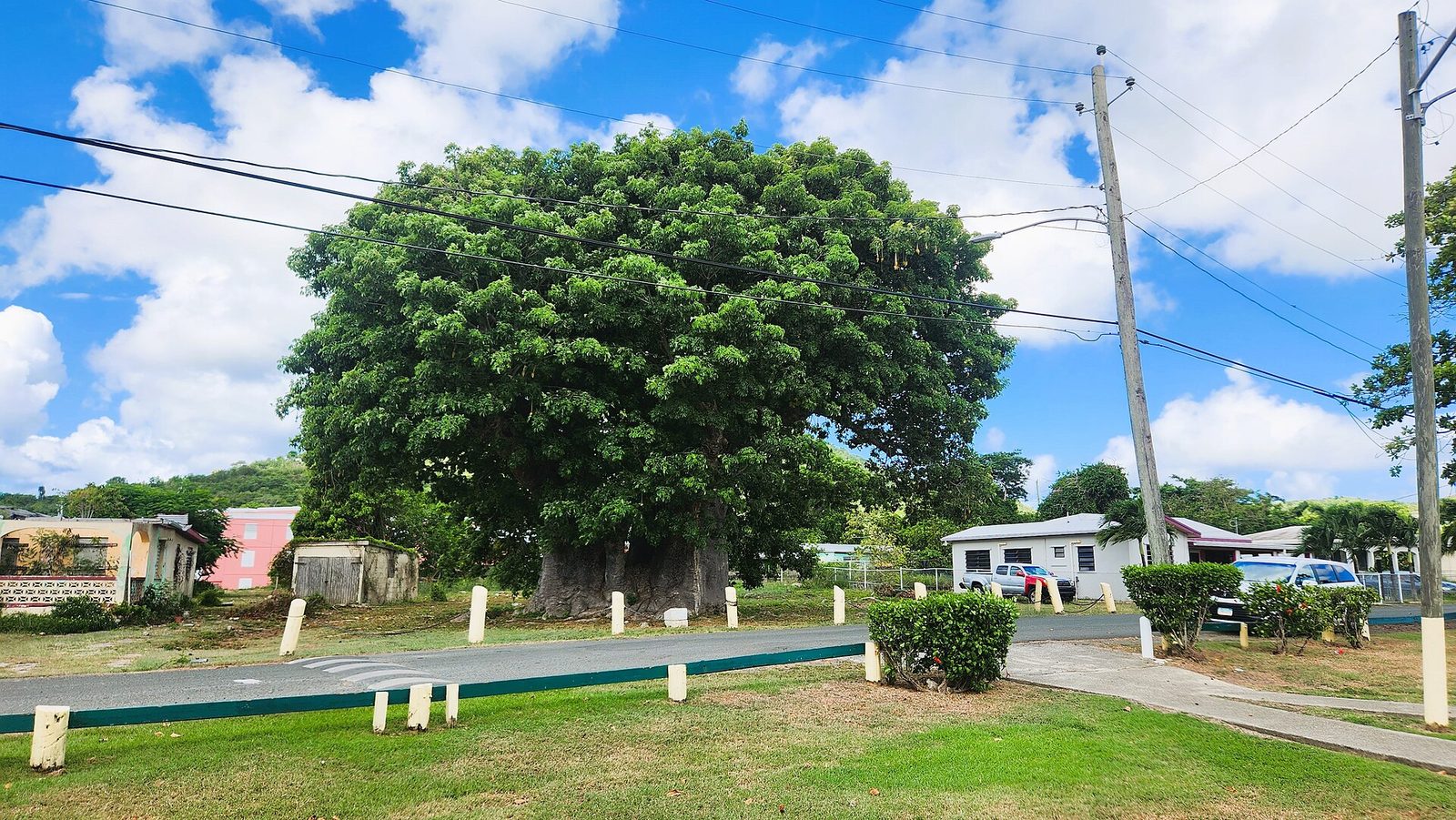
The baobabs at Grove Place, mid-island — African trees on former estate land, a short detour west of the fairgrounds along Centerline Road.Photo: CaptJayRuffins (CC BY-SA 4.0)
The La Reine Farmers Market: Agrifest every Saturday
If your week misses the fair, the Department of Agriculture's Saturday market is the consolation, and it is a good one. The La Reine Farmers Market sets up mid-island in Estate La Reine, next to La Reine Chicken Shack just off Centerline Road — a few minutes from the fairgrounds and about 30 to 35 minutes from the East End. It is a department market: local vegetables and seasonal fruit, herbs, honey, eggs, plants and young trees, baked goods, cold-brew coffee and kombucha from the newer vendors, bottled bush tea, and fresh fish, sold by the growers and fishermen themselves. Hours vary by who is describing them — Centerline Car Rentals' page says 6:30 to 11 am, other listings say dawn to noon — and the practical version is that vendors are set up by early morning and the best produce is gone by 10. Arrive by 7 or 8, bring cash and a bag.
The pairing is built in. La Reine Chicken Shack, a few steps away, cooks spit-roasted chicken over coals with johnny cakes and Crucian sides, open-air and cash-friendly, and on a Saturday morning the two together are the most local two hours the island offers before most visitors are awake. St. Croix Times' farm-stand list also puts a department Saturday market at the east entrance of the fairgrounds themselves; the department's market has moved before, so if the La Reine spot looks quiet, ask — the fairgrounds are a short drive west.
What the market cannot do is the fair's scale, and that is the point of both. The market is a morning's worth of stalls; the fair is the whole territory. But the people are the same, and the tomato is the same tomato. Our food-events guide covers the market in more detail alongside Taste of St. Croix, Mango Melee and the Christmas Festival food fair, so we will not repeat the calendar here.
Every week, earlySaturday market
Mon–SatSejah Farm stand
1 hour, 2–3 days a weekARTfarm pop-ups
Wed and SatRidge to Reef tienda
About 30–35 minFrom the villa to La Reine
With kids, with a group, and the mistakes to avoid
With kids, Agrifest is close to foolproof if you respect the sun. Opening hour for the animals; the petting zoo and donkey-cart rides before the lines; the exhibit halls as shade; a jumbie handshake; one steel-band set from the edge of the crowd; and out by early afternoon. A stroller works on the paved parts and struggles on grass and after rain, so a carrier is better for a toddler. Small bills for the rides. Wipes. Hats on everyone. And accept that a child will want a rabbit — the answer is the petting zoo photo, not the rabbit.
With a group — and The Cerulean sleeps twelve across the main house and the guest cottage — split up on purpose. Set a meeting point (the stage is the easy one) and a time, send the eaters to the food rows and the gardeners to the farmers' hall and the grandparents to the shade of the exhibit tents, and reconvene for the set you all want to hear. Two cars are better than one van, because someone will want to leave at 1 and someone will not. Bring one big cooler for the collective haul and cook it together that night; the chef's kitchen and the outdoor kitchen and grill were built for exactly that evening.
The mistakes are all avoidable. Arriving at 1 pm on Saturday, when the parking is far, the pork is gone and the lines are long. Coming without cash. Buying a tree you cannot fly. Not looking at the stage schedule and missing Stanley and the Ten Sleepless Knights by an hour. Skipping the pavilion because animals seem like a kids' thing, when the Senepol are the most St. Croix thing on the grounds. Expecting Taste of St. Croix — that is a different event, restaurant kitchens and a ticketed room, in a different month; the food-events guide keeps them straight. And treating the fair as a full-day event: it is a half day of walking in the sun and an afternoon of doing nothing, and the afternoon is not optional.
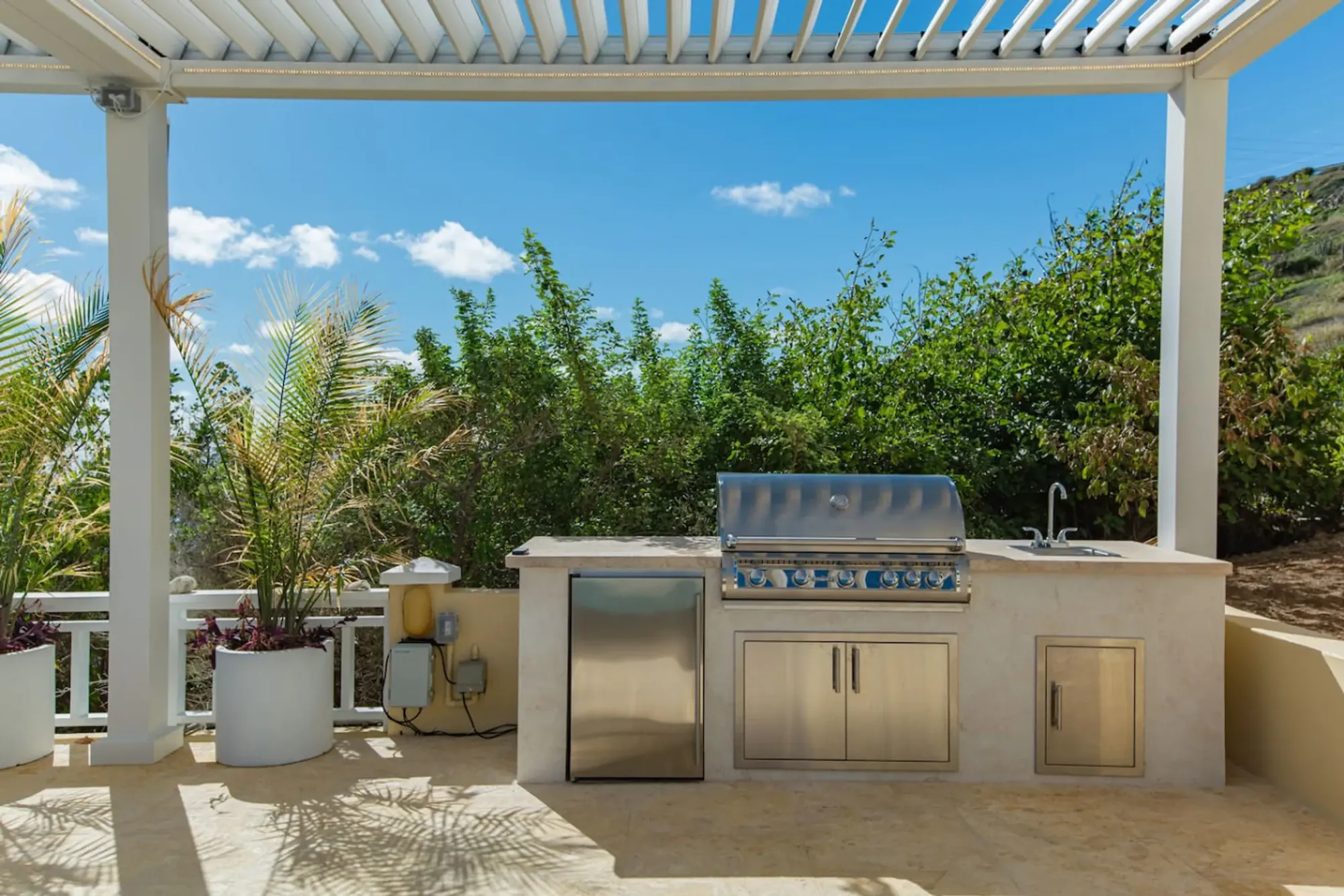
The outdoor kitchen and grill at The Cerulean, above the sea — where a group's Agrifest haul turns into dinner.Photo: The Cerulean
Doing it from The Cerulean
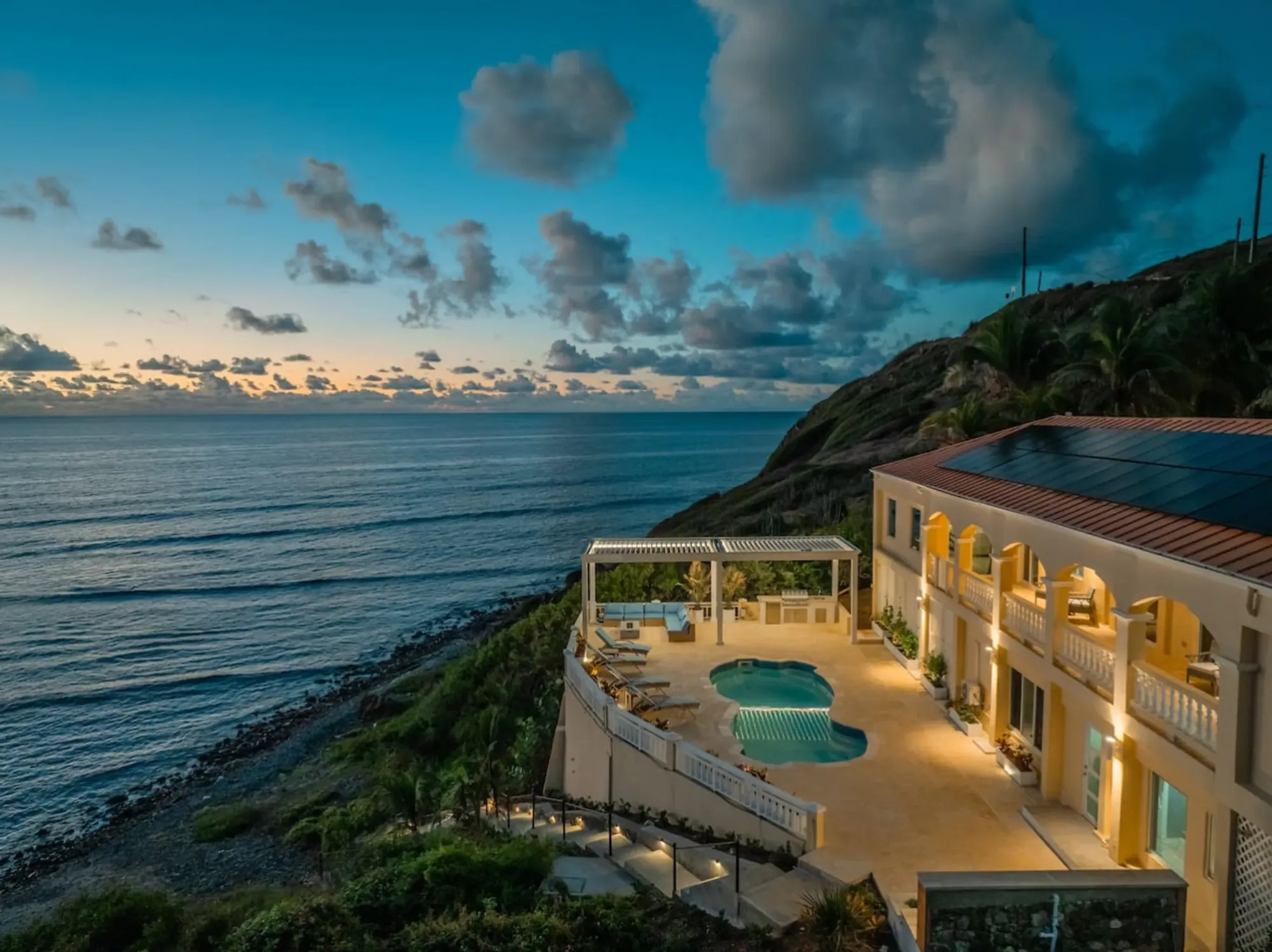
The Cerulean is on the East End, and Estate Lower Love is mid-island, so the fair is a 30 to 40 minute drive each way: west along the coast road to Christiansted, then Centerline Road through Sunny Isle to the fairgrounds. That is short enough to make Agrifest a morning rather than a day, and the shape of a good fair day from the villa follows from it. Up with the sun on the veranda — the villa faces sunrise — coffee, then leave by 8:15 with cash, hats, a bag and a cooler; gate at 9; pavilion, farmers' hall, an early lunch from the booths, the stage, the bakers' hall; shuttle to the gate; and back on the pool deck above the sea by mid-afternoon with a haul that becomes dinner. One of our guests, Suzanne, called the villa "great for multi-gen families" in a March 2026 review; a fair morning and a pool afternoon is the multi-generation day the island does best.
The kitchen is where the fair pays off. The chef's kitchen is fully equipped, the outdoor kitchen and grill sit above the water, and the dining table seats the whole house, so a bag of February tomatoes, greens and herbs, a box of Vienna cake and tarts and a bottle of bush tea turn into the most local evening of the week. If you would rather not cook after a morning in the sun, our concierge can arrange a private chef who will happily cook what you bought, or a car and driver for the fair itself so nobody has to find the parking field twice. Details of the house — the five en-suite bedrooms, the guest cottage, the private beach and the reef in front — are on the villa pages.
Book early. Presidents' Day week is a school-holiday week for much of the United States and the middle of St. Croix's high season, so airline seats and villa nights both go months out; our best-time-to-visit guide explains the season, and the getting here page has the current nonstops — Miami daily year-round, Charlotte daily from December 17, 2026, Atlanta and Chicago for the winter, and the Saturday Newark nonstop that starts October 31, 2026, the first New York-area nonstop in more than thirty years. If Agrifest is why you are coming, take the week that holds the third Monday of February, plan the fair for the Saturday morning, and give the rest of the week to the beach.
Questions people ask
When is Agrifest 2027?
Agrifest is held every year over Presidents' Day weekend, and Presidents' Day 2027 falls on Monday, February 15. The 2027 fair is listed as February 13 to 15, which fits the pattern, but the Department of Agriculture and UVI usually confirm dates, hours and prices only a few weeks ahead. The 2026 fair ran Saturday to Monday, February 14 to 16, 9 am to 6 pm daily, with the opening ceremony at 10 am on Saturday. Treat 2027 as expected, not fixed, until the organizers publish it.
How much does Agrifest cost to get in?
As of 2026, gate admission was 8 dollars for adults, 5 dollars for children and 6 dollars for seniors, and multi-day or weekend passes have been offered in past years. Prices change a little from year to year, so check the fair's own announcement. Budget more for inside the gate: most food and craft vendors run cash-only, plates are generous but not cheap, and the produce and seedlings are the best value on the grounds. Bring small bills.
Where is the fair, and how far is it from the East End?
At the Rudolph Shulterbrandt Agricultural Complex in Estate Lower Love, the Department of Agriculture's grounds in the middle of the island off Centerline Road, a few minutes from the airport. From The Cerulean on the East End it is about 30 to 40 minutes by car through Christiansted, longer on the fair's busiest afternoons. Parking is on and around the complex, a shuttle runs from one end of the grounds to the other, and in past years the VITRAN bus has run a special Agrifest schedule.
What should I eat at Agrifest?
Start with a pate — the fried, flaky hand pie filled with beef, saltfish or chicken — and a cup of local juice, then a plate: kallaloo, red peas soup, crab and rice, fish and fungi, stew chicken, conch in butter sauce, or the stone-oven roast pork that sells out early. In the bakers' hall look for Vienna cake, guavaberry tarts, tamarind balls, butter cookies and cocoa cheese, a fudge-like candy. Drinks are the local range: sugarcane juice, tamarind, passion fruit, ginger beer, peanut punch and bush tea. Carry cash.
What is a Senepol, and can I see one at the fair?
Senepol is a beef breed developed on St. Croix. N'Dama cattle came from Senegal in 1860; by 1889 Henry C. Nelthropp had 250 of them at Granard Estates, and in 1918 his son Bromley bought a Red Poll bull from Trinidad to add milk and remove the horns. The result — polled, short-haired, usually red, built for heat and ticks — took the name Senepol in 1954. Twenty-two cows went to the mainland in 1977; there are now more than 14,000 registered animals. The livestock pavilion is where you meet them.
Is Agrifest good for young children?
It may be the easiest kid day on the island. There is a petting zoo, donkey-cart rides and carnival rides, a livestock pavilion with cattle, pigs, sheep, goats, chickens, ducks, rabbits, emus and peacocks, mocko jumbies on stilts, steel bands, and enough juice and tarts to fuel the whole loop. Go at opening while the air is cool and the lines are short, use the exhibit halls as shade breaks, and plan to leave by early afternoon for the villa pool.
Can I take plants or produce home to the mainland?
Produce and herbs for the villa kitchen, yes — that is the best purchase at the fair. Flying plants, seeds or fresh produce back to the mainland is a different question: baggage leaving the U.S. Virgin Islands is subject to agricultural inspection, and rules on soil, plants and fruit are specific, so check the current USDA guidance before you buy a seedling to travel with. Bottled hot sauces, spice mixes, sealed jams and dried bush tea are the safer souvenirs; ask the vendor.
What if my trip misses the fair?
The Department of Agriculture's La Reine Farmers Market runs every Saturday morning mid-island, next to La Reine Chicken Shack, from about dawn until late morning. Sejah Farm's stand is open Monday through Saturday, ARTfarm runs one-hour pop-up stands two or three days a week in season, and Ridge to Reef Farm's tienda opens Wednesday and Saturday afternoons near Frederiksted — call or check each before driving. On the calendar, Mango Melee in July and the Christmas Festival food fair are the other big local-food days.
Which day of the fair is least crowded?
Nobody publishes attendance by day, so treat this as experience rather than data: the first hour after the 9 am gate is reliably the quietest on any day, Saturday builds after the 10 am opening ceremony and Farmer of the Year awards, and mid-afternoon on the weekend days is when the food lines and the parking are at their worst. If your dates allow, go at opening on Saturday for the freshest produce and roast pork, or on the Monday holiday for a slower loop.
The Cerulean
Twelve of you, one private beach.
The Cerulean sleeps twelve on St. Croix's quiet East End — check your dates.