

Two warm-water trips sit a few hours from the East Coast, and they feel nothing alike once you land. The Bahamas is an Atlantic nation of roughly 700 islands and cays that begins 50 miles from Florida, with busy Nassau in the middle and the pale shallows of the Exumas off to the southeast. Americans need a passport to fly in. St. Croix is a single Caribbean island of 84 square miles, part of the USVI, and you get there on a driver's license, spend dollars and never stand at an immigration counter. It lies roughly seven degrees of latitude closer to the equator, so January afternoons average 84°F and the harbor water hovers near 81°F. Pick the Bahamas for a quick hop out of Florida, a cruise, a resort with a water park or a week aboard a boat among the cays. Pick St. Croix when your group would rather explore one island by car, wander two little Danish-built towns, snorkel the reef at a national monument and share a single house. Ours is The Cerulean, a twelve-guest oceanfront home on the East End.
The quick version
Either one is easy to fall for, so the choice rests on the kind of week your group pictures. The Bahamas sits nearest to Florida and offers range: a quick flight or a ship into Nassau, big resorts with water slides and gaming floors, and past them a long string of quiet cays that are best reached by boat. St. Croix is one island of green hills, reefs, a patch of northwestern rain forest and two old harbor towns, and many guests rent a house or a small inn and get around in a rental car.
For travelers from the States, the largest practical gap is paperwork. Because the Bahamas is its own nation, anyone flying in, babies included, carries a passport. St. Croix flies the American flag. At the TSA checkpoint, adults use a REAL ID or another document the agency lists, kids under 18 show nothing at the checkpoint, and no passport stamp waits for anyone at arrival.
The next gap is latitude. Nassau lies near 25 degrees north and St. Croix near 17.7, and in winter that spread adds up to roughly six degrees Fahrenheit on an afternoon thermometer and about eight after dark.
| At a glance | St. Croix | The Bahamas |
|---|---|---|
| Passport for Americans | Not required | Needed to fly in |
| Currency | U.S. dollar | Bahamian dollar, held at par with the greenback |
| Driving side | Keep left | Keep left |
| Location | Caribbean Sea, inside the U.S. Virgin Islands | Atlantic Ocean, starting 50 miles off Florida |
| Layout | A single island of 84 square miles | Roughly 700 islands and cays |
| Population | 41,004 (2020 census) | 398,165 (2022 census) |
| Typical January high | 84°F | 78°F (Nassau) |
| Common ways to stay | Villa or small inn | Resort, cruise cabin or boat |
Each row gets its own chapter further down, with the sources gathered at the bottom. Weighing the American islands against each other as well? Our three-island guide lines up St. Croix with St. Thomas and St. John next door. The journal also has matching pieces that pair St. Croix with Puerto Rico and with Punta Cana.
Where the Bahamas shines
For plenty of Americans, the Bahamas is the first island trip they ever take, and it deserves the spot. Begin with distance. Bimini is just 50 miles from the Florida coast, East Coast flights can be as brief as an hour, and ferries out of Fort Lauderdale and West Palm Beach can make the crossing to the closest islands in two hours at the quickest. A South Florida family could finish breakfast at home and be in the sea by noon.
Next comes variety. The tourism ministry markets 16 separate island destinations, each with its own personality. Nassau holds the history, the dining and the large resorts. The Exumas are 365 cays scattered through shallow water in every shade of blue and green. Bimini bills itself as the world's sport fishing capital, and Hemingway stayed there for two years. Andros has a 190-mile barrier reef and upward of 180 blue holes. Harbour Island, five minutes by ferry from Eleuthera, is known for pink sand, while Inagua is home to over 80,000 flamingos.
The country also excels at the large, effortless resort vacation. Near Nassau, a family can check in somewhere with a water park, restaurant after restaurant and sand right outside, and go all week without a car. Ship passengers get a full day in a walkable historic town. Sailors get cay after empty cay, sheltered coves and sandbars.
Bahamian culture is distinct as well. Junkanoo, the national street parade, takes over Nassau on Boxing Day and once more on New Year's Day, a night of music, dancing and good-natured rivalry that follows months of costume building, with smaller events through the summer.
It is a fine match for Floridians who have a long weekend free, families after an all-in-one resort, cruise fans, fishermen and anyone who has dreamed of a week afloat among empty cays. If that describes your trip, the Bahamas will treat you well.
The map, the latitude and the shape
Both are warm, clear-water island trips, and geography explains most of the contrast. A common question is whether the Bahamas counts as Caribbean. Strictly, it sits just north, in the Atlantic. On Eleuthera the tourism ministry highlights a slim bridge with deep blue Atlantic water to one side and the turquoise Bight of Eleuthera to the other. For travel purposes the country usually gets lumped in with the Caribbean, and its beaches fit the image, so the name holds.
Latitude says more than the label does. Nassau is at roughly 25 degrees north. The Tropic of Cancer, which marks the top edge of the tropics, runs across Little Exuma, and a beach there carries its name. St. Croix's latitude is roughly 17.7 degrees north, deep inside the tropics and in the Caribbean Sea proper, and that is why winter days and sea temperatures run a bit higher there.
Then there is the layout. The Bahamas counts some 700 islands and cays, only about 30 with residents, scattered over an area the tourism ministry puts at 100,000 square miles. The Exumas by themselves stretch past 120 miles. Visiting another island generally means another flight, a ferry or a boat ride, and a lot of itineraries pass through Nassau.
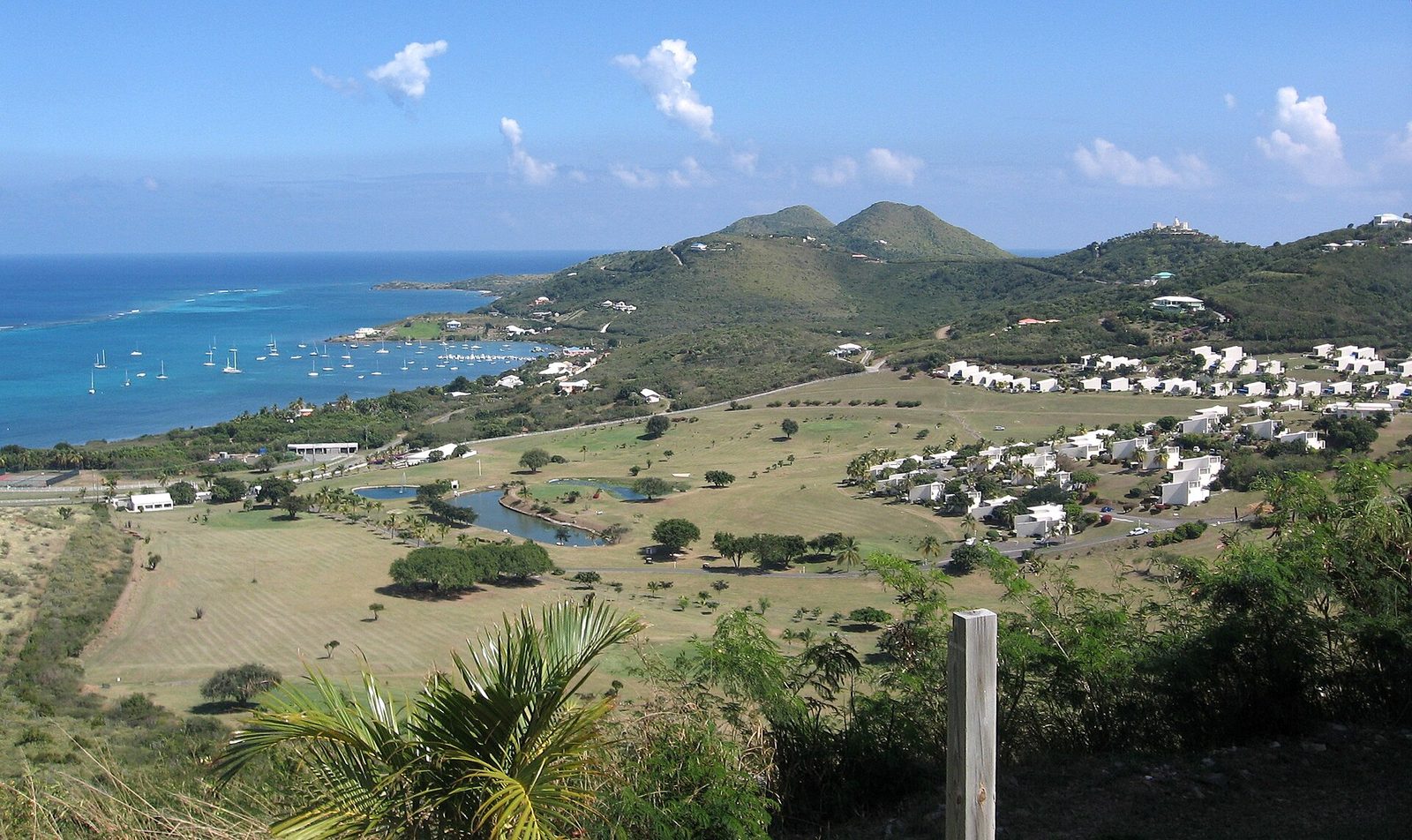
With 84 square miles, St. Croix is the biggest island in the USVI, and every corner of it is reachable by road. Starting at our East End house, the drive to Christiansted runs 15 to 20 minutes, the airport lies 35 to 40 minutes off, and Frederiksted, on the far western tip, is close to 50. In one week you can stand at the spot farthest east in all of the United States, drive a rain forest road, climb two forts, tour a rum distillery and snorkel a reef monument, all with one rental car and no extra boarding pass.
A scatter of cays pays off for people who love boats and light aircraft. One island pays off for a group that would like to unpack a single time and still find something different every day.
Passports, licenses and ID
Since St. Croix asks for the least, begin there. The U.S. Virgin Islands belong to the United States as a territory, so flying down from the mainland counts as domestic travel. From May 7, 2025, TSA officers have wanted adults to present a license that meets REAL ID rules or another item from the agency's list, a passport for instance. Travelers younger than 18 flying inside the country are not asked for ID. When you land, nobody inspects documents or luggage. Our USVI passport guide explains it all, along with the brief inspection you pass before flying home.
The Bahamas is another country, and getting there by plane calls for a passport book. For Americans flying back into the U.S., the federal border agency, Customs and Border Protection or CBP, accepts a passport book or a trusted traveler card like NEXUS, and it states that kids, too, must show their own passports when they travel by plane.
The Bahamian Department of Immigration's visitor page wants each arriving traveler to hold a passport good for six months or more, a return ticket or other proof of onward travel, and a filled-out immigration card, and it adds that the passport card will not be accepted. Holders of U.S. passports need no visa for visits as long as eight months. The State Department publishes its own Bahamas page too, so the easy approach is to leave six months on every passport and reread both pages before booking. That is how things stood as of our November 2026 check. For the Bahamas, it means looking at every passport in the group, the children's included, long before the flight.
Papers to gather for a group
6 itemsYour ticks stay in this browser only.
With twelve travelers, that is the gap between tracking a dozen expiration dates months in advance and simply bringing the wallets people already carry. For 20 destinations at once, see the single table on our no-passport Caribbean page.
Cruises and the closed-loop exception
Lots of Americans recall visiting Nassau with no passport, and their memory is right: they arrived by ship. CBP's wording is that U.S. citizens taking closed-loop cruises, which it defines as sailings that start and finish at one U.S. port, may reenter on two documents, the traveler's birth certificate plus government-issued photo identification.
Three points are worth noting. First, the rule is about returning to the United States. The same page warns that the countries on your itinerary may still want a passport, so check with the cruise line about what it requires at embarkation. Second, the loop must close. A sailing from Miami that finishes in San Juan does not count, and the exception does not apply. Third, CBP says U.S. citizen children younger than 16 coming in by land or sea need nothing more than a birth certificate or other proof that they are citizens.
The exception ends at the pier. A resort week in Nassau reached by plane needs a passport, as does a flight home from the Bahamas for anyone who leaves the ship partway, because the air rule kicks in the moment a plane is involved. That is why a valid passport tucked in a bag makes a smart backup on every cruise, closed loop or not.
St. Croix doesn't need the exception at all. A ship that stops at Frederiksted is calling at an American port, and a family flying in for a villa week stays domestic door to door. Should anyone in your party lack a passport, say a teen whose passport ran out or a grandparent who never got one, the Bahamas means a cruise and St. Croix means a week ashore.
Preclearance on the way home from Nassau
Heading home from Nassau comes with a shortcut called preclearance. CBP posts its own officers at 16 sites across 6 countries, and Lynden Pindling International Airport in Nassau is among them. You clear U.S. inspection there, before you board, and on landing stateside you exit like a domestic traveler, straight to your connection or the taxi line.
For families, that means the queue comes at the beginning of the day while everyone still has energy. Leave extra time at the airport on departure day, and know that Nassau is the sole Bahamian airport on CBP's list, so flights back from the smaller islands are inspected wherever they touch down.
St. Croix has its own departure check. Ahead of mainland flights, agriculture inspectors go through luggage and border officers may ask about citizenship and anything you bought, all before you reach the gate. Allow around two hours. There is nothing at the far end and nothing on the flight in.
Shoppers come out ahead from the Virgin Islands. Returning travelers can bring home $1,600 worth of goods duty-free from the USVI, compared with $800 from most places, plus five liters of alcohol for those 21 or older provided one or more bottles were produced in the territory. Rum from the Cruzan distillery near Frederiksted qualifies. Our USVI duty-free guide walks through the details.
Dollars, phones, clocks and the left lane
Day-to-day matters are easy in either place, and plenty of them match. The Bahamian dollar is pegged one to one with the U.S. dollar. The Central Bank of The Bahamas lists the cash rate at par, and the tourism ministry says the two are taken interchangeably across every island, so nothing needs exchanging before the trip. You'll find ATMs in Nassau, on Grand Bahama and on most of the bigger Out Islands, and the ministry advises bringing cash to the small ones. Tips run around 15 percent and are often already on the bill. On St. Croix it's dollars only, and the cards and ATMs you use at home all work.
Traffic keeps left in both. The Bahamas follows British rules of the road, so watch for roundabouts. On St. Croix you also keep left, but the cars are the usual American kind, driver's seat on the left. Speed limits sit at 55 mph on the highway, 20 through town and 35 elsewhere. Bring your regular U.S. license, which is valid there unchanged. Each main road is described in our St. Croix driving guide.
Phones are where they part. For U.S. carriers, St. Croix counts as home: Verizon, to name one, counts the USVI as domestic roaming territory, just as it does the mainland and Puerto Rico, and the territory's tourism department says most carriers get a signal. In the Bahamas, an American phone rides on local networks through roaming deals, so check your plan's international rate before you go and decide which phones in the group need it.
Clocks are close. The Bahamas runs on Eastern Time and observes daylight saving. On St. Croix the clock is Atlantic Standard Time the whole year, which lines up with the East Coast from spring through summer and sits one hour ahead in winter. Neither place moves anyone's watch more than an hour.
| Everyday detail | St. Croix | The Bahamas |
|---|---|---|
| Money | U.S. dollar | Bahamian dollar, with U.S. dollars accepted everywhere |
| Phone plans from home | Domestic roaming on Verizon (ask your carrier) | International roaming |
| Time zone | Atlantic Standard, no change all year | Eastern, with daylight saving |
| Power | 120 volts | 120 volts |
| Driving | Left side, American cars | Left side |
Winter warmth in the air and the sea
Both make bright, warm winter getaways, and latitude puts them a few degrees apart. In the Bahamas Department of Meteorology's 1971 to 2000 normals, published by the World Meteorological Organization, Nassau averages 78°F on January afternoons and 63°F at night. That means sunny beach days with a light layer for eating outside after dark. On St. Croix, NOAA's 1991 to 2020 normals for the airport give January an average high of 84°F and a low of 71°F, so guests take an early swim and eat dinner on the deck in short sleeves.
| Month | St. Croix highs and lows | Nassau highs and lows |
|---|---|---|
| December | 85.1 high, 72.5 low | 79.5 high, 65.1 low |
| January | 84.2 high, 71.2 low | 78.1 high, 62.8 low |
| February | 84.6 high, 71.4 low | 78.3 high, 63.1 low |
| March | 85.0 high, 71.5 low | 80.1 high, 64.2 low |
| April | 86.0 high, 73.4 low | 82.2 high, 66.7 low |
The sea tracks the same way. NOAA's Christiansted harbor gauge averages 80.9°F in January and 80.3°F in February, its coolest month, rising to 86.6°F by September. The Bahamian tourism ministry's Exumas fact sheet puts sea temperatures between 73°F in February and 82°F in August. You can swim in both. In February the Christiansted figure is the warmer one, so snorkelers can drift above the reef for an hour at a stretch.
Come summer, they nearly match. The average August high is 89.8°F in Nassau and 89.5°F on St. Croix, with trade winds over both. In spring the gap narrows as well: by April, Nassau's afternoons reach about 82°F and St. Croix's about 86°F, so a spring break trip is warm in either place. St. Croix's highs, lows and water temperatures for each month are in the weather-by-month guide.
Because the villa looks east, winter mornings start with sunrise over the water just beyond the house, and the day's opening swim is only a few steps down.
Visitor numbers on each side
The Bahamas hosts visitors in huge numbers, and Nassau's harbor is the center of it. The Ministry of Tourism recorded 12.5 million visitors in 2025, a record and an 11.4 percent jump over 11.22 million in 2024. Cruise passengers accounted for 86.5 percent, and arrivals by sea topped 10.6 million. Nassau Cruise Port, which describes itself as among the busiest cruise ports anywhere, estimates 6.1 million passengers on almost 1,600 ship calls during 2025.
Overnight guests are a smaller slice. The ministry tallied over 1.8 million stopover visitors in 2025, roughly two-thirds of whom stayed in or near Nassau, while almost 30 percent continued to the Out Islands. The 2022 census counted 398,165 Bahamians, and 296,732 of them, around three in four, live on New Providence, the island Nassau sits on. Those overnight figures say more to a family than the cruise totals do, since they describe who is sleeping on the islands each night.
St. Croix runs smaller, with 41,004 residents counted in 2020. During 2024, the Virgin Islands' economic research bureau recorded roughly 186,400 visitors flying in from the mainland, while the Frederiksted cruise pier handled 71 ship calls carrying 169,228 passengers. Put side by side, Nassau's port logs more ship calls in three weeks than St. Croix's pier does all year.
To a visitor, those numbers translate into two moods. Nassau on a ship day buzzes, with Bay Street sidewalks packed, music playing and tours departing every few minutes. St. Croix's towns keep a regular weekday rhythm. Christiansted has no berth for cruise ships, and most days of the year no ship is in port anywhere on the island. The journal's piece on quieter Caribbean islands ranks St. Croix with Aruba, Grand Cayman and Turks and Caicos by visitors per resident.
A day in Nassau
Nassau is a good town to walk. The downtown spans some 20 square blocks of monuments, murals and museums. Bay Street, which the tourism ministry names as the oldest road in the Bahamas, runs past pastel facades, Parliament Square and the open-air Straw Market, where local craftspeople sell what they make. The Pompey Museum sits in a building that predates 1769, opened as a museum in 1992 and honors Pompey, an enslaved man from the Exumas remembered for his bravery.
Up the hill a few minutes is the Queen's Staircase, 66 steps cut from solid limestone in 1794 to connect Fort Fincastle with the streets below. They sit at the end of a deep rock cut under palms, a nice spot to rest on a hot afternoon.
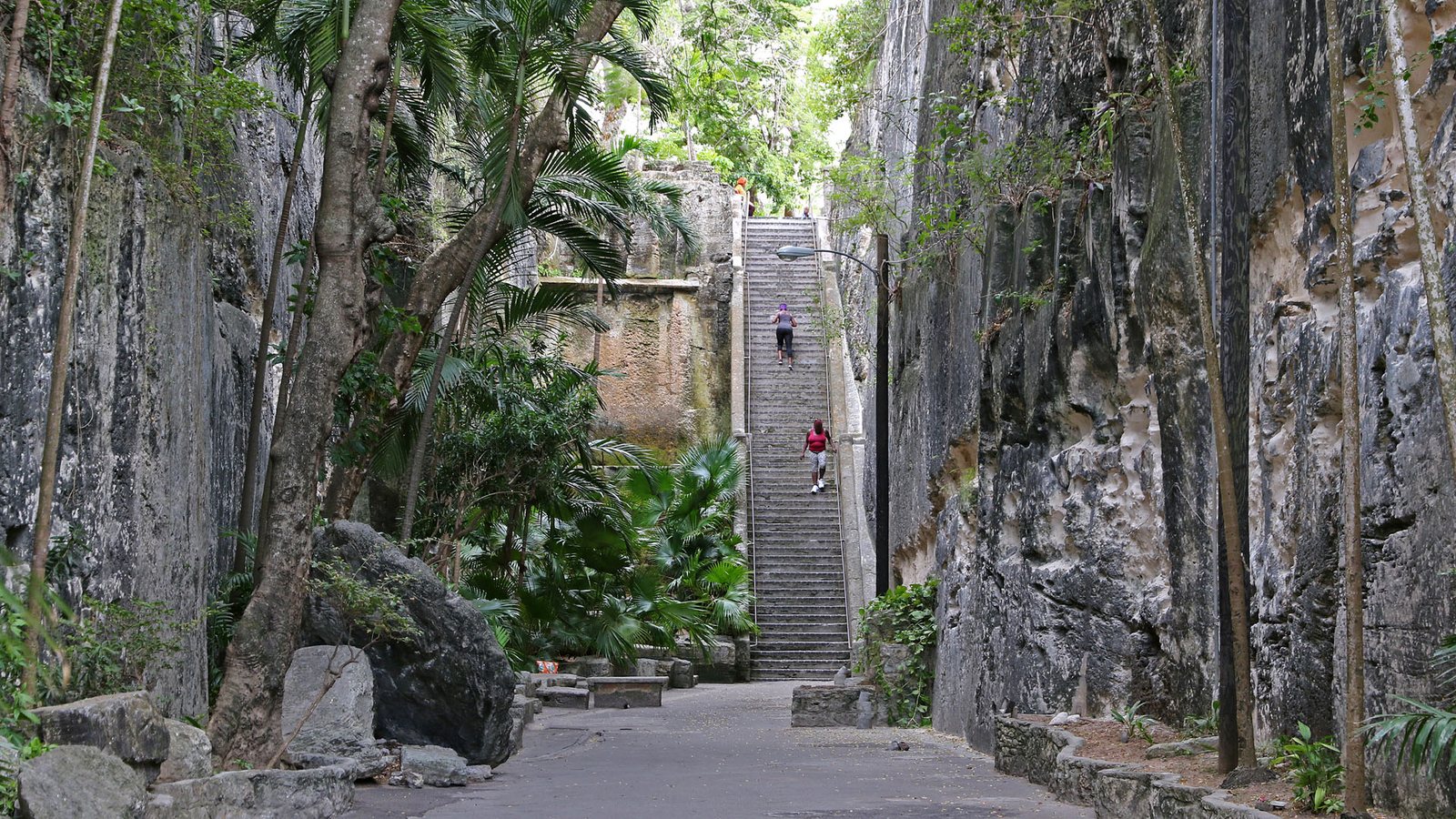
To eat, the ministry points visitors to the Fish Fry at Arawak Cay, a strip of casual restaurants and beach shacks, and to Potter's Cay for conch salad. To see gardens, the Retreat grows about 170 species of palm across 11 acres. To swim, Cable Beach fronts the resort district and Cabbage Beach is on the island across the harbor.
That island, connected to Nassau by bridge, is the picture many people have of a Bahamas resort trip, at a property with a water park, upward of 20 restaurants and what the ministry calls the largest open-air marine habitat on earth. Over on Cable Beach, another complex has three hotels, ten pools, a golf course and a big casino. Both are designed for families who want it all behind one gate.
If your family wants a packed week with zero planning, it is tough to top. A day in St. Croix's pair of towns, coming up next, is smaller in scale: a fort to explore, streets lined with arcades and lunch above the harbor.
Christiansted and Frederiksted
Each of St. Croix's towns can be learned in a single morning, and each has a fort worth climbing. Denmark laid them both out and ruled the island until 1917.
Founded September 1, 1734, Christiansted was the seat of government for the Danish West Indies. In 1952 the waterfront gained national historic site status, under National Park Service care. Fort Christiansvaern, put up from 1738 to 1749, stands right on the harbor, and kids can walk the ramparts beside the old cannons and look into the cells. Admission costs $10 for anyone 16 or older, nothing for those under 16, and one ticket covers three days. Past the fort, arcaded streets lead to a waterside boardwalk of restaurants. The 2020 census counted 1,770 people in town. Small boats, the Buck Island tour boats and the seaplane share the harbor, and our house is 15 to 20 minutes' drive away.
American history buffs will recognize a name. As a teenager, Alexander Hamilton lived in Christiansted, clerking from 1766 at a King Street import-export house, before sailing north in fall 1772 toward New York. Teens who know the musical usually like standing on the street where it all begins, and our Hamilton guide maps the spots linked to his island years.
Frederiksted, at the west end, got its Danish street grid in 1751, and Fort Frederik went up between 1752 and 1760. It was at that fort, on July 3, 1848, that freedom for the enslaved across the Danish colony was proclaimed, which is why the town is called Freedom City. The town itself is home to 528 residents. Its pier, 1,526 feet long, serves as the island's cruise dock and one of its favorite dive sites, and sunsets drop straight into open sea off the waterfront.
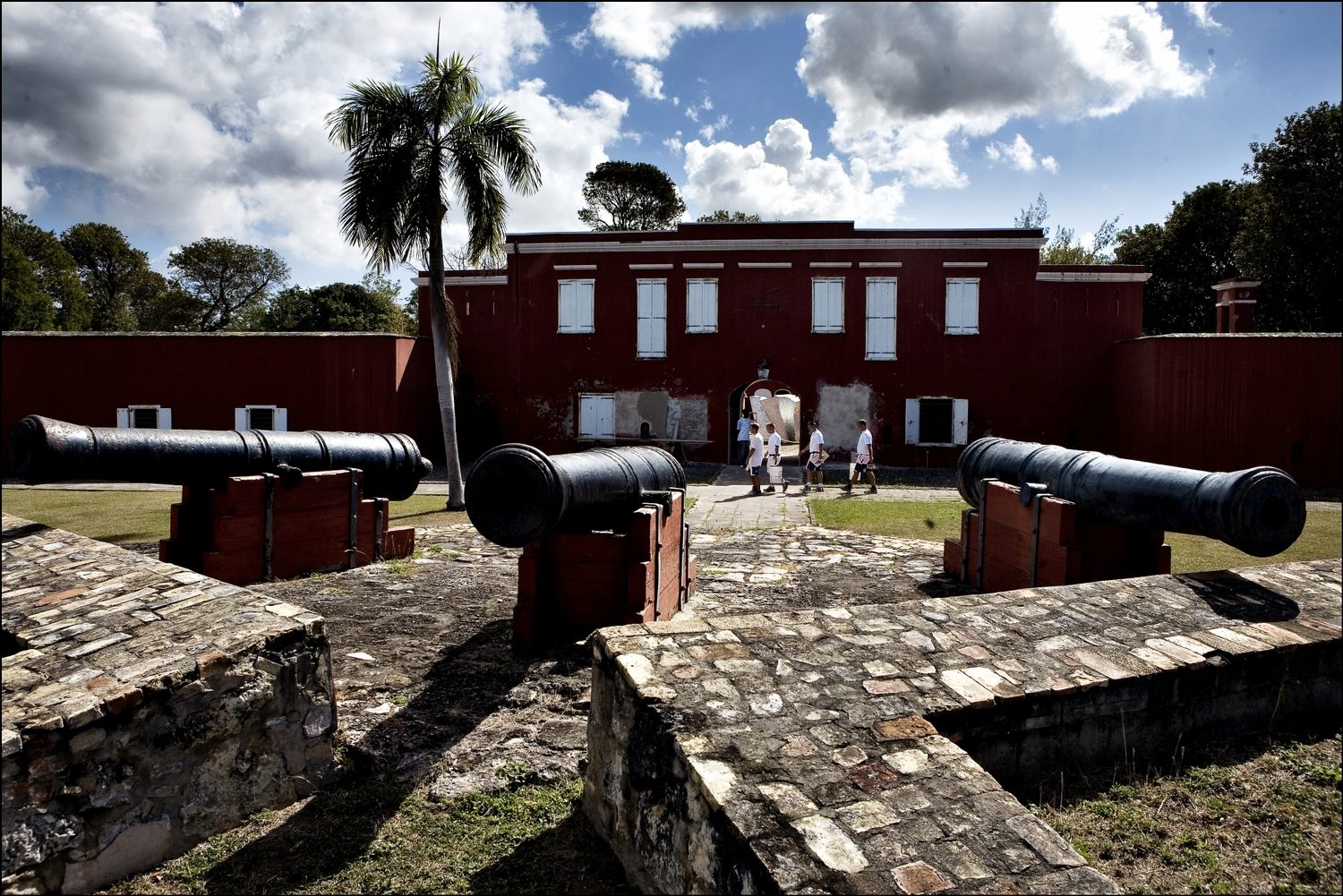
Each town keeps its own festivals. Nassau has Junkanoo, and St. Croix has the Crucian Christmas Festival, its carnival, which Frederiksted has hosted since 1952. For 2026 to 2027 it is set for December 26 through January 2. Its parades come at the end: children march on January 1, adults the following day.
Our town guides for Christiansted and Frederiksted cover each one street by street, including parking, places for lunch and opening hours at both forts.
The Exumas and the Out Islands
The Exumas are the postcard Bahamas: 365 cays starting 35 miles southeast of Nassau and running past 120 miles, with shallow turquoise channels between. The tourism ministry splits the chain into Great Exuma, Little Exuma and the Exuma Cays, home to roughly 7,300 residents.
Exuma days mostly revolve around a boat. Big Major Cay, called by the ministry the official home of the swimming pigs, is a boat ride from Staniel Cay, and the pigs swim out to greet arrivals. Thunderball Grotto, a sea cave just west of Staniel Cay, is entered by swimming in when the tide is low. A water taxi from George Town reaches Stocking Island. In between the famous stops are empty cays, sheltered coves and sandbars.
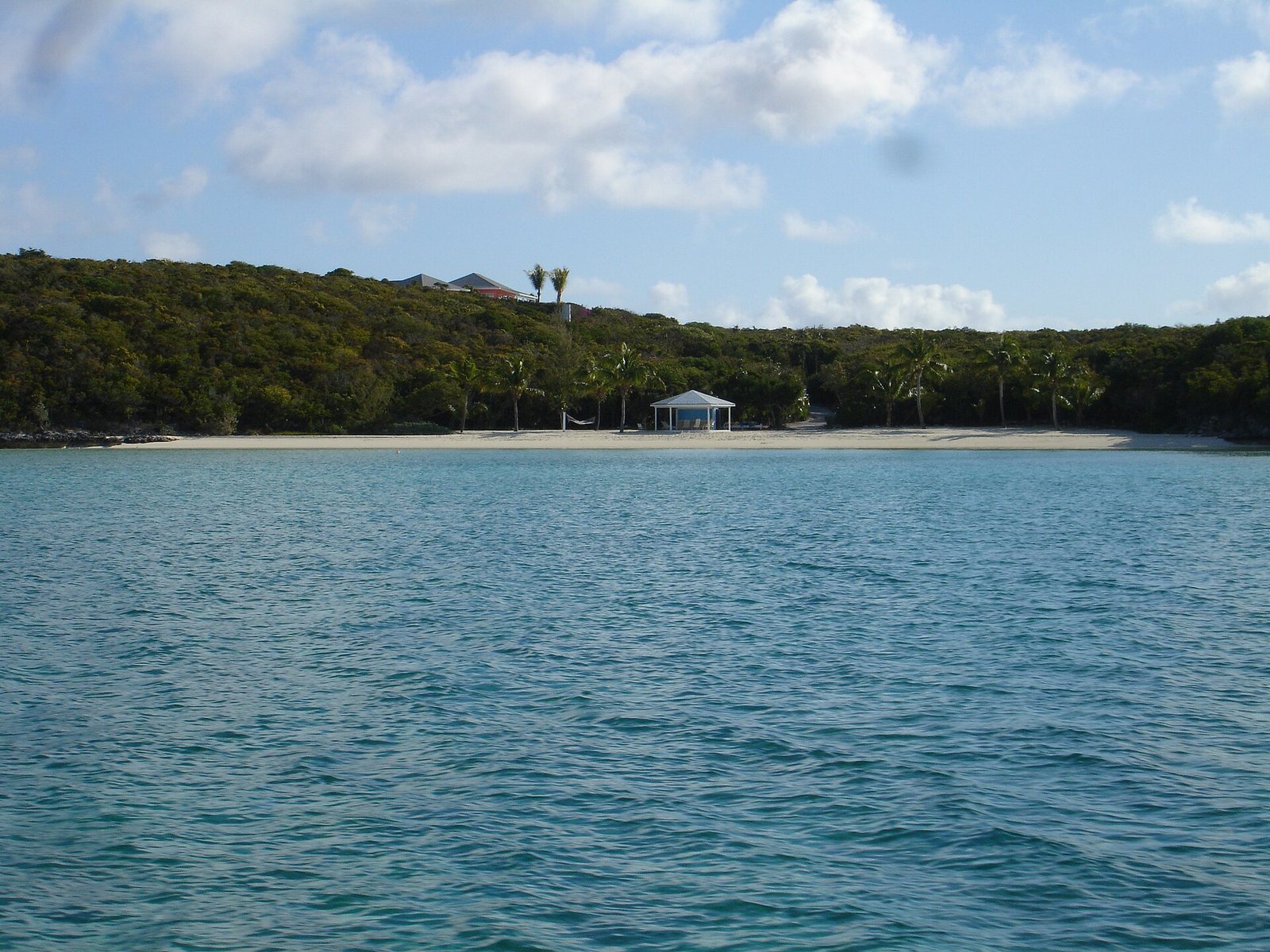
Reaching it takes some planning, and the ministry's tips help. Great Exuma's Exuma International Airport has daily domestic and international service, and Staniel Cay has its own small airport. If you connect via Nassau, give yourself at least 90 minutes for immigration and customs. A few of the little island airlines are missing from the large booking sites, so check their own websites.
Plenty of visitors come over on their own boats from Florida. Private boaters need passports, and as of November 2026 the ministry lists a 30-day cruising permit at $150 for boats up to 30 feet, $250 for 30 to 50 feet and $350 for 50 to 100 feet.
The Exumas are just one group within the Out Islands, which is the ministry's term for every island beyond the country's two cities. Each pulls people for its own reason: Andros for reef and bonefish, Eleuthera for 210 miles of shoreline, Harbour Island for its pink sand, Inagua for flamingos. Most trips focus on just one.
So the Exumas are the obvious match for St. Croix's East End. Both have quiet beaches and clear water above reef. The Exumas spread theirs over 120 miles of ocean and reach them by boat. St. Croix gathers its coves, its monument reef and its towns on a single island, each one reachable by road.
Driving St. Croix from end to end
St. Croix packs plenty into its 84 square miles, and nothing is much more than an hour from the house. The East End has sunny hills along the coast above a chain of coves. The center of the island is former sugar land, scattered with more than 100 mill ruins across the old estates. In the northwest the land rises to roughly 1,165 feet at Mount Eagle, which pulls in enough rain to feed the rain forest along Mahogany Road.
| Place | Drive from the house | What you'll find |
|---|---|---|
| Jack and Isaac Bay trailhead | 5 minutes or so | 300-acre preserve, two beaches you hike to |
| Point Udall | Roughly 10 minutes | Farthest-east spot in the United States |
| Green Cay Marina | Roughly 10 minutes | Departures for Buck Island |
| Christiansted | 15 to 20 minutes | Fort, boardwalk, most of the restaurants |
| Salt River Bay | Roughly 35 minutes | Kayak tours at night on a bay that glows |
| Cane Bay | Roughly 45 minutes | Beach with a wall dive just offshore |
| Frederiksted | Roughly 50 minutes | Fort Frederik, the pier, sunsets |
| Estate Whim | 50 to 60 minutes | Museum on an old sugar estate |
Inland are the days away from the beach. Estate Whim, a museum of the sugar era near Frederiksted on Centerline Road, keeps a stone windmill and the remains of its sugar works, and the ruins of another old Danish estate now hold a botanical garden in St. George Village. Up in the northwest, Mahogany Road curves through rain forest beneath tall trees, a shady, green drive and a nice break from the shore. See our sugar estates guide and our rain forest drive guide for both.
That range is what one bigger island gives a group. One household can tour the fort in the morning while another hikes out to Isaac Bay, and by two o'clock everybody is back by the pool. No one waits on a boat schedule or a second flight to see something fresh.
Renting a car is the way to go, and twelve people normally need two. Driving is on the left, the cars are American and speeds stay low. Uber and Lyft don't operate on the island, so lock in the cars alongside the villa booking. Our car rental directory names the companies; the concierge can book your rental car and an airport pickup.
Kick off with sunrise at Point Udall. The stone monument on the headland marks the country's farthest-east point and is the favorite sunrise perch on the eastern shore. Our Point Udall guide gives sunrise times through the seasons. Later on, spend a day heading west: the Cruzan distillery tour lasts around an hour and is booked online, and the Frederiksted sunset is ten minutes past it.
Andros and the Exuma Cays park
The Bahamas has extraordinary reefs and blue water, and two spots lead the list. First is Andros, the largest island in the country. Its barrier reef runs 190 miles, ranked third largest on the planet by the tourism ministry, and past it the seabed drops over 6,000 feet into a deep trench called the Tongue of the Ocean. Andros also counts upward of 180 blue holes, both inland and along the coast, plus what the ministry describes as some of the Caribbean's best bonefishing. Five parks protect it, among them marine parks spanning 8,500 acres of reef and West Side National Park at 1.5 million acres.
Second is the Exuma Cays Land and Sea Park. Its manager, the Bahamas National Trust, dates it to 1958 and calls it the world's first land and sea park. It spans 176 square miles of cays, reef and open sea. Fishing, shelling and conching are all banned inside, and wardens based at Warderick Wells patrol the waters. Boats tie up to the park's moorings, and the payoff is a run of cays where fish, sea turtles and iguanas are fully protected.
Divers know Bimini too, with roughly two dozen sites, among them shark dives and the wreck of the Sapona, which went aground in 1926.
Getting to these places is part of the fun. Andros has small airports with domestic flights via Nassau, as well as ferries and mail boats, and the Exuma park requires a boat. For a family with a few eager divers or sailors, the journey is the whole idea. For a mixed group with little kids and grandparents, a reef near the breakfast table is a big help, and St. Croix has several.
Buck Island's reef and the Cane Bay drop-off
St. Croix's most famous reef is a national monument you can reach with a morning boat ride. Buck Island Reef National Monument dates from 1961 and grew in 2001, when all of it became a no-take reserve, the same rule the Exuma park uses. The island itself is a 176-acre speck lying 1.5 miles or so off the northeast coast, within a monument of over 19,000 acres of land and water. Elkhorn coral wraps around about two-thirds of Buck Island's shore, while a snorkel trail with markers runs across the lagoon at the east end, where grottoes reach depths of about 12 feet.
The monument opens 7 am to 5 pm, has no entry fee and is reachable only by water, aboard a private boat or one of the tour boats that hold National Park Service permits. Boats depart the Christiansted wharf and Green Cay Marina, a ten-minute drive from our gate. Most outings combine the snorkel trail with a stop at Turtle Beach, a white strand on Buck Island's western tip, and a private charter works well for twelve. The concierge handles bookings, and our Buck Island guide sorts out boat choices and park rules.
Divers know St. Croix for its wall. Off Cane Bay, a north-coast beach around 45 minutes away, the reef shelf stops in roughly 40 feet of water, somewhere between 100 and 200 yards out, and the wall plunges from there, so divers simply walk in from the sand. Close by, Salt River Canyon has two more walls reached by boat, and the Frederiksted pier is known for seahorses around its pilings. Our wall diving guide lists sites and dive shops, and several of the shops run a first dive with an instructor for guests without certification.
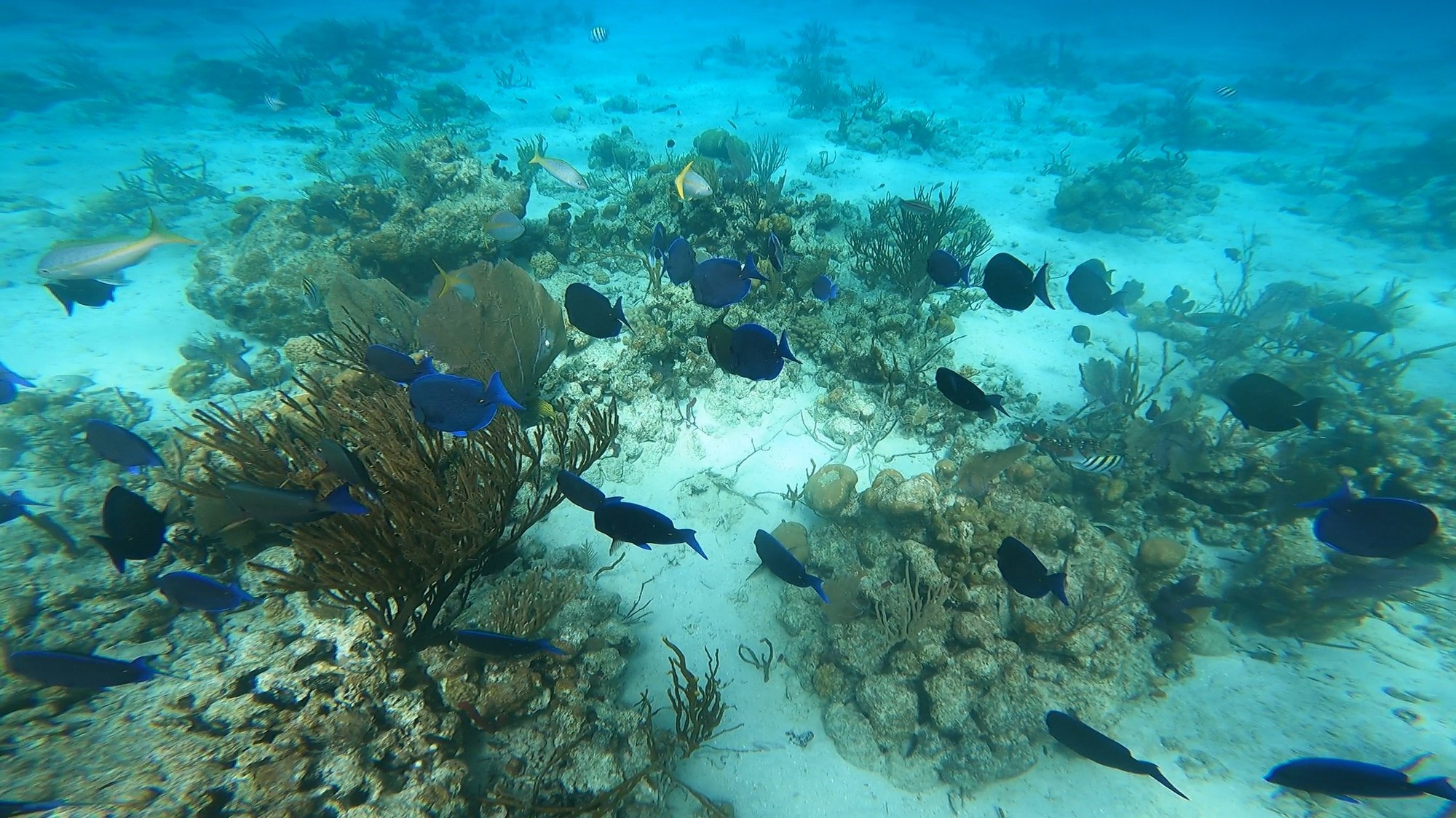
Andros wins on reef length and the Exumas on park size. St. Croix's edge is proximity: a monument reef one short boat trip from a marina just up the road, a wall you can wade out to from the beach, and reef right below the villa's steps.
Snorkeling below the pool deck
Snorkeling at The Cerulean begins right under the pool deck. Walk down a few stairs from the deck to the private beach, where shallow water sits behind the reef and the fish show up a few feet from shore. Young snorkelers can watch reef fish without a boat, a guide or a schedule.
The beach looks toward the sunrise, which makes early morning a fine time to go in. Guests wander down ahead of breakfast for a swim and return to the deck while the coffee is still warm. Pack a favorite mask and snorkel from home, or rent gear in town.
These waters belong to the territory's East End Marine Park, set aside in 2003 and covering about 60 square miles of ocean. Five minutes along the road, a trail leads into a 300-acre preserve, Jack and Isaac Bay, that The Nature Conservancy has managed since 1999, with two beaches you can only walk to. Cramer's Park and Chenay Bay offer calm, shallow water for small kids, and from Teague Bay you look out at Buck Island. Hawksbills and green turtles graze on this coast's reefs and seagrass year-round. Our guide to the beaches out east takes them one cove at a time.
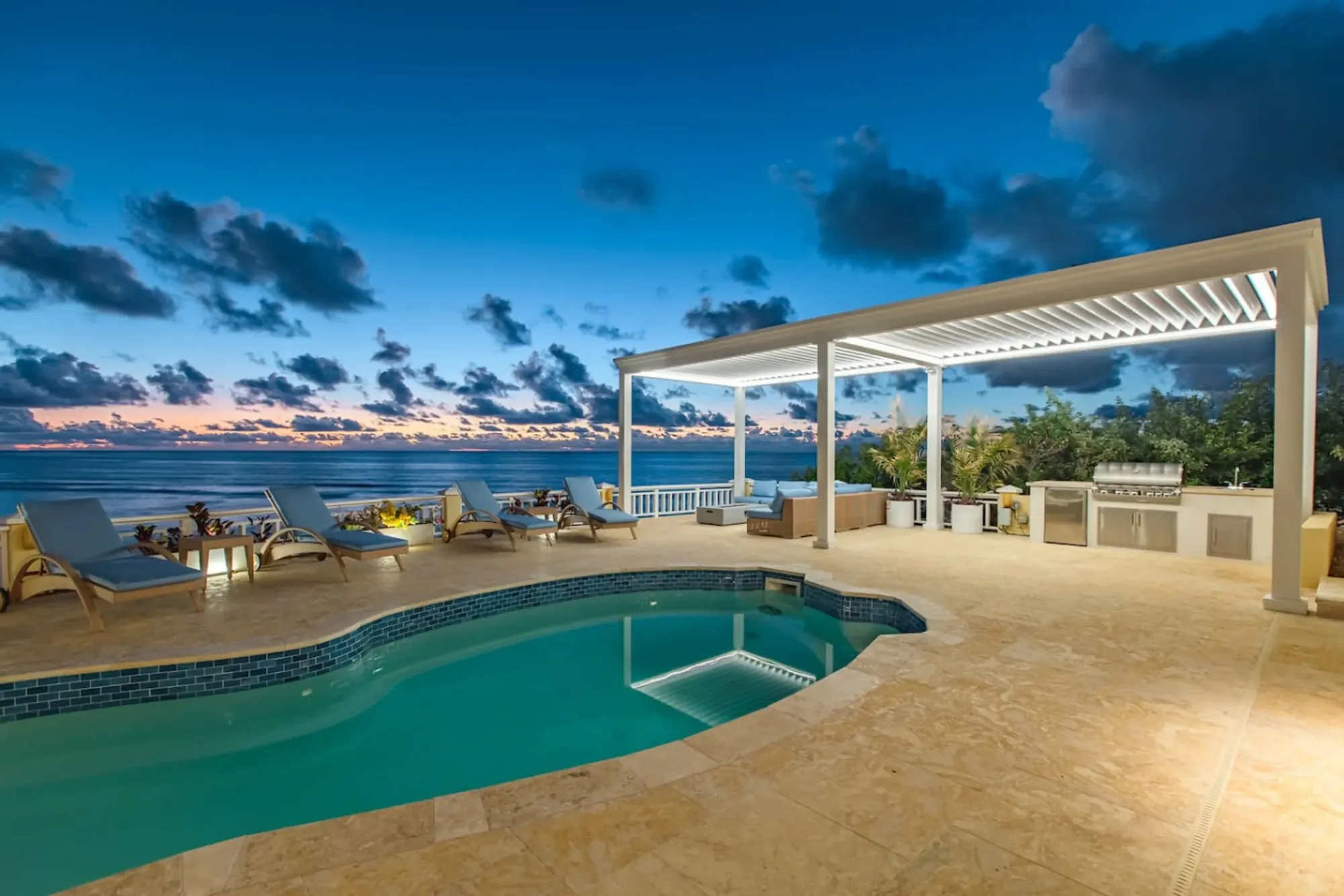
Up above the sand, the pool deck is where everyone ends up: the private pool set in wide travertine above the shoreline, loungers in the sun, a pergola for shade, covered seats and a fridge for drinks at the water's edge. Photos of the steps and the shallows are on the private beach page.
Conch, kallaloo and fried bread
Conch is the shared dish, and in the Bahamas it is practically a national habit. The tourism ministry names five ways to eat it. Conch salad is raw conch, diced, with onion, sweet pepper and lime and orange juice. Cracked conch is pounded, floured and deep fried, usually alongside fries. Conch chowder puts carrots and potatoes in a dark broth. Stewed conch comes over white rice, and scorched conch is a relative of the salad with cucumber and tomato. Lots of visitors try their first at the Fish Fry stalls on Arawak Cay.
On St. Croix, conch (pronounced konk) shows up mostly as a filling: inside pates, the island's fried turnovers, wrapped in a curry roti, and on the menu at La Reine Chicken Shack next to coal-roasted chicken and, on Saturdays, a whole roast pig. The island's signature dishes are others. Kallaloo, a thick pot of greens cooked with okra, is kin to Louisiana gumbo and is spooned over fungi, a side of cornmeal and okra. Sorrel, a spiced hibiscus drink, comes out at the holidays, and maubi, made from tree bark, is an acquired taste.
One name turns up on both sides. Conch chowder in the Bahamas is served with johnny cake, and on St. Croix johnny cakes are little golden fried breads you want to eat hot.
The larger difference is where you eat dinner. A Nassau resort week means restaurants, and there are many. A villa week means a few nights out in Christiansted, roughly fifteen minutes away, and others at home. The kitchen at The Cerulean is a chef's kitchen, with an ice maker, a large island, and a full-size cooking range and oven, and enough place settings for a dozen or more, plus a gas grill in the outdoor kitchen by the pool. The concierge can stock the refrigerators ahead of your arrival and hire you a private chef, for one special dinner or for each night of your stay.
Request fish in butter sauce, kallaloo over fungi and a basket of johnny cakes, and you'll taste the island at your own table. The Crucian food guide on this site walks through each dish, and a journal piece on island groceries and private chefs covers the shopping.
A block of rooms or a whole house
Each destination hosts a group well in its own way. Groups bound for Nassau usually reserve a block of rooms, and the big resorts make that simple, with dining, pools and a beach on one property. On a cruise, a group has cabins down one hallway and gathers for dinner. Out Island lodging is smaller, matching the islands.
Lodging on St. Croix is modest in scale. The 2024 territorial count tallied roughly 1,000 rooms spread across the island's hotels and resorts, some 1,190 homes listed on short-term rental sites, plus about 300 villas, so renting a single house for the whole party is a perfectly ordinary way to come.
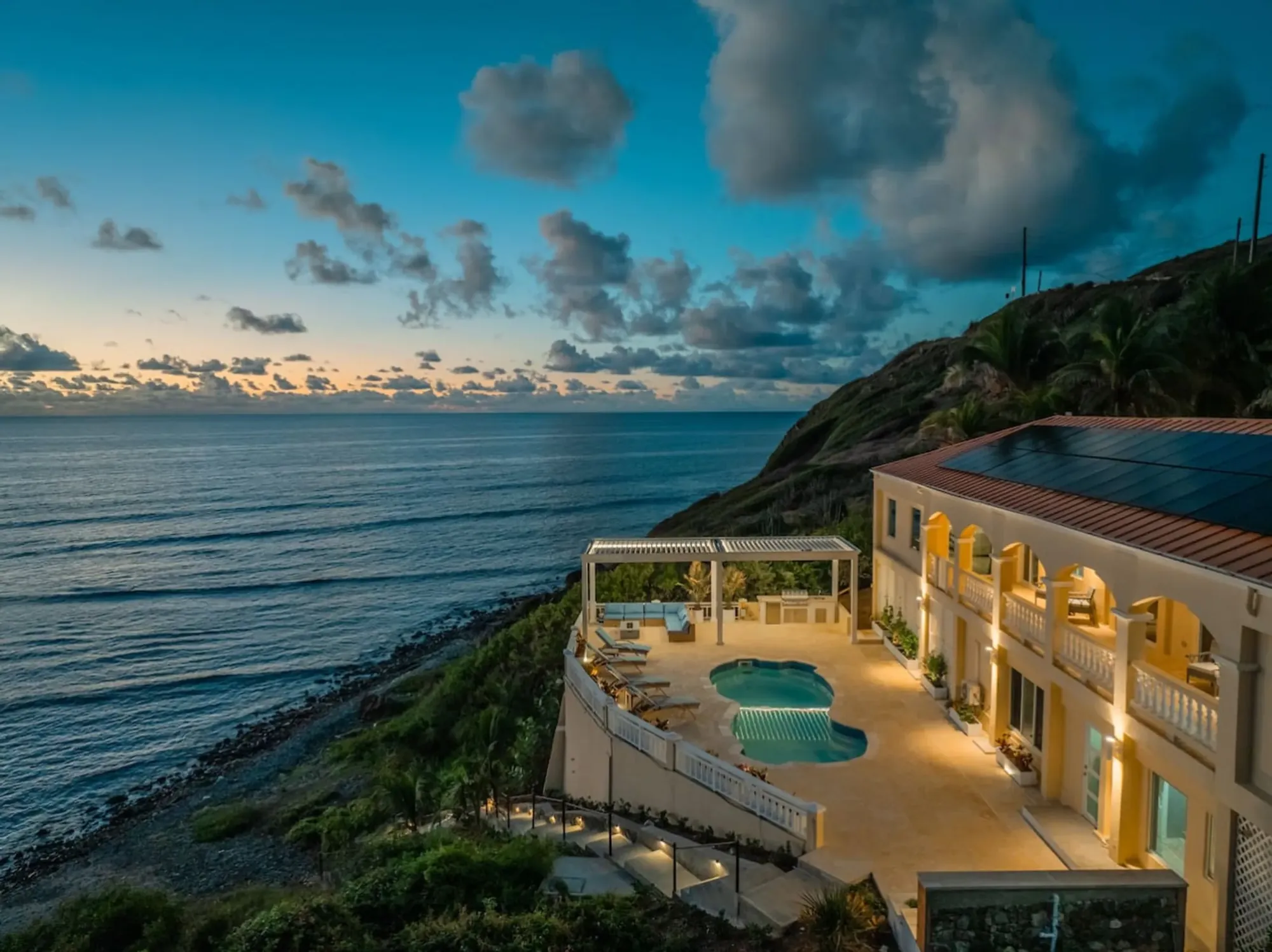
The Cerulean is a house like that. You reach it through a gate at the end of a private drive, and inside are a main house whose four bedrooms all have private baths, a private pool, a guest cottage set apart, a fire pit, a private beach below and a gas grill in an outdoor kitchen. Five bedrooms hold six beds for twelve guests, there are five bathrooms, and air conditioning cools every room.
In a house, the rhythm of the day shifts. Breakfast happens at a single table. Kids splash in the pool while grandparents read a few steps away on the covered terrace. No one takes an elevator or walks a long corridor to find everyone else, and after the youngest are in bed, the adults are right there at the fire pit.
Villas are rented nightly as a whole, so the group works out how to divide the cost. For two or three households, splitting by bedroom is easiest. Settle on the approach before anyone buys a ticket; the booking calendar shows the rate for your dates.
Main house, cottage and loft
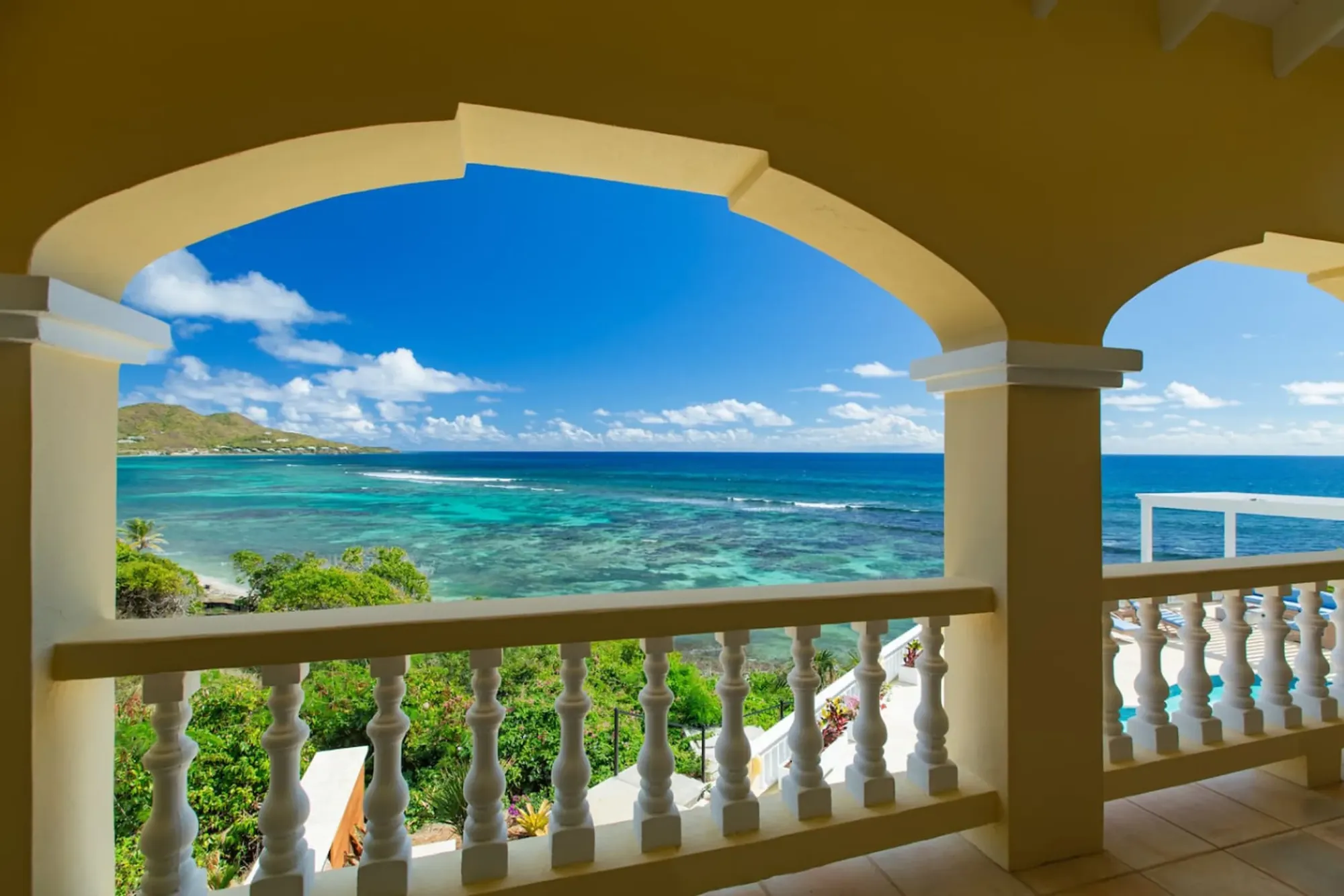
The floor plan is what keeps twelve people comfortable. In the main house, four bedrooms, three looking straight out to sea, surround an open kitchen, dining area and great room beneath a vaulted wood-beam ceiling. An arched veranda stretches along the ocean side. One bathroom has a freestanding tub, and another a walk-in shower of marble with a window looking out on the ocean.
Roughly twenty steps off, the guest cottage stands as a separate little home with a kitchen of its own, a living room, one bedroom and a full bathroom. From its living room a spiral staircase rises to the loft, where the sixth bed is. Nobody else ever books the cottage by itself, so your group has the cottage, the main house, the beach and the pool all week with no strangers.
Having a second front door makes group travel easier. Grandparents up at five can brew coffee in their own kitchen. Parents with a napping baby can keep one building quiet. Two families splitting the week each get a living room. And the loft at the top of the spiral stair makes an easy teen hangout.
The house has the basics a group relies on: fresh linens and towels, a sound system, smart TVs, a washer and dryer, fast Wi-Fi and free on-site parking. For the littlest guests: a travel crib, baby gates, a high chair. Each room is pictured on the bedrooms page, so settle the room plan and send it around.
Nonstop flights to each
Nassau ranks among the simplest islands to reach from the U.S. When we read the Bahamian tourism ministry's flight page in November 2026, it showed American five times daily from Miami and twice daily from Charlotte, Delta twice daily from Atlanta, JetBlue twice daily from Fort Lauderdale plus daily from New York and Orlando, and United twice daily from Newark and daily from Houston. Flights from the East Coast can take as little as an hour, and the country has 20 international airports with scheduled service.
St. Croix has fewer flights, and they fit villa weeks that begin and end on Saturdays. A Saturday landing also lines up with the villa's 4 pm check-in. Here is the published STX nonstop schedule as of November 2026. Airlines change timetables, so double-check when you book.
| From | Flight time | Carrier and days |
|---|---|---|
| Miami | Roughly 3 hours | American, year-round, two a day this winter |
| Charlotte | Roughly 3 3/4 hours | American on Saturdays, daily starting December 17 |
| Atlanta | Roughly 3 3/4 hours | Delta on Saturdays, daily starting December 19 |
| Newark | Roughly 4 1/4 hours | United on Saturdays |
| Chicago O'Hare | Roughly 5 hours | American on Saturdays starting December 19, with a break January 3 to February 12 |
| San Juan | Under an hour (40 to 50 minutes) | JetBlue every day from November 19, Cape Air every day |
From Florida, the arithmetic is easy. Nassau is roughly an hour off. St. Croix is about three hours from Miami without leaving the country, and Orlando travelers connect in Miami for a journey often under seven hours total. From the Northeast, United serves both nonstop out of Newark. From the Carolinas and Georgia, Charlotte and Atlanta, the same hubs with Nassau service, fly nonstop to St. Croix all winter.
Groups from different cities can land close together. Picture one family on the Charlotte flight, another coming from Atlanta and a third from Miami. From the terminal, our driveway is 35 to 40 minutes away, which puts everyone at the house by dinnertime. Current routes live on our getting here page, and each home city has its own page: Miami, Orlando, Atlanta, Charlotte and New York.
Saturday to Saturday out east
This is the usual shape of a week for twelve, arriving and leaving on Saturdays. Each day gets one outing, and the rest of it happens at the house.
- Day 1Fly in by afternoon, pick up the cars and head east. The villa managers guide you to the house and walk you through it. A swim, then an easy dinner on the deck.
- Day 2Early risers catch sunrise at Point Udall, ten minutes off. Snorkel the reef under the pool deck. Grill fish for dinner.
- Day 3Morning boat to Buck Island from Green Cay Marina for the snorkel trail, then Turtle Beach.
- Day 4Christiansted for the fort and the boardwalk, lunch by the harbor, and a grocery run on the way back.
- Day 5Everyone splits up. Hikers head for Isaac Bay, little ones paddle at Cramer's Park, and divers go to Cane Bay.
- Day 6Out west to Frederiksted for Fort Frederik, a swim at a west-end beach and the sunset over the sea.
- Day 7Stay home with the reef and the pool, an in-villa massage for anyone who booked, and a private chef for the farewell dinner.
- Day 8A last swim, a 10 am checkout and the drive to the airport.
A Bahamas week has its own joys. A resort stay near Nassau might fill those days with the water park, the beach, a day downtown and maybe a boat to the closest cays. A boat week in the Exumas would mean sandbars, snorkeling and a fresh anchorage every night. The East End week is the one where twelve people share a pool, a reef and a dinner table, and still take in a fort, a monument and a sunset over the far shore.
Evenings take little organizing. Dinner travels from the outdoor kitchen to the table over the water, the fire pit gets lit as the sun drops, and the covered terrace, around its fire table, is where the night's last conversations usually land. No one needs to drive after dark unless they choose to. On a dark night with no moon, a guided kayak trip on Salt River Bay, roughly 35 minutes off, shows the water lighting up around each paddle stroke, and our bioluminescent bay guide explains choosing the right night.
Which one to book
Both trips bring warm water and a slower pace, so fit the place to the people.
Go with the Bahamas if you're in Florida and want an island an hour away, if you're cruising and some relatives lack passports, if the kids have their hearts set on a water park, or if you've been dreaming of a boat week through the Exuma cays. It handles all of those beautifully.
Plenty of families have done the Bahamas before. They sailed when the kids were little, or spent a long weekend in Nassau, and now the kids are grown and the group has doubled. For the next trip, a week in one house on an American island is an easy next step: the same warm sea, conch still on the menu, a bit farther south, and the whole crew under one roof.
Go with St. Croix if no one in your group should have to renew a passport, if you'd like the warmer winter water of the pair, if forts, towns, a rain forest road and a reef monument within driving distance sound good, or if the real goal is having everyone at one address.
Booking The Cerulean is straightforward. Sterling Point manages the villa on St. Croix. You can check in from 4 pm, checkout is by 10 am, and each stay opens with a staff member guiding you up to the house and showing you around. The concierge can handle housekeeping, private chefs, provisioning, boat days, airport pickup and in-villa massage whenever you ask.
The order to book in
8 itemsYour ticks stay in this browser only.
Holiday weeks and winter Saturdays work for many families, so settle dates with each household early. Check the calendar for your week, and bring everyone on the IDs already in their wallets.
Questions people ask
Is a passport required to visit the Bahamas?
If you fly, yes. The Bahamas is another country, and CBP, the federal border agency, requires U.S. citizens coming home by air to show a passport or a trusted traveler card, including a passport for every child. Bahamian immigration wants each visitor to have a passport valid for six months or longer, a return ticket and a filled-in immigration card, and Americans need no visa. Rules shift, so reread the official pages before booking.
Can I cruise to the Bahamas with no passport?
In many cases. Under CBP's rule, U.S. citizens on a closed-loop cruise, meaning one that sails from a U.S. port and comes back to that port, may reenter showing a birth certificate plus photo identification from a government. Ports along the route and the cruise line itself may still require a passport, and flying home from a foreign port needs one, so confirm with your cruise line.
Do the U.S. Virgin Islands require a passport like the Bahamas does?
No. Flying into the Bahamas takes a passport, but St. Croix and the rest of the USVI are American territory, so trips from the mainland count as domestic. Adults show the TSA a license that meets REAL ID rules, or a different ID on its list, and children under 18 traveling inside the U.S. are not asked for identification. Nobody checks passports when you land, and the only inspection is a brief agriculture and customs stop before the flight back.
Is the Bahamas part of the Caribbean?
Technically no. The Bahamas lies in the Atlantic, north of the Caribbean Sea, starting roughly 50 miles from Florida, though travelers usually group it with the Caribbean. St. Croix lies in the Caribbean Sea, its latitude roughly 17.7 degrees north, around seven degrees of latitude below Nassau, which is why its winter weather and sea are a few degrees warmer.
Is St. Croix or the Bahamas warmer in winter?
St. Croix, by about six degrees in the afternoon. The Bahamas Department of Meteorology's January normals for Nassau show an average high of 78°F and low of 63°F. NOAA's 1991 to 2020 normals for St. Croix's airport give 84°F and 71°F. For the sea, NOAA's Christiansted harbor station averages about 81°F in January, while the Bahamian tourism ministry lists 73°F for the Exumas in February.
Do U.S. dollars work in the Bahamas and on St. Croix?
In both places. The Bahamian dollar is fixed one for one against the U.S. dollar, the Central Bank of The Bahamas quotes cash at par, and the tourism ministry says the two currencies are used interchangeably across all the islands. St. Croix, as U.S. territory, uses only the U.S. dollar, and debit and credit cards work exactly like at home.
Do cars keep left in both the Bahamas and the USVI?
They do. The Bahamas uses British road rules, roundabouts included. The USVI keeps left too, though St. Croix's rentals are ordinary U.S.-market cars, the driver seated on the left. Limits are low: 55 mph on the highway, 35 on most roads and 20 in town. A U.S. driver's license is accepted as it stands.
Is the flight to Nassau shorter than the flight to St. Croix?
Yes, Nassau is nearer. The Bahamian tourism ministry says East Coast flights can be as short as an hour, and there are several a day from Miami. On the published schedule, St. Croix is roughly three hours from Miami, about 3 hours 45 minutes from Atlanta or Charlotte, and just over four hours from Newark. Confirm current times with the airline.
Would St. Croix suit a family or group that usually goes to Nassau?
It does if the group wants a house. St. Croix offers two small historic towns, Buck Island Reef National Monument, quiet East End beaches and no passport rule for U.S. citizens. The Cerulean has room for twelve: there are four en-suite bedrooms under the main roof, the guest cottage adds a kitchen, a full bath and a sleeping loft, and there is a private pool and steps to a beach behind the reef.
Does the Nassau airport have U.S. preclearance?
Yes. CBP runs preclearance at 16 locations in six countries, and Nassau's airport is one. Passengers headed to the United States clear U.S. inspection in Nassau before they board and land as domestic travelers. St. Croix's mainland flights are domestic already, with a quick agriculture and customs stop before departure at the airport.
Sources
We opened each listed page in the course of November 2026. Border rules, airline timetables and visitor figures are revised often, so reread the official source before you plan around one.
- U.S. Customs and Border Protection — Western Hemisphere Travel Initiative (closed-loop cruises, documents by air and sea)
- U.S. Customs and Border Protection — Preclearance locations
- Bahamas Department of Immigration — Visitors, before your arrival
- The Islands of The Bahamas (Ministry of Tourism) — Travel basics: currency, driving, time zone, flight times
- The Islands of The Bahamas (Ministry of Tourism) — Flying to The Bahamas
- The Islands of The Bahamas (Ministry of Tourism) — Nassau island page
- The Islands of The Bahamas (Ministry of Tourism) — The Exumas
- The Islands of The Bahamas (Ministry of Tourism) — The Exumas fact sheet (cays, length, sea temperature)
- The Islands of The Bahamas (Ministry of Tourism) — Andros
- The Islands of The Bahamas (Ministry of Tourism) — Bimini
- The Islands of The Bahamas (Ministry of Tourism) — Eleuthera and Harbour Island
- The Islands of The Bahamas (Ministry of Tourism) — The 16 islands
- The Islands of The Bahamas (Ministry of Tourism) — Bahamian Out Islands (700 islands and cays)
- The Islands of The Bahamas (Ministry of Tourism) — 5 ways to eat conch in The Bahamas
- The Islands of The Bahamas (Ministry of Tourism) — Boating regulations and cruising permits
- Bahamas Ministry of Tourism, Investments and Aviation — Record 12.5 million visitors in 2025 (Jan 28, 2026)
- Bahamas Ministry of Tourism, Investments and Aviation — More than 11 million visitors in 2024 (Feb 5, 2025)
- Nassau Cruise Port — Another record year: an estimated 6.1 million passengers in 2025 (Feb 2, 2026)
- Bahamas National Statistical Institute — Official 2022 census results and data highlights
- Bahamas National Trust — Exuma Cays Land and Sea Park
- Central Bank of The Bahamas — Exchange rates (Bahamian dollar at par with the U.S. dollar)
- World Meteorological Organization, World Weather Information Service — Nassau climate normals from the Bahamas Department of Meteorology
- NOAA NCEI — 1991 to 2020 monthly normals, station VQW00011624 (St. Croix, Henry E. Rohlsen Airport)
- NOAA NCEI — Coastal Water Temperature Guide (Christiansted Harbor, St. Croix)
- U.S. Census Bureau — 2020 Census, U.S. Virgin Islands population by island and town (Table 1)
- National Park Service — Buck Island Reef National Monument, basic information
- National Park Service — Christiansted National Historic Site, fees
- Visit USVI — Travel tips and frequently asked questions
- TSA — Acceptable identification at the checkpoint
- Verizon — Domestic roaming FAQs (U.S., Puerto Rico, U.S. Virgin Islands)