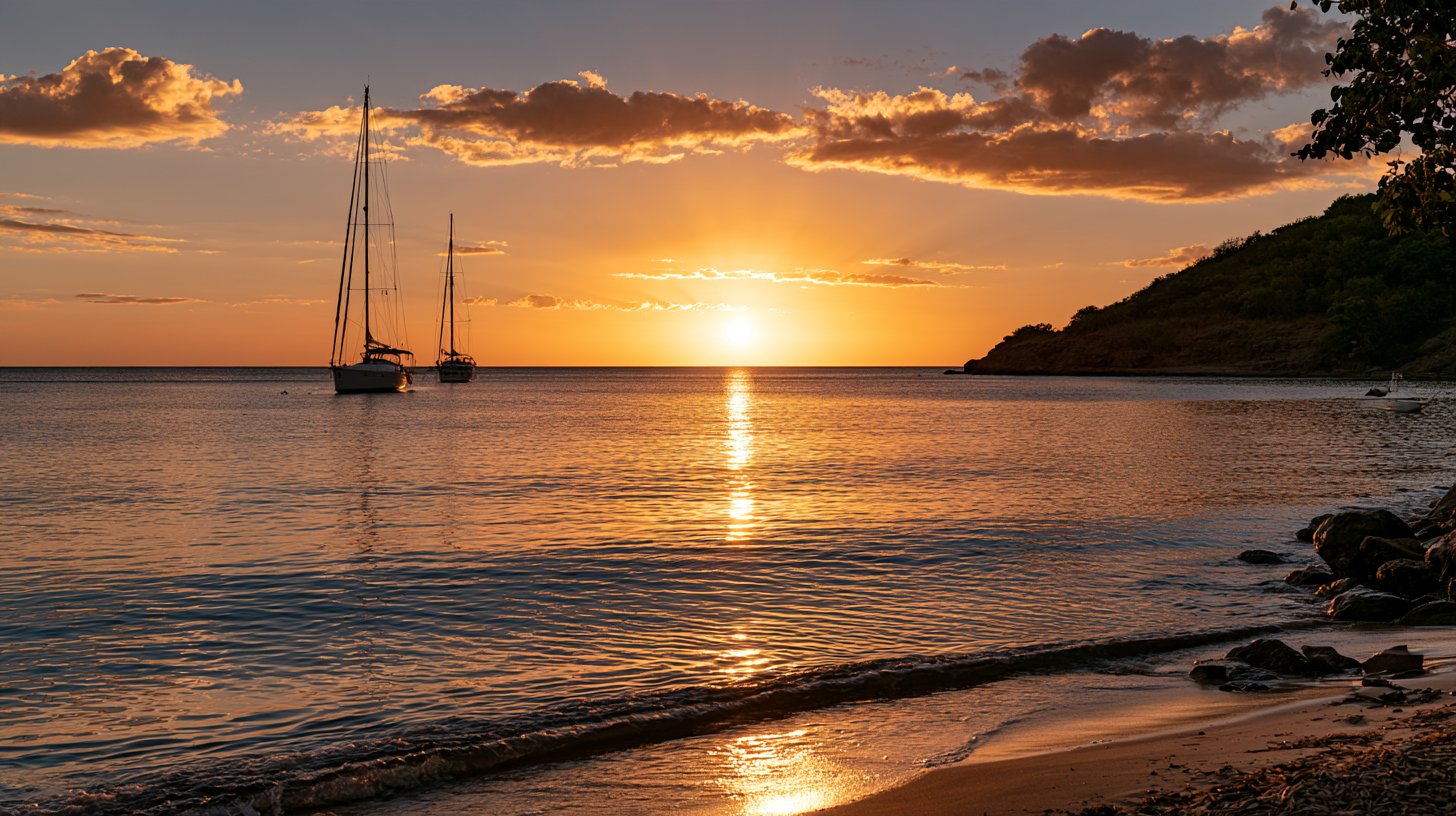


Puerto Rico and St. Croix sit about 65 miles apart in the same warm sea, and both fly the U.S. flag. That makes them the two easiest Caribbean trips for an American family: no passport, U.S. dollars and a domestic flight. They are also very different places to spend a week. Puerto Rico is a big island with a capital city, a walled old town with forts begun in the 1500s, a national forest and more than 6.8 million arriving passengers at its main airport in 2025. St. Croix is a small one, with 41,004 residents at the 2020 census, two Danish-built harbor towns, a reef protected as a national monument and a sunny, quiet East End. This guide compares the two on the things a group plans around: size, visitors, language, driving, beaches, reefs, towns, food and flights. It ends with a plan that works well for many groups, a night or two in Old San Juan and then the short hop to St. Croix and The Cerulean, our five-bedroom villa on the East End.
Puerto Rico and St. Croix at a glance
Start with what the two islands share, because it is a lot. Both are U.S. territories. A U.S. citizen flies to either one on a domestic ticket with the same ID used for a flight to Denver, pays in U.S. dollars, and on most phone plans keeps calling home as usual. Both sit in the northeastern Caribbean, where the wind blows all year and the water is warm enough for a swim before breakfast. And they are neighbors: St. Croix lies about 65 miles southeast of Puerto Rico, and the small planes that link them take about 40 to 50 minutes.
The differences are about scale and pace. Puerto Rico is a large, lively island of about 3.2 million people, with a capital city, the forts and cobblestone streets of Old San Juan, a rain forest in the national forest system, three bioluminescent bays, big beach hotels and nonstop flights from across the mainland. St. Croix is the largest of the U.S. Virgin Islands and still a small place: about 84 square miles and 41,004 residents, two towns the Danes laid out in the 1700s, farmland and old sugar mills, a reef that has been a national monument since 1961, and an East End of low sunny hills, small bays and private villas like ours.
Most travelers decide by the shape of the trip they want. A couple who wants city nights, a long list of restaurants and a famous old quarter will love San Juan. A family or a group of eight to twelve who wants one house, one long table and a quiet beach of its own tends to find St. Croix a natural fit. Plenty of people do both, and the last chapters of this guide show how to fit them into one trip. If you are also weighing the other U.S. Virgin Islands, our St. Croix vs. St. Thomas guide compares the three of them the same way.
Passports, dollars and phones
For a U.S. citizen, both islands are domestic travel. You board in Miami, Newark or Atlanta with a REAL ID-compliant license or another TSA-accepted ID, such as a passport or a Global Entry card, and you land with no immigration line. Children under 18 flying with an adult need no ID of their own at the checkpoint. That is why both islands come up whenever someone looks for a Caribbean trip without a passport, and our page on the Caribbean without a passport explains which islands qualify and why the rest need one.
Money and phones work the way they do at home. Both islands use the U.S. dollar, cards are widely accepted, and a little cash is handy for a roadside stand or a Saturday market. Most major U.S. carriers include Puerto Rico and the U.S. Virgin Islands in their domestic coverage, depending on the plan. Search your carrier's coverage page for the island before you fly and you will know in a minute.
There is one small difference on the way home. The U.S. Virgin Islands sit outside the U.S. customs territory, so flights from St. Croix to the mainland include a short customs check before boarding, alongside the agriculture inspection of bags that Puerto Rico and the Virgin Islands share. It comes with a perk: visitors returning from the Virgin Islands get a duty-free allowance of $1,600 a person, double the usual $800, and it still applies if you connect through San Juan or Miami. Arrive at the St. Croix airport about two hours before a mainland flight and the whole process takes a few minutes of your morning. Our no-passport guide walks through it step by step, from the agriculture table to the gate.
Size and population
The easiest way to feel the difference between these islands is to put the census numbers side by side. Puerto Rico has 3,424 square miles of land and counted 3,285,874 people in the 2020 census, with an estimate of 3,184,835 in mid-2025. St. Croix has about 84 square miles and counted 41,004 people. Puerto Rico has roughly 40 times the land and 80 times the residents, and about twice as many people per square mile.
| Puerto Rico | St. Croix | |
|---|---|---|
| Land area | 3,424 sq mi | About 84 sq mi |
| Residents, 2020 census | 3,285,874 | 41,004 |
| People per sq mi, 2020 | About 960 | About 490 |
| Main towns | San Juan, the capital, founded 1521 | Christiansted, 1,770 residents, and Frederiksted, 528 |
On the ground, scale shows up as distance and choice. Puerto Rico is big enough for regions with their own character: the San Juan metro area on the north coast, the mountains of the Cordillera Central in the middle, the surf beaches of the west, and the small islands of Vieques and Culebra off the east coast. You can spend a week there and see a fraction of it, which is part of its appeal. St. Croix is an island you get to know. From the villa on the East End, Christiansted is about 15 to 20 minutes away, the airport 35 to 40, and Frederiksted, at the far western end, about 50.
The towns tell the same story. San Juan is a working capital with neighborhoods, a cruise port, shopping malls and a busy airport, and Old San Juan is its historic heart. St. Croix's two towns are small enough to learn in a morning. Christiansted, the island's main town, had 1,770 residents inside its town limits in 2020, and Frederiksted had 528. The East End, where The Cerulean sits, counted 2,336 people across its whole census district. For a guest, that means quiet roads at sunrise, a beach with a handful of people on it, and towns that feel familiar by your second visit.
A big island gives you variety and a city at your door; a small one gives you space, quiet and a short drive to everything. The question is which of those your group came for, and for a family week in one house, St. Croix's scale is a large part of the appeal.
Visitors and crowd size
Puerto Rico is having a remarkable run. 2025 was its fifth record year in a row: Luis Muñoz Marín International Airport in San Juan counted more than 6.8 million arriving passengers, hotels and short-term rentals booked nearly 7.9 million nights, and more than 1.6 million cruise passengers came ashore. New resorts keep opening, the Four Seasons among them in 2025, and the island's calendar of concerts, festivals and big sporting events keeps growing. If you like the energy of a popular place, San Juan delivers it.
St. Croix runs at a different scale. In 2024, a record year for air arrivals across the U.S. Virgin Islands, St. Croix welcomed 186,400 air arrivals from the mainland, the figure the territory's tourism department presented in March 2025. Cruise ships call at the Frederiksted pier on the west end: 71 calls in 2024, carrying 169,228 passengers, or about one ship every five days on average. Christiansted's harbor is used by the seaplane, the Buck Island boats and local sailors.
Numbers like these turn into the small things guests notice. Buck Island Reef National Monument, the island's best-known day out, counted 40,079 visitors in all of 2025, about 110 a day on average, so a snorkel boat shares the reef with only a few others. The bays below the villa hold whoever walked down the steps that morning. And because so much of the island is homes, farms and open hills, the drive between beaches is part of the scenery.
A busy island has more of everything: more restaurants, more nightlife, more flights, more events. A quiet one has more room per person. That room is what a group gets on St. Croix: a quiet beach on its doorstep, a reef without a queue and a week that runs on its own clock. Our page on St. Croix's East End shows the corner of the island the villa calls home.
Everyday language on each island
Puerto Rico is a Spanish-speaking island with two official languages, Spanish and English. Spanish is the language of daily life: in the Census Bureau's 2020 to 2024 surveys, 95.5 percent of residents age five and older spoke a language other than English at home. English is widely understood in the places visitors go, from the hotels of Condado and Isla Verde to the restaurants of Old San Juan, and many residents switch between the two with ease.
For a traveler, that makes Puerto Rico a pleasant place to practice. A few words of Spanish, a buenos días at the café and a gracias at the counter, are noticed and appreciated, and the music, the menus and the conversations around you give the trip the feel of somewhere far from home, without the passport.
St. Croix is English-speaking. English is the official language of the U.S. Virgin Islands, and it is what you hear in shops, restaurants, doctors' offices and on the radio. Spanish is commonly spoken too, and part of the reason is a shared history: families from Puerto Rico, many from the small island of Vieques a short sail to the west, came to St. Croix from the 1920s onward to cut cane and stayed, and their children and grandchildren are part of the island today. Families from islands farther down the chain, Trinidad above all, have added their own accents and their own cooking.
For a group with grandparents and teenagers, everyday English is a quiet convenience. The grandparent asking a pharmacist about a prescription, the teenager ordering lunch on their own and the driver reading the signs on the way east all do it in their own language.
Driving and getting around
Driving is where the two islands differ most, and both are easy once you know the rule. In Puerto Rico you drive on the same side of the road as on the mainland, rent a car the way you would at home, and let the GPS guide you along the marked highways. In San Juan you can also skip the car for a day or two: rideshare works in the metro area, and Old San Juan is best seen on foot.
On St. Croix you drive on the left, in ordinary American cars with the steering wheel on the left. The driver sits next to the edge of the road rather than the center line, and most drivers settle in within the first ten minutes. Speeds are gentle: 20 mph in town unless posted, 35 mph on most roads and 55 mph on the Melvin H. Evans Highway, the one divided road. Your U.S. license works as it is. Plan on a car for the week, since rideshare apps do not operate on the island; the beaches, the towns and the restaurants are spread from one end of the island to the other, and the drives between them, past bays, pastures and old windmill towers, are part of the pleasure.
A group of ten to twelve needs two cars, or a passenger van and a car, which also lets the early risers head to Point Udall while the rest of the house sleeps. Reserve them when you book the villa so the right cars are waiting, and our car rental directory lists the agencies at the airport and those that meet flights. If two branches of the family land on different flights, the villa's concierge can arrange an airport pickup and a vehicle for the week. Our driving guide covers the roads by name and the drive east from the airport.
Condado and Isla Verde
San Juan has something few capitals can offer: a real beach in the middle of the city. Condado, between Old San Juan and the airport, is the district of beach hotels, shops by local designers, restaurants, bars and casinos, with the sand on one side of the street and the city on the other. The Condado Vanderbilt, a full-service resort, is one of the strip's landmarks, along with the tower of La Concha. Behind the beach, the Condado Lagoon is a favorite for stand-up paddleboarding with the skyline in view.
Isla Verde, in Carolina just east of San Juan, is the other big hotel beach. Its golden sand is lined with tall palms, hotels, restaurants and shops, and it sits close to the airport, which makes it easy for a short stay. Both beaches suit travelers who want a swim in the morning, a walk to lunch, and plenty of places for dinner without getting in a car. For a couple on a long weekend, it is hard to beat.
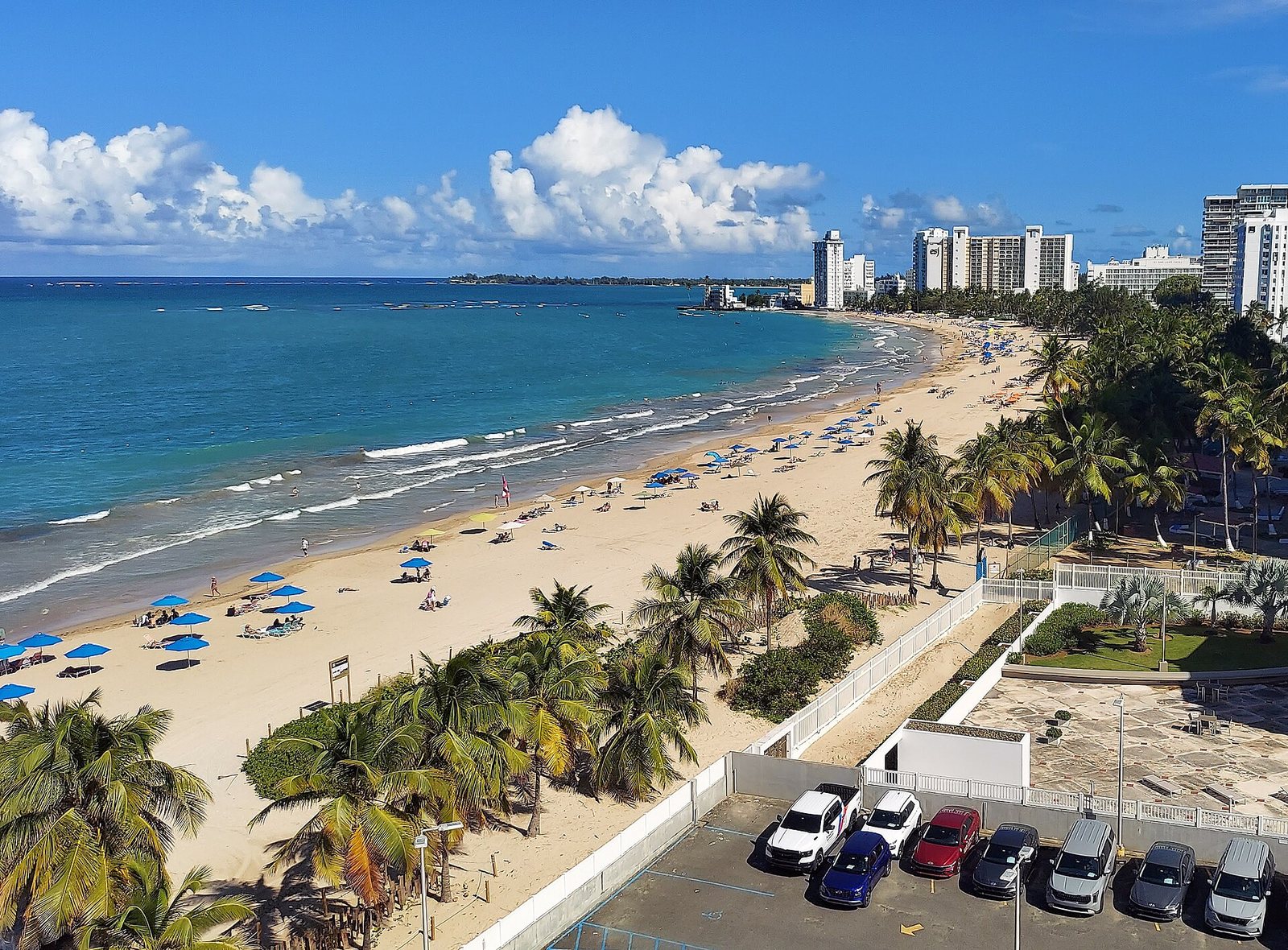
A group of twelve experiences a hotel beach differently. Twelve people usually means five or six rooms, sometimes on different floors, a pool shared with the rest of the hotel, and a table for twelve to book each night. That suits some groups very well, especially for a night or two at the start of a trip. For a week together, many families prefer one house where everyone wakes up in the same place, the coffee is in the same kitchen and the beach is at the bottom of the steps. The next two chapters describe what that looks like at The Cerulean.
A private beach on the East End
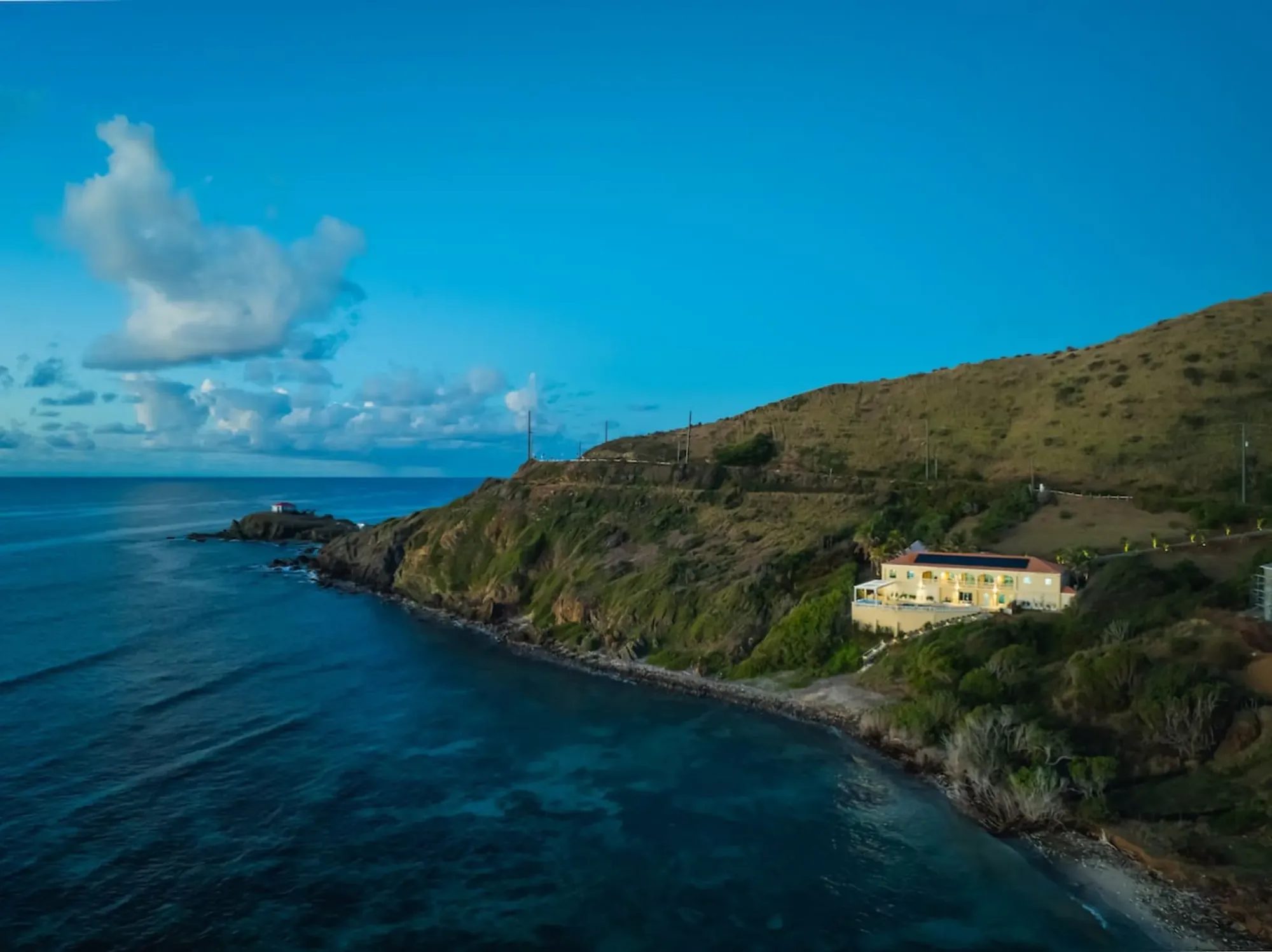
The Cerulean sits on its own stretch of shore on St. Croix's East End, and the beach is part of the house. Down a short set of steps from the pool deck, the villa has its own private beach with direct water access. The water in front of it is shallow and protected by a reef, and the snorkeling starts a few feet out, so you can be among the reef fish before breakfast.
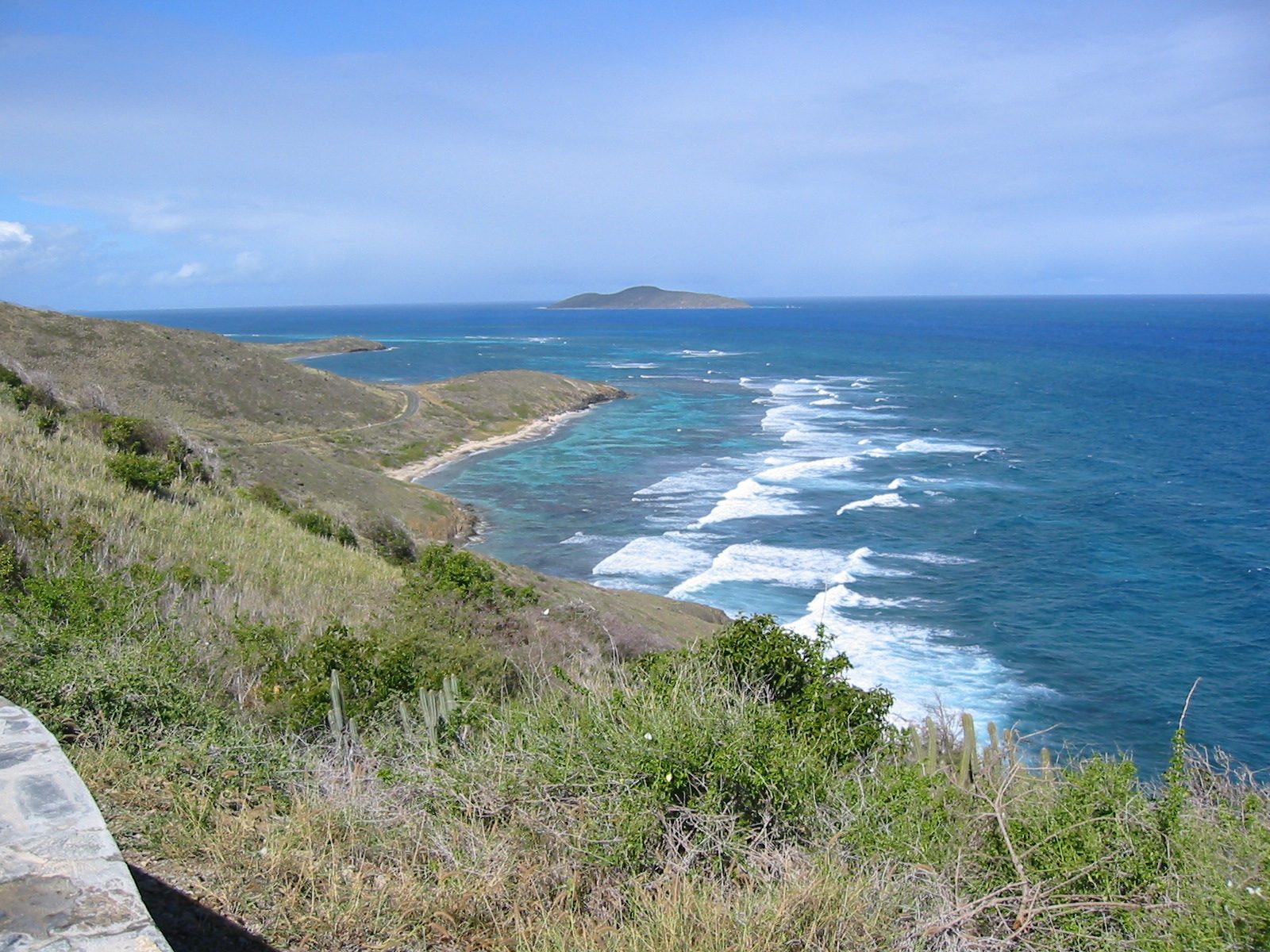
That line of white water offshore is the reef breaking the swell, which is why the water near the beach stays calm and why the fish stay close. Mornings are the best time to swim: the house faces east, the sun comes up over the sea, and the water is at its stillest before the breeze builds. Brown pelicans fish the reef line most mornings, and green turtles and hawksbills use the reefs and seagrass of the East End all year.
“Pure perfection. A gorgeous home right on the ocean, amazing snorkeling right in front of the house in the shallow water protected by the reef.”
Emily, a guest in April 2026
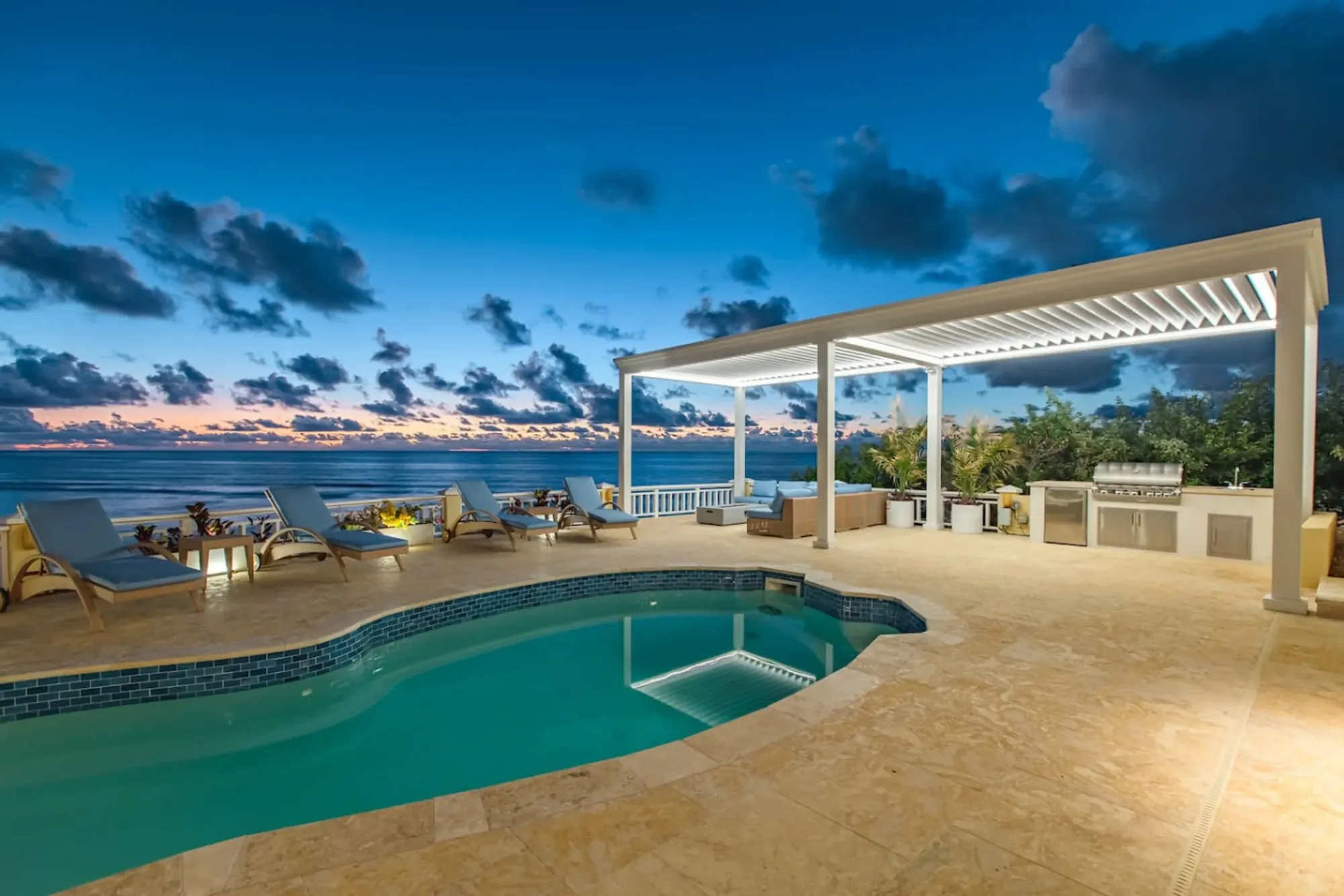
Above the beach, the private pool and its large deck sit directly over the shoreline, with sun loungers, a shaded pergola, covered seating for the middle of the day, an outdoor kitchen with a gas grill, a drinks refrigerator by the pool and a fire pit for the evening. The whole arrangement lets the group's day move between sea, pool and shade without anyone getting in a car. Our pages on the private beach and the pool and deck have more photos.
A day at the villa's beach is a simple one: masks and snorkels, a cooler, a book and a towel, carried down the steps, with the pool deck and the shade of the pergola a minute away. Pack mineral sunscreen, since the Virgin Islands ban the common chemical filters, and long-sleeve rash guards so everyone needs less of it.
Room for twelve in one place
The Cerulean sleeps twelve across five bedrooms and two buildings, and the second building is what sets the house apart. The main house holds four bedrooms under a vaulted, beamed roofline, each with its own bathroom and three with direct ocean views, around an open kitchen and living space that works as one big gathering room. About twenty steps away, the guest cottage is a small house of its own, with its own front door, its own kitchen, a living room, a bedroom and a full bath, plus a spiral stair up to a loft with the villa's sixth bed.
The cottage is never rented separately; it comes with every booking, so the whole property is yours. Every room in both buildings is air-conditioned, with ceiling fans as well. That layout lets a group be together all day and still have quiet when it counts. The cottage can be the grandparents' house, with its own kitchen for early coffee; or the young family's, so naps run on their own schedule; or the second family's front door when two families share. The loft, up the spiral stair, is the bed the kids argue over, and it suits the younger sleepers in the group.
“Four spacious bedrooms in the main house, plus a separate fifth suite. Ideal for groups or multi-generational families.”
Suzanne, a guest in March 2026
The shared spaces are built for a crowd. The chef's kitchen has a big island, a full-size range and oven, a dishwasher, an ice maker and service for twelve or more, and the cottage kitchen adds a second full-size refrigerator. The dining table sits under the beamed ceiling, and the outdoor kitchen takes over when dinner moves to the deck. Our bedrooms page walks through each room.

The villa keeps everyone on one property and around one table, with a second front door for whoever needs quiet. Settle who sleeps where before anyone packs, and copy the plan into the family chat.
Room planner
Who sleeps where
Six beds across the main house and the guest cottage, two people to a bed. Type names in, copy the plan, and paste it into the family chat. Nothing leaves this browser.
Buck Island Reef National Monument
Buck Island is St. Croix's headline day on the water. It is a small, uninhabited island of 176 acres about a mile and a half off the northeast coast, wrapped on two sides by an elkhorn coral barrier reef, with a marked underwater snorkel trail in its lagoon and a white beach at its western end. President Kennedy proclaimed it a national monument on December 28, 1961, and in 2001 the monument was enlarged to more than 19,000 acres, almost all of it water, and made a no-take reserve, so the fish, the coral and even the shells stay where they are.
The day is simple. You go out on one of the authorized boats, including several from Green Cay Marina, about ten minutes from the villa. The crew hands out gear and leads small groups along the trail, which runs through the shallow lagoon past coral grottoes at depths of up to about 12 feet. Afterward there is time on Turtle Beach for a swim and a picnic. The monument is open 7 am to 5 pm, there is no entrance fee, and half-day trips ran roughly $95 to $105 an adult in 2026; check the current price when you book. Our Buck Island guide covers the boats, the trail and the rules.
Puerto Rico has wonderful water too, and much of the best of it is around its small islands. Culebra's Flamenco Beach has been named among the world's top beaches more than once, and small airlines and charters fly out to Culebra and Vieques. Both make lovely day trips or short stays from the main island.
On St. Croix, the reef day starts about ten minutes from the villa. The boat leaves Green Cay Marina in the morning, the crossing from the East End is short, and you are back at the house for a late lunch by the pool. Book a weekday morning boat for the calmest crossing, and put Buck Island on the second or third day of the trip so everyone has practiced with a mask on the villa's own reef first.
Diving the Cane Bay wall
Divers know St. Croix for one thing above all: the wall. Along the north shore the sea floor drops away toward a basin roughly four kilometers deep, and at Cane Bay the lip of that drop begins about 100 to 200 yards from the sand, at around 40 feet. You can walk in off the beach with your tank, swim out over the reef and hang at the edge of deep blue water, a wall dive you reach without a boat.
The wall is only one of the island's dive sites. At Salt River Canyon a boat puts you on two walls facing each other across a submarine canyon. Under the Frederiksted pier, on the west end, divers look for seahorses among the pilings on one of the island's best-known dives, by day or at night. Dive shops at Cane Bay and in Christiansted run introductory dives for first-timers and full certification courses, so a teenager curious about scuba can try it with an instructor.
The north shore is typically calmest from about May to November, which makes summer and fall the easy seasons for Cane Bay, and the shops can steer you to the best site for the day's sea at any time of year. Cane Bay is about 45 minutes from the villa, an easy morning drive along the north shore, and the beach there has places to eat on the sand for afterward. Our wall guide explains the geology and the dive sites, and the Cane Bay guide covers the beach day around it.
Puerto Rico's long coastline is a fine place to dive, paddleboard and surf, with well-known surf beaches on the west coast at Rincón, Isabela and Aguadilla. For a group where some people dive and others snorkel or sit on the sand, St. Croix's mix is easy to run from one house: the divers go to Cane Bay in the morning, the snorkelers do the villa's reef or Buck Island, and everyone meets on the pool deck by lunch.
El Yunque and the sunny East End
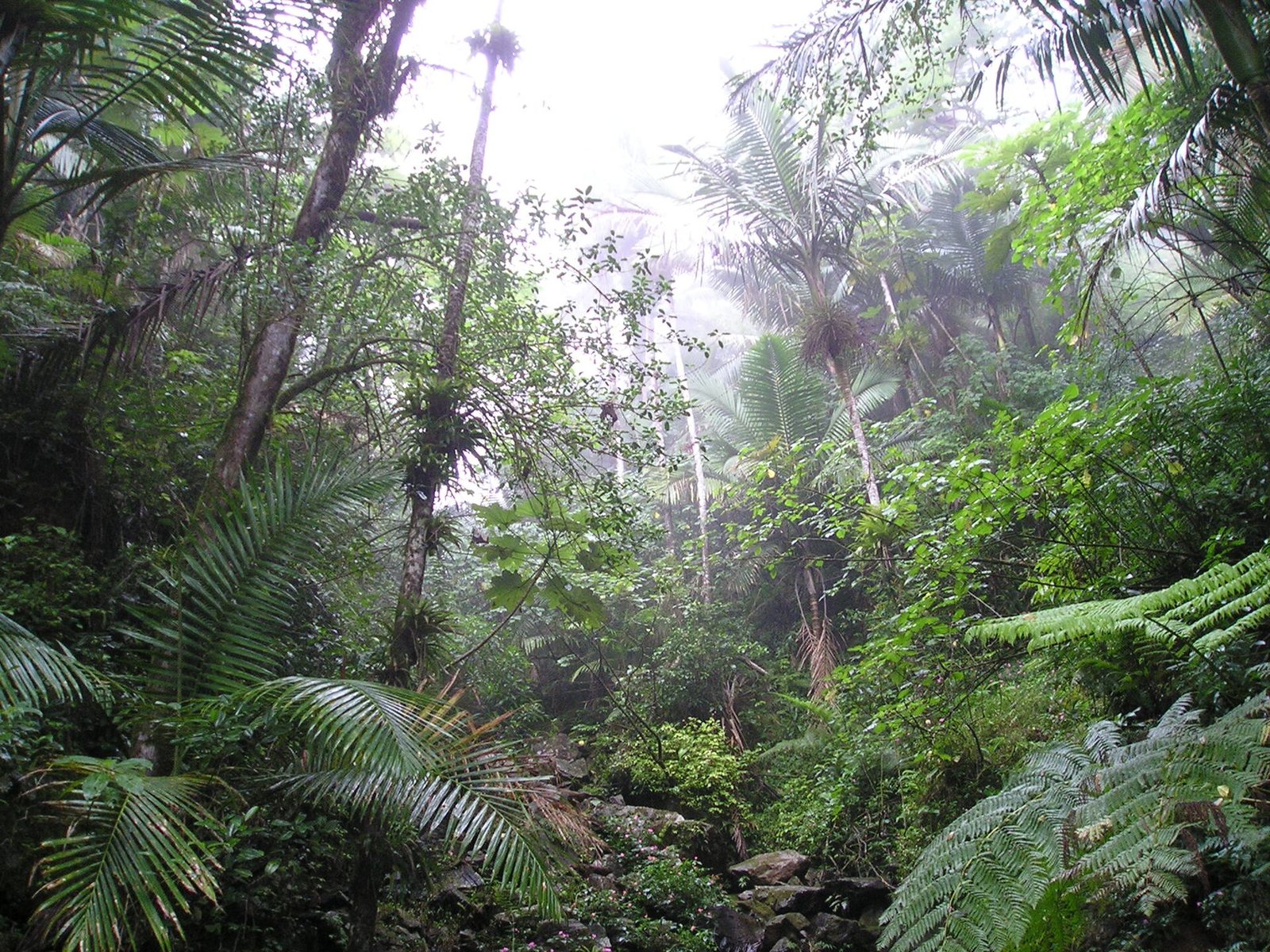
El Yunque is one of the great days in the Caribbean. It is the only tropical rain forest in the U.S. National Forest System, more than 28,000 acres of it in the mountains of northeastern Puerto Rico, about 45 minutes from San Juan. The road climbs into cool, deep green forest, the higher slopes turn into cloud forest, and the coquí, Puerto Rico's famous little frog, lives among the leaves. Entry to the forest is free; the El Portal visitor center charges $8 for adults 16 and up. The forest is open from 8 am to 5 pm and entry may pause when the parking fills, so go early, and pair it with Luquillo Beach, 10 to 15 minutes away.
The forest is green because of the rain: some areas receive more than 120 inches a year, which is what keeps the canopy so thick. Bring a light rain jacket and enjoy it as part of the day.
St. Croix's East End is a different kind of beautiful. It is the sunny, breezy end of the island, with low coastal hills, golden grass and sea grape, a little like the coast of California. The trade wind blows in from the east all year, straight onto the villa's terraces, and in NOAA's long-term averages for the island, rain mostly comes as short showers that pass quickly, with the East End getting less of it than the airport. For a beach week, that adds up to long hours on the sand, mornings on the water and dinners outdoors.
If your group wants a forest day too, St. Croix has its own. Islanders call the green northwest hills the Rain Forest, and Mahogany Road runs through them under a closed canopy of big trees, about an hour west of the villa. It is a gentle outing, an easy drive with a stop or two, and it pairs well with lunch in Frederiksted. Our Mahogany Road guide covers the route, and the weather guide has the month-by-month averages for the island.
Sunrise at Point Udall
The East End's best show starts early. Point Udall, about ten minutes from the villa, is the easternmost point of the United States by travel, a headland of sunny coastal hills and cliffs above the sea. On top stands the Millennium Monument, a large stone sundial built for the New Year of 2000, when ceremonies were held here to watch the first sunrise of the year on U.S. soil. The point was named in 1969 for Stewart Udall, and on most mornings a few early risers stand there with coffee and watch the sun come up over the sea.
The villa faces the same direction. The house looks east, so the first light comes straight off the sea into the bedrooms and onto the veranda, and on a lazy morning you can watch the sunrise without leaving the house.
Below the point lies the Jack and Isaac Bay Preserve, 300 acres protected by The Nature Conservancy since 1999, with two bays you reach only on foot. The trailhead is about five minutes from the villa, the walk takes 10 to 40 minutes each way depending on the route, and the reward is a beach with no road to it and the East End's best snorkeling from shore at Isaac Bay. Start by seven with plenty of water for everyone, since the trail is sunny. For the biggest view on the East End, Goat Hill rises to 672 feet, with the bays on one side and Buck Island on the other.
The water off this whole tip of the island sits inside the East End Marine Park, about 60 square miles of protected sea created in 2003. What the East End adds to a Caribbean trip is a quiet kind of luxury: the country's easternmost sunrise point down the road, a beach at the end of a trail, and a reef you share with turtles. Our Point Udall guide has sunrise times by season, and the East End beaches guide goes bay by bay.
Old San Juan
Old San Juan is a World Heritage old town, and it deserves a day or two of anyone's trip. The city was founded in 1521, and its old town keeps the cobblestone streets and colonial architecture of the Spanish centuries, with plazas, cafés and bars inside the remains of the walls that once held the harbor.
The forts are the heart of it. Castillo San Felipe del Morro, begun in 1539, guards the entrance to San Juan Bay, and it was repaired and enlarged for some 250 years after. Castillo San Cristóbal was under construction from 1634 to 1790, and the city walls, begun in 1634, are 20 feet thick. The National Park Service runs both forts as San Juan National Historic Site, and in 1983 UNESCO recognized the site, together with La Fortaleza, now the governor's residence, as a World Heritage Site. One $10 ticket covers both forts for 24 hours, and visitors 15 and younger enter free.
Between the forts, the old town is a walk. Casa Blanca, built in 1521 as a residence for the family of Juan Ponce de León, is now a museum. Hotel El Convento is a 17th-century convent turned hotel. The evenings are lively, with cocktail bars like La Factoría and late dinners, and the city has two rival claims to the piña colada, Puerto Rico's national drink: one from the Caribe Hilton and one from Barrachina. Order one at each and judge for yourself. San Juan is about 15 minutes from the airport, which makes the old town an easy first or last night of a trip.
The best way to enjoy it is on foot and early. Start at El Morro when it opens, while the morning is still cool, then work back through the streets toward San Cristóbal and lunch. Comfortable shoes matter on the cobblestones and the ramps of the forts. Two nights give you a full day in the old town and an evening in Condado or on Calle Loíza in Santurce, the street known for bar-hopping and live music, and that is the plan we suggest in the chapter on doing both islands.
Christiansted and Frederiksted
St. Croix's history is Danish, and its towns show it. Christiansted, founded in 1734, was the capital of the Danish West Indies, and its waterfront still has the yellow walls of Fort Christiansvaern, built from 1738 to 1749, along with the old customs house, the scale house and streets of arcaded buildings in soft colors. The National Park Service has kept the historic waterfront as Christiansted National Historic Site since 1952. The fort costs $10 for adults 16 and older, the ticket is good for three days, and children under 16 enter free. In 2025 the site counted 100,165 visitors for the whole year, so you can climb the ramparts and stand by the cannon without a line.
Christiansted is the town closest to the villa, about 15 to 20 minutes from The Cerulean. Do the fort in the morning, walk the boardwalk, take lunch on the water and browse the galleries and jewelry shops under the arcades. Alexander Hamilton worked as a teenage clerk in this town before he sailed north to the American colonies, and our guide to Hamilton's St. Croix follows his footsteps. The seaplane to St. Thomas lands in the harbor, and Buck Island boats leave from the same waterfront.
Frederiksted, at the west end, was laid out on a Danish grid in 1751, and its red fort, Fort Frederik, dates from 1752 to 1760. It is the place where the enslaved people of St. Croix won their freedom on July 3, 1848, and islanders still call it Freedom City. Today it is a quiet, handsome waterfront town with a long pier, bars that fill for sunset, and the sun going down over open water. It is about 50 minutes from the villa, so make it a west end day with a beach, the free art museum at CMCArts and dinner on the strand.
Next to Old San Juan, these are small towns, and that is their charm: a fort, a waterfront and a few streets of shops and restaurants, with a favorite table found by the end of the week. Our guides to Christiansted and Frederiksted go block by block.
Food and rum on both islands
Puerto Rico is one of the great food islands of the Caribbean. Order mofongo, mashed fried plantain usually seasoned with garlic, in San Juan, where restaurants from casual to chef-driven serve it. Then drive into the hills for lechón, a whole pig roasted for hours over coals after a long marinade in adobo. Puerto Ricans have whole roads of lechoneras for it, the so-called pork highways, in Naranjito, in Trujillo Alto along PR-175 and in Cayey, with arroz con gandules, tostones and, on good days, live music on the side. Add the piña colada and a visit to Casa Bacardí, one of the largest rum distilleries in the world, and a food lover could plan a whole trip around the table.
St. Croix's own kitchen is well worth discovering. Crucian food grew out of the island's farms and its many arrivals. The signature dish is kallaloo, a stew of greens served over fungi, and the street food is the pate (PAH-tay), a fried turnover filled with beef, chicken or saltfish. Johnny cakes, small golden fried breads, come alongside many meals. La Reine Chicken Shack, mid-island, slow-cooks its chicken over coal and is an island institution. And Puerto Rico is already in the pot: the families who came from Vieques from the 1920s on brought rice-and-beans cooking, roast pork and, at Christmas, coquito.
Rum is a shared love. St. Croix makes Cruzan at Estate Diamond, a few minutes east of Frederiksted, on land that has held a sugar mill since 1760 and that the Nelthropp family has run since 1950, and the Captain Morgan distillery is on the island too. A tour and a tasting make an easy afternoon on a west end day; book ahead. Our Cruzan rum guide has the history and the tour.
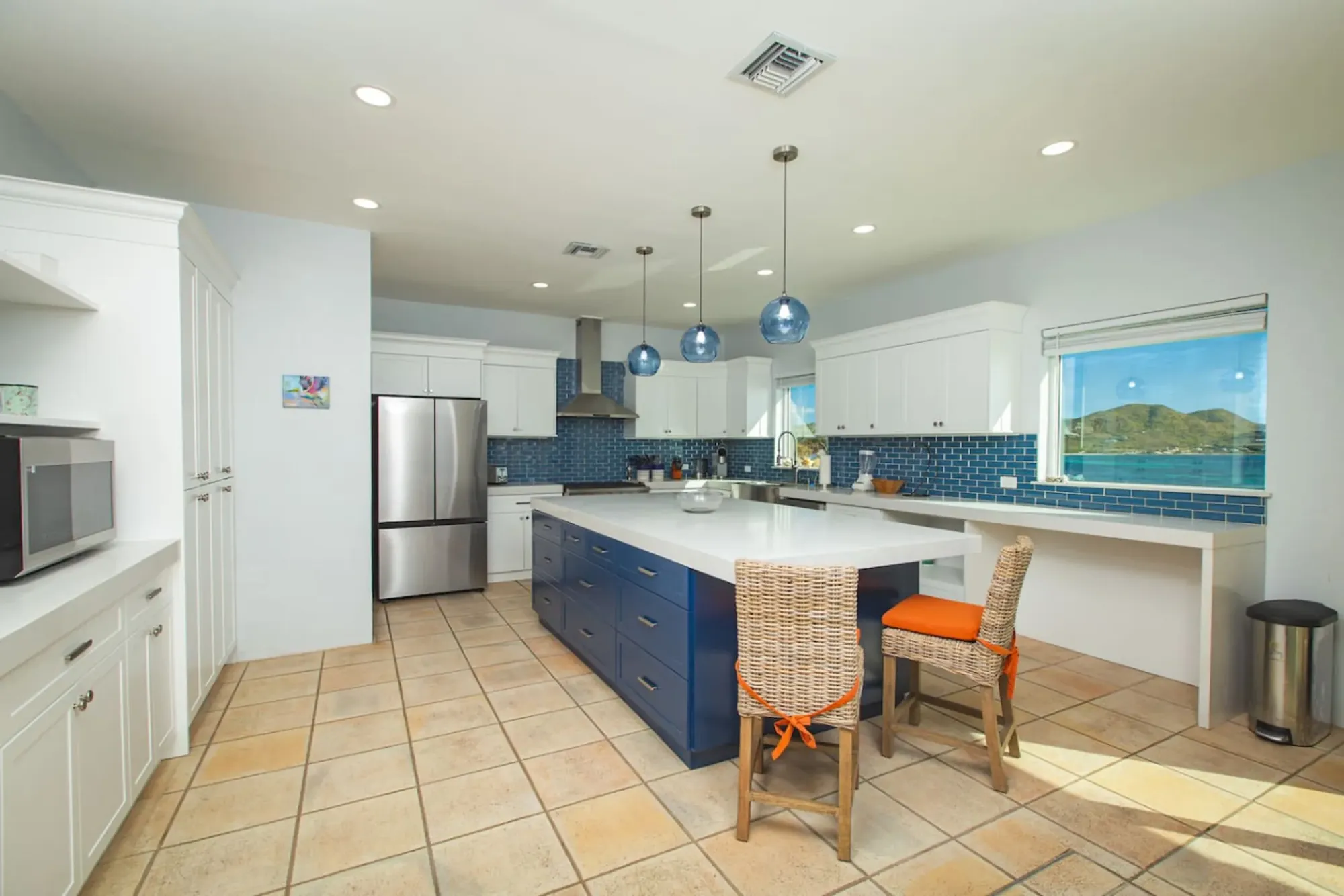
The biggest food difference for a group is where dinner happens. In San Juan, dinner is out, and the choice is endless. At the villa, dinner is wherever you want it. The chef's kitchen and the outdoor grill handle family nights, and a private chef can cook one dinner or the whole week, Crucian dishes included; our private chef directory lists the island's chefs. The concierge can stock the kitchen before you land. Our Crucian food guide explains the rest of the menu.
Bioluminescent bays
Both islands have bays that glow at night, and a paddle through one is a highlight of any trip. Puerto Rico has three: the famous bay on Vieques, known as one of the brightest in the world, Laguna Grande in Fajardo, and La Parguera in Lajas. Each one glows when a paddle or a hand stirs the water, thanks to tiny organisms that light up when they are disturbed.
St. Croix has its own at Salt River Bay, on the north shore about 35 minutes from the villa. The glow comes from the same organism behind the Puerto Rican bays, a dinoflagellate called Pyrodinium bahamense, and Salt River is one of only a handful of bays anywhere where it glows all year. Guided kayak tours of about two hours paddle out through the mangroves after dark, and the darkest nights, around the new moon, are the brightest; tours cost roughly $50 to $70 a person in 2026.
Salt River ties the two islands together in another way. On November 14, 1493, on his second voyage, Columbus's fleet of seventeen ships stood off this bay and sent a boat ashore for water. Five days later, on November 19, the fleet reached Puerto Rico. The bay and its shore are now Salt River Bay National Historical Park and Ecological Preserve, about 1,000 acres run by the National Park Service together with the Virgin Islands government, and it counted 12,126 visitors in 2025, many of them in kayaks after dark.
Plan a bio bay night around the moon: check the calendar before you book the villa week and pick an evening near the new moon. Our bio bay guide explains the moon rule and the tour operators, and the story of 1493 is in our Columbus at Salt River guide.
Flights from the mainland
San Juan is a major air hub with the most nonstops of the two. More than 20 commercial airlines fly into Luis Muñoz Marín International, with nonstops from New York, Boston, Orlando, Philadelphia, Hartford, Dallas, Houston, Baltimore, Washington, Chicago and other cities on American, Delta, United, JetBlue, Southwest and Frontier.
St. Croix's nonstops have grown for the 2026-27 season, and they line up well with a villa week. American flies from Miami every day, twice a day this winter, in about three hours. United's Saturday nonstop from Newark begins October 31, 2026, the first New York-area nonstop to St. Croix in more than 30 years, and runs to September 10, 2027. Delta flies from Atlanta on Saturdays from November 14 and daily over the holidays, from December 19 to January 8. American flies from Charlotte on Saturdays from November 7 and most days from December 17 to early April, and from Chicago O'Hare on winter Saturdays from December 19.
| From | Airline | To St. Croix, winter 2026-27 | In the air |
|---|---|---|---|
| Miami | American | Daily, twice a day this winter | About 3 hours |
| Newark | United | Saturdays from Oct 31, 2026 | About 4 1/4 hours |
| Atlanta | Delta | Saturdays from Nov 14, daily Dec 19 to Jan 8 | About 3 3/4 hours |
| Charlotte | American | Saturdays from Nov 7, most days Dec 17 to Apr 5 | About 3 3/4 hours |
| Chicago O'Hare | American | Winter Saturdays from Dec 19 | About 4 3/4 hours |
| San Juan | JetBlue and Cape Air | JetBlue daily from Nov 19, Cape Air several a day | 40 to 50 minutes |
Everyone else connects once, through Miami, Charlotte, Atlanta or San Juan. That last option is the one that ties this guide together: San Juan has the nonstops, and St. Croix is 40 to 50 minutes from San Juan. The Saturday nonstops line up neatly with a Saturday-to-Saturday villa week, and a San Juan connection works any day of the week.
Our getting here page keeps the routes current, and there are city pages for New York, Boston, Chicago, Atlanta, Charlotte, Miami and Philadelphia. Schedules change by season, so confirm yours when you book.
Doing both islands
You do not have to choose. The neatest Caribbean plan we know starts in Old San Juan and ends at the villa: fly a nonstop to San Juan, spend one or two nights in the old town, then take the short hop to St. Croix for the villa week. It gives the group a city, the forts, a rain forest if you want one and a few great dinners out, and then a week of quiet on the East End. It also solves the flight question, since San Juan has nonstops from so many cities.
There are three ways across. JetBlue is scheduled to fly San Juan to St. Croix every day from November 19, 2026, leaving San Juan at 2:50 pm and landing at 3:30 pm, as published in October 2026. Cape Air flies the same route several times a day on small planes, in about 40 to 50 minutes. Fly The Whale flies from San Juan's Isla Grande airport several times a day, in about 40 minutes. Check the bag allowance for your fare before you pack, since it varies by airline and aircraft.
The JetBlue timing fits the villa nicely. Check-in at The Cerulean is at 4 pm, and the drive east from the airport takes 35 to 40 minutes, so a 3:30 landing, a rental car and the drive put you at the gate soon after the house is ready. Have the concierge stock the kitchen before you land and the first evening is a swim, a grill and the stars over the deck. Going home, fly a nonstop from St. Croix on a Saturday, or hop back to San Juan for its wider choice of flights; the duty-free allowance holds either way.
A few practical notes. Book the island hop on the same ticket as your mainland flight when you can, or leave a generous gap if it is separate. Keep the first night in San Juan for arriving and the second for the old town, and add a third San Juan day for El Yunque if your group loves forests. Pack for both: walking shoes for the cobblestones, and masks, a rash guard and mineral sunscreen for the reef. The concierge can arrange the airport pickup on St. Croix, the cars, a private chef and the Buck Island boat, so the villa week starts the moment you land.
A ten-day trip with both islands
Here is a loose plan for ten days that starts in Puerto Rico and finishes with a Saturday-to-Saturday week at the villa. Move the days around to suit your flights and the moon.
Thursday
Fly a nonstop to San Juan. Check in to a hotel in or near Old San Juan, walk the streets at sunset and eat out.
Friday
El Morro when it opens, then San Cristóbal before lunch, Casa Blanca and the old town in the afternoon. A piña colada at whichever bar you believe invented it, then dinner in the old town or Condado.
Saturday
A slow morning, then the hop to St. Croix: JetBlue's afternoon flight or a Cape Air or Fly The Whale departure. Collect the cars, drive east 35 to 40 minutes, and meet the villa managers for the guided welcome and the house tour. Swim off the beach before dinner.
Sunday
Sunrise from the veranda or at Point Udall, then the villa's reef with masks on before the breeze comes up. Pool, a long lunch and a grill night.
Monday
The Buck Island boat from Green Cay Marina in the morning, Turtle Beach, and back by lunch.
Tuesday
Christiansted: the fort, the boardwalk and lunch on the water. Groceries on the way home, or let the concierge handle them.
Wednesday
Divers to Cane Bay; everyone else on the Jack and Isaac Bay trail early, then the villa. If the moon is dark, the Salt River bio bay after dinner.
Thursday
A west end day: Mahogany Road, a rum tour at Cruzan, a swim at Rainbow Beach and sunset in Frederiksted.
Friday
Nowhere at all. Beach, pool, a book, and a private chef for the last dinner, with the fire pit after dark.
Saturday
One last swim, checkout by 10 am, and the airport about two hours before a mainland flight for the short customs and agriculture check.
Planning a San Juan and St. Croix trip
10 itemsYour ticks stay in this browser only.
Which island suits your group
Puerto Rico is the right call for a lot of trips, and we say that happily. Choose it for a long weekend with a nonstop from your home airport, for a couple who wants city nights and a new restaurant every evening, for a group that loves forest walks and the famous bio bay on Vieques, for beach hotels with everything around them, and for anyone who wants to practice their Spanish. Old San Juan alone is worth the flight.
St. Croix is the right call when the trip is about the group. Choose it for eight to twelve people who want one house with a pool, a private beach and a kitchen big enough to cook together; for grandparents who want their own door and teenagers who want the loft; for snorkelers and divers, with Buck Island and the Cane Bay wall in the same week; for travelers who like small towns with real history; and for anyone who wants English as the everyday language, quiet roads and a sunrise ten minutes from bed. One February guest described the house this way.
“This place was beyond what we expected. The beachfront area was perfect to sit and listen to the waves, and the house gave everyone their own space and bathrooms.”
Lisa Jeff, a guest in February 2026
And for many groups, the right call is both: a night or two in Old San Juan, then the short hop south. Either way, there is no passport to renew and no currency to change, and the flight between the two islands is under an hour.
If St. Croix is part of your plan, The Cerulean is a five-bedroom villa on the East End that sleeps twelve, with a separate guest cottage, a private pool and its own reef-protected beach. It books through Sterling Point, the St. Croix company that manages the villa; check the calendar for your dates and live rates. Check-in is at 4 pm and checkout at 10 am. Tell us about your group, and the concierge can line up the airport pickup, the kitchen, a chef and the Buck Island boat before you land.
Questions people ask
Is St. Croix or Puerto Rico better for a group villa trip?
It depends on the trip. Puerto Rico suits groups who want a city, a long list of restaurants, El Yunque and beach hotels. St. Croix suits families and groups of eight to twelve who want one house, a private beach and a quiet week. The Cerulean on St. Croix's East End sleeps twelve across a main house and a separate guest cottage, with its own pool and reef-protected beach.
Do you need a passport to go to Puerto Rico or St. Croix?
Not as a U.S. citizen. Puerto Rico and St. Croix, in the U.S. Virgin Islands, are both U.S. territories, so flights from the mainland are domestic. Adults board with a REAL ID-compliant license or another TSA-accepted ID, and children under 18 flying with an adult need none. Flights home from St. Croix include a short customs check before boarding.
Do people speak English on St. Croix and in Puerto Rico?
St. Croix is English-speaking: English is the official language of the U.S. Virgin Islands, and Spanish is commonly spoken too. Puerto Rico has two official languages, Spanish and English, and Spanish is the language of daily life; census surveys find 95.5 percent of residents speak a language other than English at home. English is widely understood in the places visitors go.
How far is St. Croix from Puerto Rico, and how do you fly between them?
St. Croix lies about 65 miles southeast of Puerto Rico. Cape Air flies San Juan to St. Croix several times a day in about 40 to 50 minutes, Fly The Whale flies from San Juan's Isla Grande airport in about 40 minutes, and JetBlue is scheduled to fly the route daily from November 19, 2026. Check current schedules and bag limits before you book.
Which side of the road do you drive on in St. Croix and Puerto Rico?
In Puerto Rico you drive on the right, the same as on the mainland. On St. Croix you drive on the left, in ordinary American cars with the steering wheel on the left. Speeds are gentle, 20 mph in town and 35 mph on most roads, and most drivers settle in within minutes. Plan on a rental car for the week, or ask the concierge for an airport pickup.
Is St. Croix quieter than Puerto Rico?
Yes. St. Croix is a much smaller island, with 41,004 residents at the 2020 census against Puerto Rico's 3.3 million, and its cruise pier had 71 ship calls in 2024, about one every five days. Puerto Rico welcomed more than 1.6 million cruise passengers in 2025. The East End, where The Cerulean sits, is St. Croix's quiet, sunny end, with bays, hike-in beaches and Point Udall.
Can you visit Old San Juan and St. Croix on the same trip?
Yes, and it is an easy plan. Fly a nonstop to San Juan, spend one or two nights in Old San Juan for the forts and the restaurants, then take the 40 to 50 minute hop to St. Croix. JetBlue's scheduled daily flight lands at 3:30 pm, which fits The Cerulean's 4 pm check-in after the 35 to 40 minute drive east.
Does St. Croix have a rain forest like El Yunque?
St. Croix has a smaller green corner that islanders call the Rain Forest, in the northwest hills, where Mahogany Road runs under a closed canopy of big trees. El Yunque in Puerto Rico is far larger, more than 28,000 acres, and is the only tropical rain forest in the U.S. National Forest System. St. Croix's East End, where the villa sits, is the sunny end.
Is St. Croix worth visiting?
For a group that wants space, reefs and quiet, very much. St. Croix has Buck Island Reef National Monument, the Cane Bay wall for divers, two Danish-built towns with forts on their waterfronts, a bioluminescent bay, Crucian food and rum, and an East End of sunny bays and sunrise views, all on U.S. soil with no passport and English as the everyday language.
Sources
Facts in this story were checked in October 2026 against the sources below. Event dates, flight schedules, prices and hours change, so confirm anything you plan around.
- U.S. Census Bureau — QuickFacts, Puerto Rico (population, land area, language at home)
- U.S. Census Bureau — Population of the U.S. Virgin Islands: 2010 and 2020 (Table 1)
- Discover Puerto Rico — Puerto Rico tourism breaks records in 2025 (Jan 22, 2026)
- Discover Puerto Rico — Fun and interesting facts about Puerto Rico (languages, passport, coastline)
- Discover Puerto Rico — San Juan, Metro region
- Discover Puerto Rico — Visit El Yunque National Forest
- Discover Puerto Rico — Car rentals (driving side)
- Discover Puerto Rico — Transportation in Puerto Rico
- Discover Puerto Rico — Top beachside accommodations (Isla Verde, Condado)
- Discover Puerto Rico — Beaches and watersports
- Discover Puerto Rico — Exploring the pork highways
- National Park Service — San Juan National Historic Site fees
- National Park Service — San Juan National Historic Site history and culture
- Government of the U.S. Virgin Islands, OMB — Revenue Estimating Conference, March 2025 (Department of Tourism air arrivals and cruise figures)
- Visit USVI — Travel tips and FAQs (language, currency, driving)
- Visit USVI — No passport required for U.S. visitors
- National Park Service — Buck Island Reef National Monument
- National Park Service — Christiansted National Historic Site
- The Buccaneer — Nonstop flight schedule to St. Croix (updated Oct 7, 2026)
- NOAA NCEI — 1991-2020 monthly normals, Christiansted / Henry E. Rohlsen Airport
- USDA APHIS — Traveling to the U.S. mainland from Puerto Rico and the USVI
- Legal Information Institute — 19 CFR 148.33, the $1,600 Virgin Islands exemption